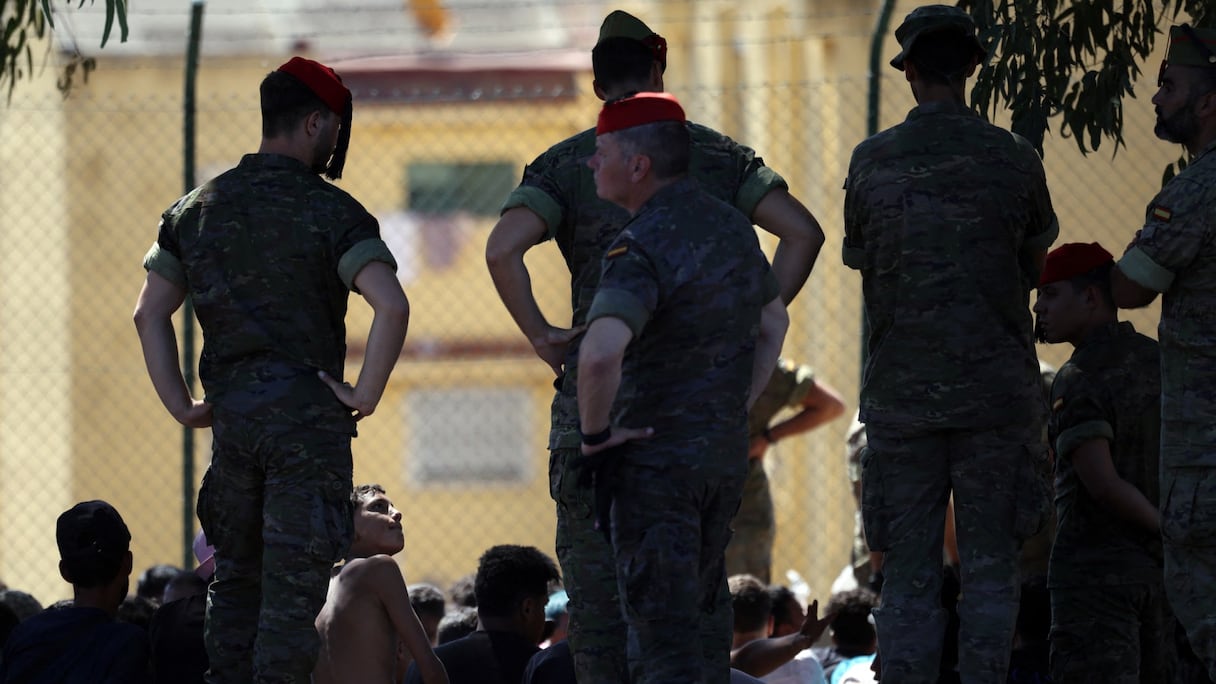
The National Human Rights Council (CNDH) has reported a heavy toll from the mass attempts to cross into Ceuta and Melilla in late July. In preliminary findings released on Thursday, the institution recorded 14 deaths on the Moroccan side of the border and called on Rabat and Madrid to establish a joint mechanism to determine the exact number of victims, identify the remains, and return them to their families with dignity.
Prepared by a monitoring committee established on July 29, the report is based on field investigations and digital monitoring conducted during the events at the Fnideq-Ceuta and Bni Ansar-Melilla border crossings. It also highlights a number of human rights violations and the significant role social media played in spreading disinformation.
A disputed human toll
According to the Council, the clashes and attempted crossings claimed 14 lives on the Moroccan side. The report also notes that Ceuta has cited a death toll of 80, illustrating what the CNDH says are major discrepancies between different sources. Estimates of the number of people attempting to cross also vary widely, ranging from around 40,000 according to Moroccan figures to between 50,000 and 72,000 according to Ceuta.
The report also recorded 136 injured civilians, 13 of whom required hospitalization for fractures or further medical examinations. On the Moroccan side, 87 law enforcement officers received medical treatment.
Judicially, around 100 people were arrested in Fnideq, including 11 minors. Of those, 69 were placed in pretrial detention, while 14 are being prosecuted while remaining at liberty. In Bni Ansar-Nador, 23 people—including two foreign nationals—as well as 11 minors, were referred to the courts.
The incidents also caused extensive property damage. In Fnideq, 61 private vehicles, 18 public security vehicles, and 15 motorcycles were damaged or set on fire.
A Spanish court ruling behind the surge
The CNDH says the increase in attempted crossings, which began on July 14 before peaking on July 30 and 31, stemmed from a misinterpretation of a ruling issued by Spain’s Supreme Court (No. 814/2026 of July 8).
According to the Council, that misinterpretation was amplified through social media. More than 23 Facebook groups, bringing together over 1.08 million members and publishing more than 1,400 posts a day, are said to have played a major role in spreading false information. The phenomenon also spread through WhatsApp, Telegram, TikTok, and X.
Read also : Ceuta migration crisis: one week on, Madrid and Ceuta still can’t agree on the numbers
The report also points to the activities of human trafficking networks offering illegal services, including the sale of diving equipment and logistical assistance. The Council further says it identified foreign accounts and phone numbers operating within Moroccan online groups that were calling for mass departures.
Serious human rights violations
The CNDH reports a number of violations of fundamental rights during the events. In Ceuta, the closure of shops, cafés, and restaurants on July 31 and Aug. 1 reportedly left thousands of people—including women and children—without access to food or water for two days.
The report also examines violence carried out on Aug. 1 by members of the far-right movement Núcleo Nacional, who are accused of physically assaulting migrants and Muslim residents of the city while shouting Islamophobic insults.
Read also : Brussels rejects the Ceuta narrative, doubles down on Morocco partnership
In Morocco, the Council also questions whether restrictions on movement imposed at several bus and railway stations—including in Casablanca, Marrakech, Fez, and Oujda—were proportionate, as well as the methods used by law enforcement during their operations.
The CNDH also identified several cases of disinformation, including the circulation of AI-generated manipulated images used to spread false narratives about the violence.
A new reading of migration dynamics
Beyond the security dimension, the Council believes the events reflect a profound shift in the drivers of migration. Interviews conducted with young people and minors indicate that attempts to migrate can no longer be explained solely by poverty or economic hardship. Instead, they point to the emergence of a hyperconnected generation shaped by social media and a worldview in which physical borders are gradually losing their meaning.
The CNDH concludes by calling for a renewed approach to migration policy, one based on protecting human rights, combating disinformation, and strengthening cooperation between Morocco and Spain.
