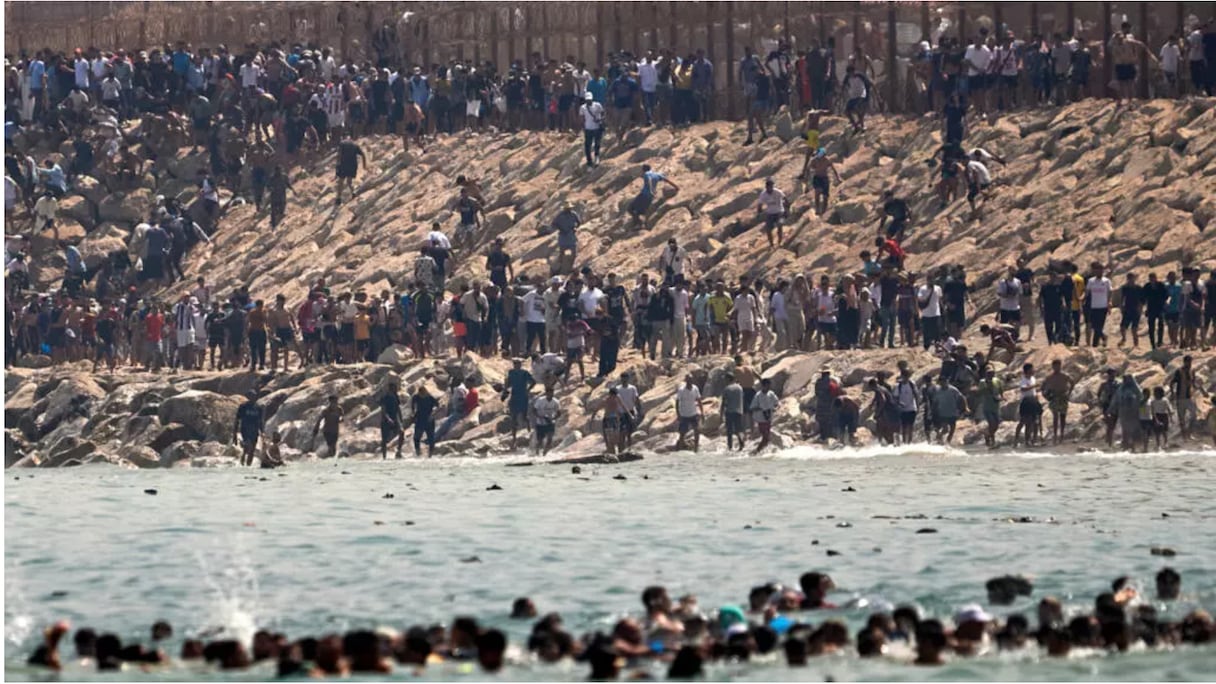
The wave of crossings at the end of July may not have marked the culmination of the operation but merely its opening offensive. After exploiting thousands of young Moroccans and plunging the border into chaos, the digital network linked to Algerian phone numbers may now be preparing to replicate the operation between August 13 and 15.
The warning comes from Italian-Swiss journalist and analyst Stefano Piazza. In a video published on Thursday, he said several indicators point to a fresh mobilization and urged close scrutiny of Algeria’s role.
“What we witnessed in Ceuta over the past few weeks is extremely serious, but it could happen again. Several indicators suggest that a new attempt could take place between August 13 and 15,” he warned.
The threat once again places Morocco on the front line. While the operation is officially directed at Ceuta and Melilla, it is Morocco that must contain the crowds, protect young people from deceptive propaganda, strengthen surveillance of roads and railway stations, and bear the human and security costs of the mobilization. Those directing the operation from abroad, meanwhile, remain safely behind social media accounts and telephone lines.
From a One-Off Wave to a Recurring Threat
Piazza bases his assessment on the report produced by Spanish intelligence and terrorism expert José María Gil Garre, whose findings were previously revealed by Le360. The investigation concluded that the wave of crossings was anything but spontaneous. Instead, it resulted from a coordinated campaign conducted across WhatsApp, TikTok, Facebook, and Instagram.
The journalist highlights the report’s principal finding: operational coordination carried out through telephone numbers bearing Algeria’s +213 country code.
“The report identifies WhatsApp groups, TikTok activity, and coordination leading back—guess where—to telephone numbers with the Algerian country code,” he noted.
Read also : Report: Evidence shows the Ceuta and Melilla assault was directed from Algeria
The existence of channels administered through Algerian phone lines, capable of issuing tactical instructions and redirecting pressure from Ceuta toward Melilla, confirms the scale of the operation already documented in José María Gil Garre’s report. It points to a hybrid destabilization campaign directed from abroad and carried out through the instrumentalization of social media and thousands of young people.
The mechanism can be reactivated without reproducing the previous wave in identical fashion. A simple call to mobilize is enough to compel Morocco to reinforce surveillance of roads, railway stations, access routes to Fnideq, and coastal areas, while Spain deploys additional personnel to Ceuta and Melilla.
Even if unsuccessful, such an attempt would achieve one of its objectives: keeping both countries under constant pressure and turning every date circulated on social media into a stress test for their security apparatus.
The timing of the proposed mobilization, between August 13 and 15, makes the warning all the more sensitive. At the height of the summer season and during Operation Marhaba, roads and railway stations across northern Morocco experience exceptionally heavy traffic. A disinformation campaign encouraging thousands of people to travel to Fnideq could cause major disruption without a single participant reaching the border.
Spain’s Civil Guard has confirmed that a fresh call for mobilization on August 15 is circulating on Facebook, WhatsApp, and Instagram. Security forces believe that “the risk of an attempt is real,” although they are not yet in a position to assess its likely scale. More than a dozen groups, bringing together some 400,000 users, are involved in disseminating these messages.
The organizers behind the new call have not been officially identified. Nevertheless, the similarity of the methods employed, the proximity of the dates, and the continued activity of the channels already identified make it necessary to consider the possibility that this is a continuation of the previous campaign.
Algeria at the Center of the Analysis
For Piazza, the Algerian dimension cannot be treated as a secondary issue.
“It is equally important to examine, with the greatest attention, the role of Algeria, which has long sought to destabilize Morocco,” he said.
The journalist points to Algeria’s political, financial, and military backing of the Polisario Front. In that context, the digital coordination conducted through Algerian phone lines would form part of a broader strategy of hostility toward the Kingdom, this time relying on the instrumentalization of migration and thousands of young Moroccans.
Read also : How the rush to Ceuta shattered the illusion of a European Eldorado
The findings of the report also call into question the accusations leveled against Morocco in the immediate aftermath of the crisis. While Rabat was accused of failing to prevent the departures, Moroccan security forces were containing the pressure on the ground, even as the trail of coordination led back to telephone numbers registered in Algeria. Morocco therefore found itself not only confronting the consequences of the operation but also shouldering responsibility that its alleged instigators were seeking to place upon it.
“We have seen this happen on many occasions, and this may simply be another attempt at destabilization,” Piazza insisted.
A second wave would demonstrate that the events at the end of July were not an exceptional migration surge but part of a mechanism capable of launching successive mobilization campaigns and keeping Morocco’s borders under sustained pressure.
The warning issued for mid-August therefore requires looking beyond Ceuta itself. The real target of the operation, Piazza argues, would be Morocco—forced to mobilize its security forces, protect young people misled by social media, and contain a crisis orchestrated from abroad. Should the call materialize, no one would any longer be able to plead surprise or continue to ignore the origin of the network driving it.
