Here we go again. Get the popcorn ready—but leave your illusions at the door.
Months in the making, the campaign has been meticulously choreographed. It was meant to explode back onto the international stage. Instead, it lands with all the force of a damp firecracker echoing down an empty hallway.
The cast, meanwhile, is exactly the same. No fresh faces, no new ideas. On the production side stands Forbidden Stories, the Paris-based collective coordinating a consortium of 16 international newsrooms. On the French distribution side are the familiar public broadcasters led by France Info and, inevitably, Le Monde, ever eager to occupy its self-appointed role as the moral conscience of establishment journalism.
The subject is tailor-made for headlines. Pegasus remains, after all, the only genuine journalistic blockbuster Forbidden Stories has produced since its creation in 2017. And when there is nothing new to report, why not resurrect an old success?
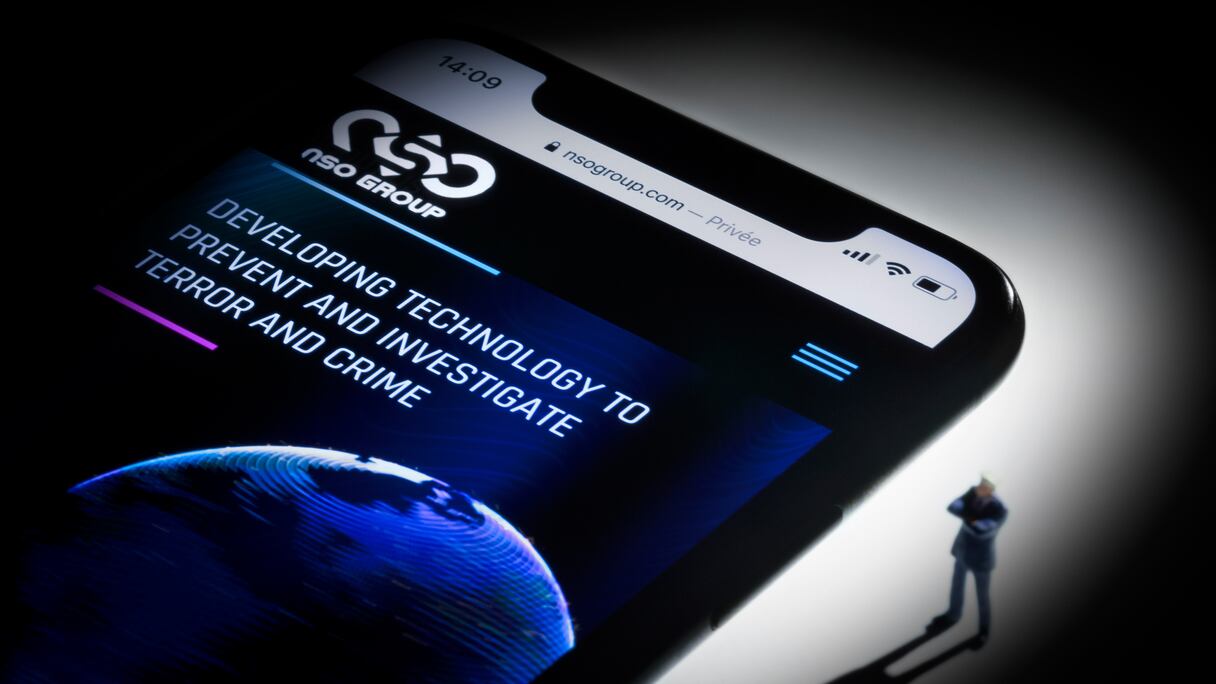
The formula is familiar. Reopen the file that dominated the summer of 2021: the allegation that Morocco’s intelligence services deployed the Israeli-made Pegasus spyware to spy on virtually everyone—from domestic critics to telephones inside the Élysée Palace.
Under the banner of supposed “new revelations,” the same five-year-old story has been hastily reheated, seasoned with phrases such as “irrefutable evidence” and “beyond any possible doubt,” then served once again across news websites and social media.
By now, the choreography has become almost comforting in its predictability. As Morocco approaches Throne Day, another media storm conveniently materializes to cloud the celebrations.
The difference this time is that the crutch supporting the entire “investigation” proves so fragile that it collapses the moment any real weight is placed upon it.
When investigative journalism starts resembling a B-movie
The fundamental problem remains exactly what it was five years ago.
The original media offensive against Rabat eventually ran into a wall: the absence of direct, incontrovertible evidence. That void was filled instead with layers of technical speculation and NGO reports whose conclusions were anything but impartial.
For this sequel, Forbidden Stories and its partners believed they had finally found the missing piece—their own Deep Throat.
Enter “Safir,” presented as a former officer of Morocco’s General Directorate for Territorial Surveillance (DGST).
Wrapped in impenetrable anonymity and staged with all the theatrical flair of a spy thriller, this mysterious figure solemnly assures readers that Morocco is, indeed, the villain of the story.
Signed documents? None.
Material evidence? None.
Previously unknown operational details? Nothing that could not have been imagined after binge-watching a mediocre espionage series on Netflix.
The reader is therefore expected to accept two propositions on faith alone: that this source exists, and that everything he says is true.
Such is the new high-wire act of modern investigative journalism, where belief increasingly substitutes for proof.
But the most revealing part of the story comes next.
This providential source, “Safir,” was interviewed neither by the consortium assembled around Forbidden Stories nor, in this instance, by Le Monde itself.
Instead, the entire edifice of what is presented as a global investigative scoop rests on the credibility of a single intermediary grandly introduced as a “journalist”: Hicham Mansouri.
To present Hicham Mansouri as the keystone of an international investigation into state cyberespionage requires either extraordinary naïveté or extraordinary cynicism.
Outside the carefully curated narrative, Mansouri is neither an investigative journalist nor an intelligence specialist. His brief exposure to journalism came through a privately run training program overseen by Maâti Monjib, a figure whose activities have long relied heavily on European funding.
His professional record in Morocco is striking less for what it contains than for what it does not. His published work amounts to little more than a handful of freelance pieces in publications with negligible readership. More telling still, he has never held a professional press card.
The defining moment of Mansouri’s “career” was not political. It came in 2015, when he was convicted under ordinary criminal law for complicity in adultery after being caught in flagrante delicto, receiving a 10-month prison sentence.
After leaving Morocco for France following his detention, he quickly adopted the far more useful identity of the “persecuted journalist.”
A rhetorical house of cards
To preserve his status in France and justify the narrative on which it depends, Mansouri has learned to deliver exactly what certain Parisian newsrooms are eager to hear: a touch of “dictatorship,” a hint of “state mafia” and a generous helping of “systematic repression.”
It is, in effect, his survival strategy.
His editorial output over a decade in exile amounts to little more than a dozen opinion pieces and polemical essays published on his Mediapart-hosted blog or on the Orient XXI platform.
Yet it is on the shoulders of this supposedly authoritative and impartial figure that Le Monde chooses to rest what it describes as its “absolute proof.” Journalism has been built on sturdier foundations.
Read Le Monde‘s reporting closely and the mechanics of the exercise quickly become apparent. Less investigative reporting than linguistic sleight of hand, it relies on dressing speculation in the language of certainty.
Take one of its central arguments.
The newspaper places considerable emphasis on a document filed in legal proceedings in the United States referring to an NSO Group client codenamed “Morgan.” The explanation offered is that NSO allegedly assigned each customer the name of a car manufacturer beginning with the same letter as the customer’s country. Morocco begins with M. So does Morgan.
An ingenious theory—until one remembers that M is also the first letter of Monaco, Mexico, Malaysia, Mauritania and Madagascar.
Apparently, for the consortium behind the investigation, the alphabet ends at Morocco’s borders.
The article also points to findings by France’s National Cybersecurity Agency (ANSSI), which identified identical email addresses allegedly used as command-and-control servers on the phones of French ministers and Moroccan opponents.
Readers are then assured, in suitably authoritative language, that this technical infrastructure was “unique to each client.”
But that conclusion rests on a premise established not by independent evidence, but by the consortium’s own 2021 investigation.
In other words, the argument proceeds in a perfect circle: Morocco is guilty because the technical framework we developed in 2021 says so, and that framework is valid because it points back to Morocco.
It is an elegant exercise in self-validation masquerading as proof.
Obsession, losing perspective and an algorithmic flop
The centerpiece of the entire case—the justification for reviving a five-year-old story—remains the so-called revelations obtained by a man who has never held a professional press card from a shadowy former officer of Morocco’s General Directorate for Territorial Surveillance.
Le Monde itself acknowledges that this is the linchpin of its case against Morocco, writing, “Above all, it is the testimony of Safir—the pseudonym of a whistleblower from Morocco’s domestic intelligence service—collected by journalist Hicham Mansouri that proves beyond any possible doubt Morocco’s use of Pegasus.”
“Beyond any possible doubt”? Really?
Le Monde asks its readers to place unwavering trust in the account of an obscure “journalist” whose published work is vanishingly thin and whose enduring hostility toward Morocco has, arguably, become his only professional currency. The investigation’s purported smoking gun rests on nothing more than Mansouri’s word.
At that point, skepticism is not merely justified—it becomes essential. So too do questions about the willingness of those who chose to amplify his claims. One can easily imagine Laurent Richard, the founder of Forbidden Stories, providing every reassurance needed about Mansouri’s credibility in order to persuade international newsrooms to buy into what is, in the end, a rather underwhelming sequel.
That Richard should go to such lengths is, in many ways, understandable. Pegasus remains the defining success of Forbidden Stories. Since 2021, the organization has struggled to reproduce the same global impact.
The desire for a sequel has become so pronounced that it seems willing not merely to cling to the thinnest branch but to fashion one if necessary.
And yet the mysterious “Safir” remains little more than an outline.
Leave aside the pseudonym. How old is he? What rank did he hold? Which branches of Morocco’s intelligence services did he serve? How did he supposedly end up in exile in France? And if he truly lives in exile, why must his identity remain so completely hidden?
None of these questions receives an answer.
The whistleblower never takes shape as a real person. He exists only through Hicham Mansouri’s telling of the story.
In the end, this remake proves technically far weaker than the original production released in 2021. The supposedly explosive narrative rests on little more than a house of cards: an unverifiable whistleblower with no face, no independently established existence and no supporting evidence, whose story reaches the public solely through an agitator lacking professional credibility—providing convenient summer copy for newsrooms hungry for attention.
What ultimately stands out is not the investigation itself but the intensity of the obsession driving it. The determination to pursue Morocco appears, at times, to have eclipsed editorial judgment.
For Le Monde, the ritual has become almost predictable. Each time Morocco approaches a major national occasion—in this instance, Throne Day—the Kingdom once again finds itself cast as the story’s principal antagonist. What once claimed to be investigative reporting now increasingly resembles an annual editorial ritual.
The public, however, appears to have grown weary of reheated narratives.
The clearest verdict has been delivered in the one arena where editorial enthusiasm cannot manufacture success: social media. Shares have been scarce, engagement negligible and public indifference unmistakable.
Attention-grabbing headlines may still spark fleeting curiosity, but neither algorithms nor readers can be fooled indefinitely.
For Le Monde and Forbidden Stories, this second season of the Pegasus affair amounts to more than a disappointing sequel. From a journalistic standpoint, it stands as one of the year’s most conspicuous editorial failures.
