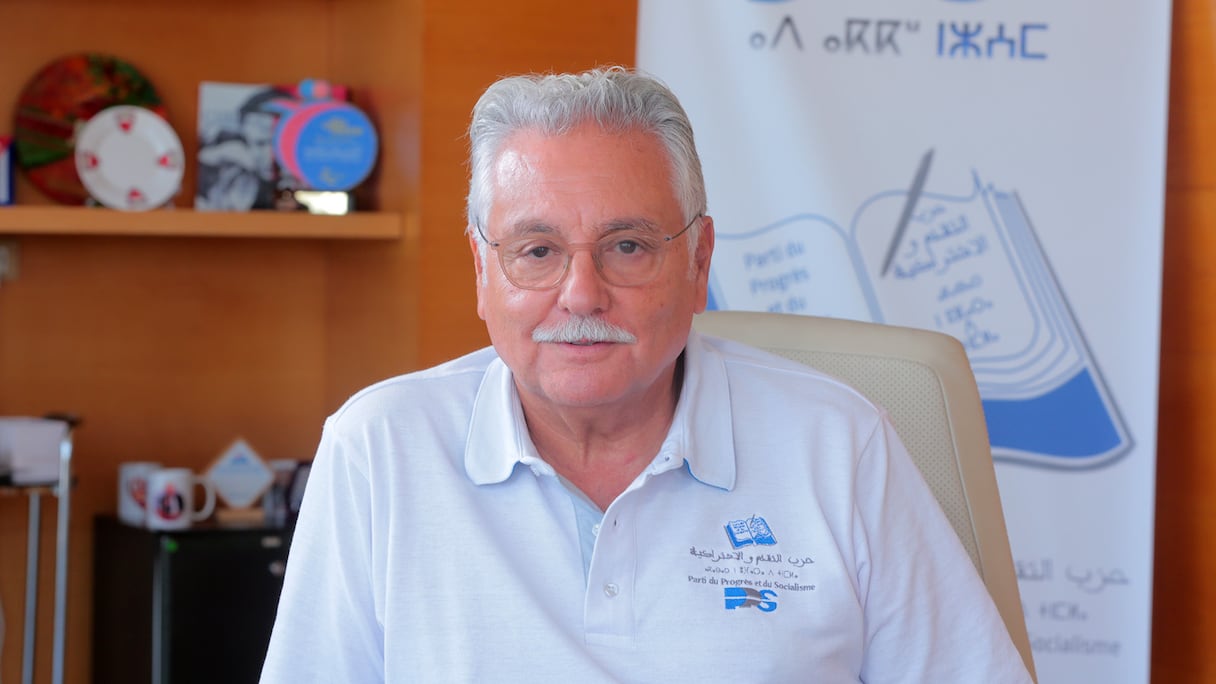
Guest on Le360’s Grand Format, PPS Secretary General Nabil Benabdallah addressed several of the main political and economic issues facing Morocco ahead of the 2026 legislative elections, including his party’s electoral program, the government’s record and tensions surrounding Sebta. He was particularly critical of the government’s policies and its handling of several key issues.
Nabil Benabdallah said his party is targeting around 50 seats in the House of Representatives, a result that could put it in a position to participate in a future government coalition.
He nevertheless ruled out any coalition with Aziz Akhannouch’s National Rally of Independents (RNI) if the party wins the elections. The PPS leader also strongly criticized the Head of Government’s record, arguing that his policies had contributed to greater impoverishment through conflicts of interest and Frakchiyas, which he said had “enriched themselves at the expense of working-class and disadvantaged people.”
Benabdallah also addressed the 280 billion dirhams allocated by the state to support prices of widely consumed goods and curb the influence of Frakchiyas. The amount was described as money “spent for nothing” by Fouzi Lekjaa, Minister Delegate for the Budget.
In response to what he described as a failure, Benabdallah renewed his party’s call for a parliamentary commission of inquiry, saying that “the government majority blocked it and avoided any accountability.” He added that “the categorical refusal by the majority proves that it has things to hide.”
PISA 2025 and the state of Morocco’s public education system
The PPS secretary general strongly criticized the government’s record in education, pointing to what he described as poor results in the sector. The 2025 PISA report, he argued, provides further evidence of the shortcomings of Morocco’s public education system.
Conducted every three years by the OECD, the Program for International Student Assessment measures the academic performance of 15-year-olds around the world. According to Benabdallah, Morocco’s results in the assessment reflect the serious difficulties facing the country’s public education system.
In its third participation in the assessment, Morocco recorded some of the lowest results in the world in science, mathematics and reading in 2025.
The PPS secretary general used the results to stress the need for a genuine education reform based on effective educational programs and properly trained human resources.
A 570-billion-dirham electoral program
On the party’s electoral program, Benabdallah reiterated that it would be based on an overall budget of 570 billion dirhams and 600 billion dirhams in tax revenues. The program includes the creation of one million jobs across various areas of the economy.
He also called for greater democratic development and stronger rights for women and young people in general.
Benabdallah then addressed tensions between Morocco and Spain, which he said had been aggravated by the burning of the Moroccan flag in Madrid during extremist demonstrations that he described as “totally unacceptable.”
He stressed that Morocco is “a sovereign nation and a strategic partner, not Spain’s ‘policeman’.”
Regarding the presidios of Sebta and Melilla, Benabdallah said they are “historically Moroccan territories whose status will inevitably have to be resolved, as colonization cannot continue.”
