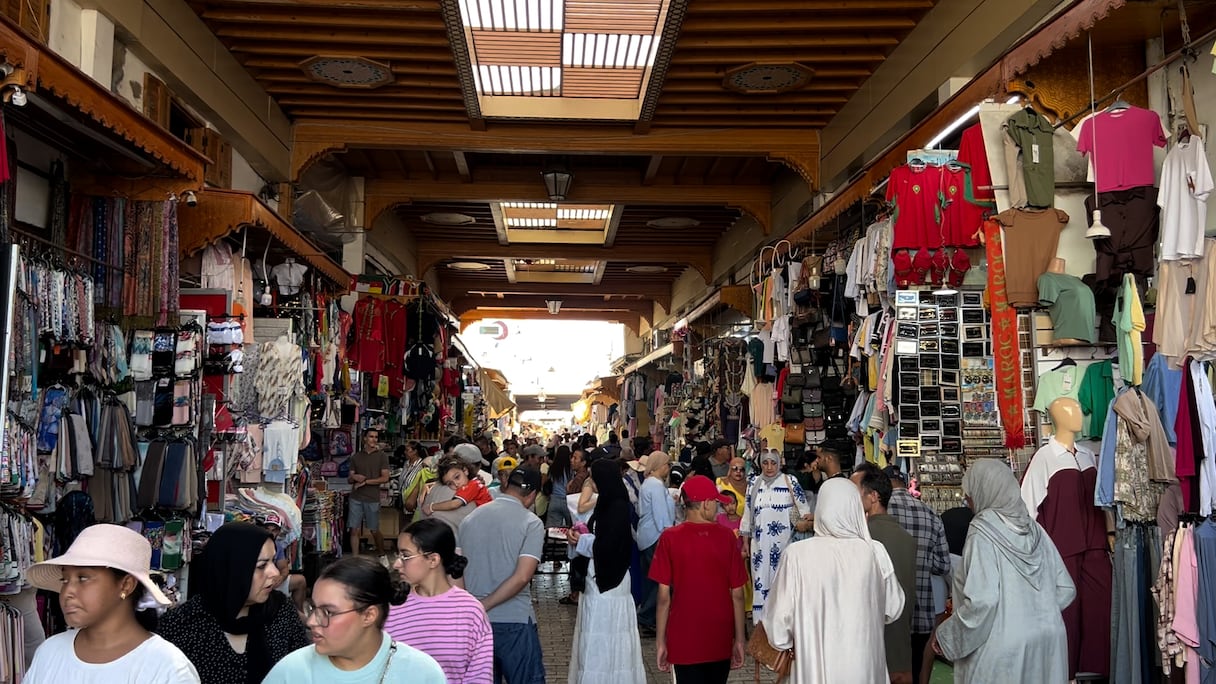
As the new school year approaches, Rabat’s medina is buzzing with activity once again. Residents are flocking to its main shopping streets to buy clothes and school supplies, much to the delight of local shopkeepers.
With the new school year approaching, commercial activity is picking up in Rabat’s medina, driven in particular by purchases of clothing and school supplies. As the summer holidays draw to a close, many Rabat residents are heading to the old city’s main shopping streets to prepare for the new school year. Bookshops, stationery stores, clothing shops and other retailers are benefiting from the increased footfall.
The bustling atmosphere is particularly noticeable along the medina’s main commercial thoroughfares, including El Gza, Souïqa, Souk Sebbate and Rue des Consuls, where much of the area’s commercial activity is concentrated.
Several shopkeepers told Le360 they welcomed the revival in business activity ahead of the new school year. This period is traditionally a busy time for local businesses, with strong demand for school supplies, clothing and other back-to-school items.
One shopkeeper in the medina, however, complained about the noise caused, according to him, by concerts held in August as part of the Rab’Africa Festival, whose Oudayas stage is located near the old city.
A major commercial and heritage hub in the capital, Rabat’s medina developed over several historical periods. While some parts of it date back to the Almohad era, its urban fabric was profoundly shaped from the 17th century onwards by the settlement of the Hornacheros and Andalusian populations.
Read also : MAD 700 in public schools, up to MAD 4,000 in private: The back-to-school Bill
Protected in particular by the Andalusian Wall and connected to the Kasbah of the Oudayas, the medina retains a dense network of commercial streets, narrow lanes and cul-de-sacs. Souïqa and Rue des Consuls have historically been among its main commercial thoroughfares.
The medina is an integral part of the site “Rabat, Modern Capital and Historic City: A Shared Heritage,” which has been inscribed on UNESCO’s World Heritage List since 2012.
