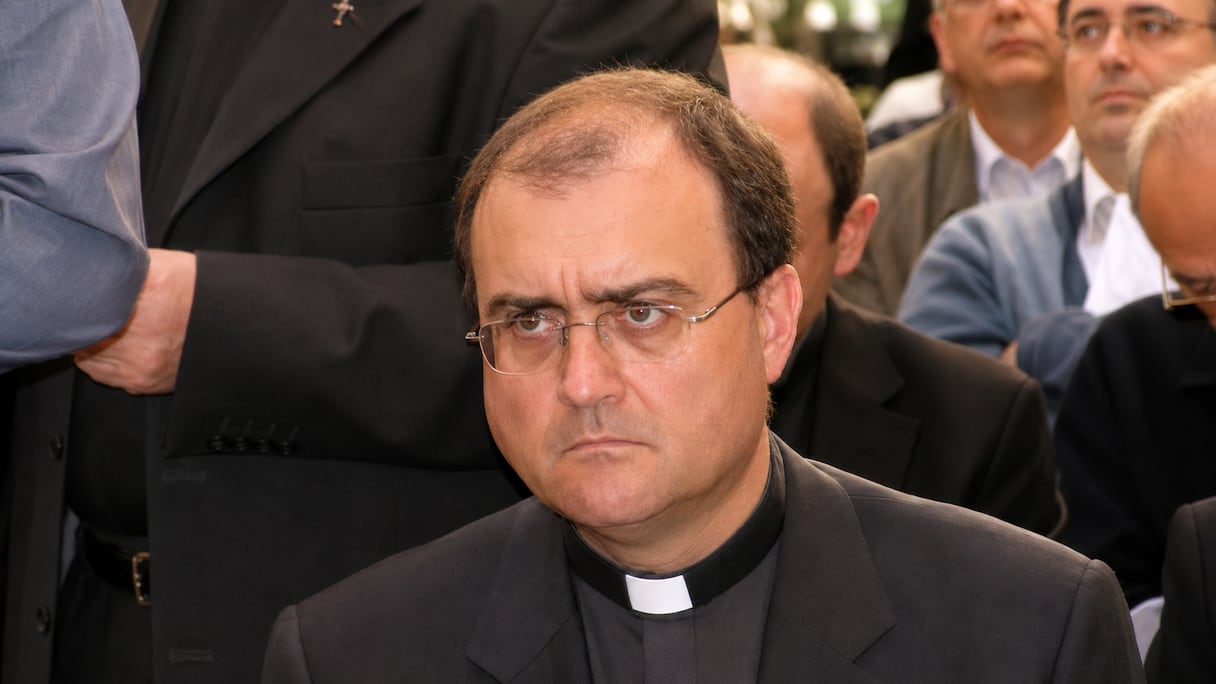
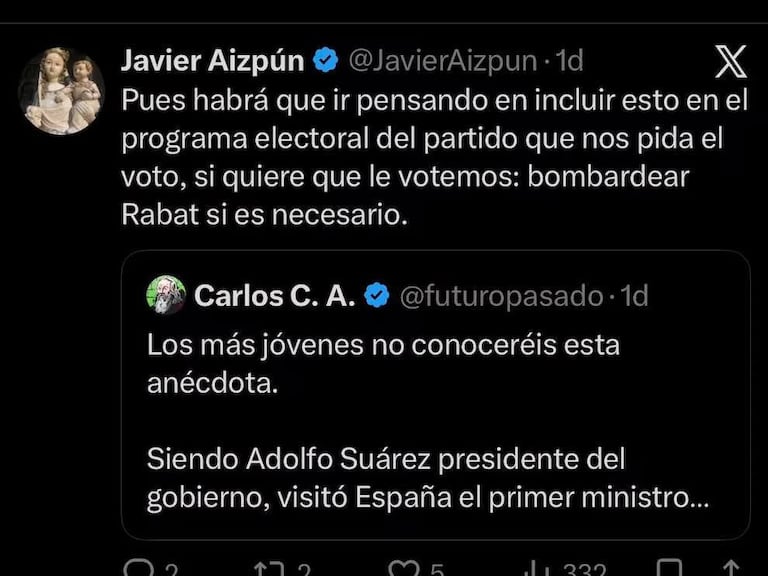
Published amid heightened migration tensions in Ceuta, the posts amount to hate speech and incitement to violence against Morocco. They carry an unmistakably warlike—and terrorist—dimension by calling for the bombing of the Moroccan capital and the use of lethal force against migrants, employing rhetoric that openly incites violence against both a sovereign state and civilians.
Among his most controversial posts, Aizpún wrote that Rabat should be “bombed if necessary.” Far from constituting mere political criticism, such statements advocate violence as a response to a migration crisis while placing an entire population in the crosshairs.
In a statement published on its official website, the Archdiocese of Pamplona and Tudela publicly distanced itself from the priest’s remarks, stressing that they reflected his personal opinions alone and in no way represented the position of the Church.
Meanwhile, the Huarte Town Council has called for Javier Aizpún’s immediate dismissal in light of the gravity of his statements, but the Archdiocese of Pamplona and Tudela has taken no disciplinary action against him. The Church has limited itself to disassociating itself from his remarks, describing them as personal opinions. Spanish television channel La Sexta reported the development.
Read also : Ceuta: Algerian network preparing fresh mid-August mobilization, warns Stefano Piazza
Following the controversy, Aizpún deleted his X account and apologized to the Archbishop. The apology, however, has failed to stem a wave of condemnation. Political figures and civil society alike have denounced the priest’s remarks as far exceeding the bounds of legitimate public debate by normalizing violence against civilians and fueling hostility toward Morocco and Moroccans.
Javier Remírez, Vice President and government spokesperson for the Government of Navarre, described Aizpún’s comments as “unacceptable,” saying they were “completely at odds not only with the law and human rights, but also with the Gospel itself.” The socialist official added that Aizpún appeared to ignore Pope Leo XIV’s stance against war and in defense of human rights.
As if calling to “bomb Rabat” were not enough, Javier Aizpún went a step further by praying on X for what he called the “reconquest of Morocco.” The use of the term is far from innocuous. It revives an imagery of confrontation and domination over the Kingdom, turning social media into a platform for hate speech that extends well beyond political criticism.
In one of his most controversial posts, published in the wake of the events in Ceuta, Javier Aizpún wrote:
“May Our Lady of Africa, patron saint of Ceuta, inspire the reconquest of Morocco and its conversion to Christianity. May we complete what Queen Isabella the Catholic left unfinished.”
Far from being an isolated outburst, the message reveals the priest’s recurring fixation with resurrecting a narrative of conquest and colonization of Morocco. His references to a supposed “reconquest” and to converting the Kingdom to Christianity revive a colonial imaginary that challenges Moroccan sovereignty and turns religious discourse into a vehicle for legitimizing hostility toward an entire nation.
Nor did Javier Aizpún’s remarks remain isolated. They found public support from another member of the Spanish clergy. Juan Manuel Góngora, a priest from the Diocese of Almería, defended the Navarre priest on X, declaring that “Father Javier Aizpún is right” and asserting that his messages merely reflected “the reality of states and governments.”
The statements are all the more serious because they come from a religious figure whose mission should be guided by the values of peace, respect, and coexistence.
From a legal standpoint, it should be recalled that Spain’s Criminal Code punishes incitement to hatred and violence (Article 510), as well as incitement to commit criminal offenses (Articles 17 and 18). It also provides for the aggravating circumstance of discrimination under Article 22.4 when offenses target a group on the basis of its origin or nationality.
Read also : How the rush to Ceuta shattered the illusion of a European Eldorado
The priest’s apology and the deletion of his X account do nothing to erase the gravity of messages calling to “bomb Rabat” and “reconquer Morocco.”
If Spain seeks to maintain a credible stance against racism, hate speech, and incitement to violence, this case represents an important test for its institutions. Freedom of expression protects opinions, but it cannot become a shield for legitimizing threats against a sovereign state or for dehumanizing an entire people.
It will now fall to the Spanish courts to determine whether these acts constitute criminal offenses and to respond with the same firmness that would be expected had the threats been directed at any other capital or any other country. Only then can the perception of double standards—when Morocco is the target of hatred—be dispelled.