Morocco has another poor PISA report card. The Education Ministry’s answer is that it belongs largely to the school system it is trying to replace.
Fifteen-year-olds scored 358 points in science, 321 in reading and 355 in mathematics in the OECD’s 2025 Programme for International Student Assessment.
All three scores were down from 2022.
Read also : Morocco ranks among the world’s lowest-performing education systems in PISA 2025
Science fell seven points, mathematics 10 and reading 18. More troubling is what sits behind the averages.
Some 73.2% of Moroccan pupils were below Level 2 across science, reading and mathematics, against an OECD average of 19.7%. At the other end, just 0.1% reached Levels 5 or 6. The OECD average was 11.9%.
The Education Ministry does not contest the numbers. It contests what they should be taken to say about the reforms now under way.
The pupils who sat PISA 2025 acquired most of their education under the previous model, the ministry said in its response to the results. Their scores therefore “cannot be considered an evaluation” of the system being rolled out under the 2022-2026 education roadmap.
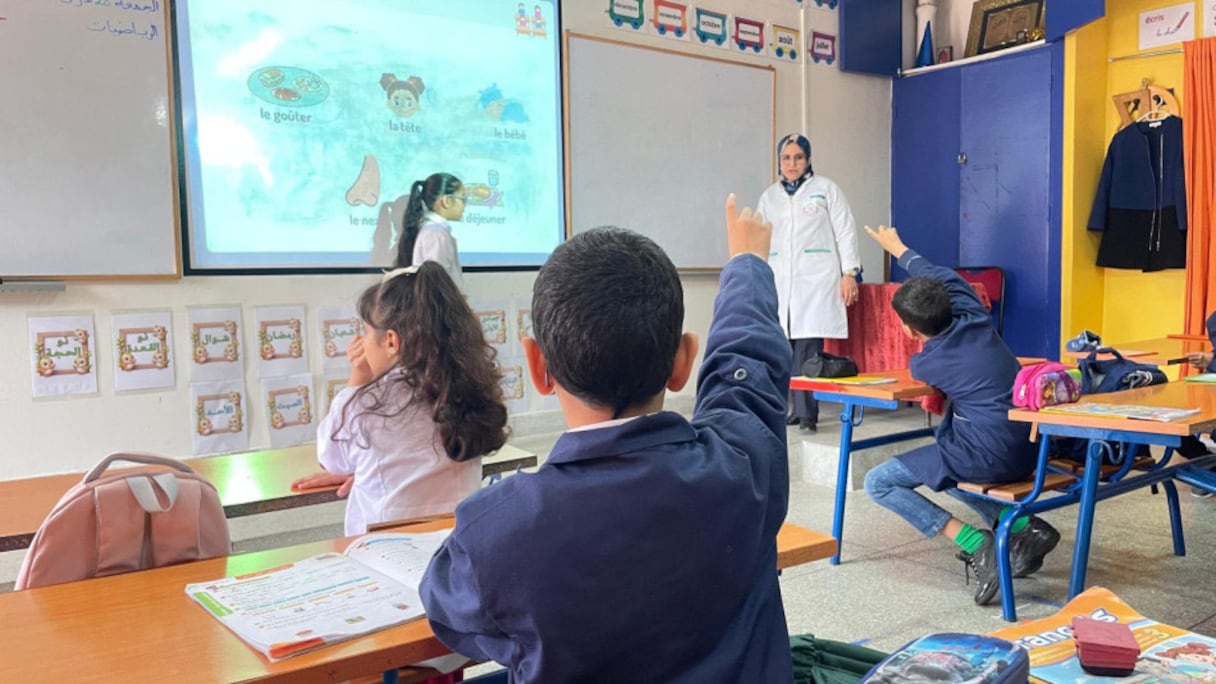
In particular, these pupils did not pass through the Pioneer Schools model now at the center of the government’s attempt to improve basic learning.
The old system’s pupils
PISA tests 15-year-olds. The ministry’s argument is that learning problems visible at that age did not suddenly appear in secondary school. They accumulated from the first years of primary education and followed pupils from one grade to another.
On this point, the ministry’s diagnosis of the PISA results is hardly flattering. It acknowledges that mastery of fundamental skills remains below the level expected and that a “significant gap” persists between Moroccan pupils and international averages.
In science, the main subject in PISA 2025, Morocco’s 358 points compared with an OECD average of 482. Only eight of the 91 participating education systems scored lower.
Reading produced an even wider gap: 321 against an OECD average of 461. In mathematics, it was 355 against 463.
The new computational thinking-based problem-solving assessment brought a score of 374, compared with an OECD average of 500.
The ministry points to some better results within the science assessment itself. Moroccan pupils scored 369 in evaluating scientific inquiry, while the components covering scientific information and environmental science produced scores of 357 each.
Modelling and programming produced 374 and 369 respectively. They do little, however, to alter the overall position.
Everyone fell—but not equally
The ministry also puts Morocco’s decline in an international context.
OECD averages fell between 2022 and 2025, it notes. Mathematics dropped from 472 to 463, reading from 476 to 461 and science from 485 to 482.
Morocco was therefore not alone in going backwards. But the arithmetic complicates that defense.
The OECD decline was nine points in mathematics. Morocco lost 10. The OECD lost 15 points in reading. Morocco lost 18. And while the OECD science average slipped three points, Morocco fell seven.
There is another complication closer to home. Several MENA systems moved in the opposite direction in science.
The UAE gained 26 points between 2022 and 2025 to reach 458. Saudi Arabia gained 23 to reach 413. Jordan gained 32 to reach 407.Qatar scored 434.
Mauritius, the strongest of the five participating African systems, scored 438 in science — 80 points above Morocco — as well as 405 in reading and 407 in mathematics.
Morocco did remain ahead of Kenya, Zambia and Rwanda in science.
Among the MENA systems cited in the results, only the Kurdistan Region of Iraq, at 352, scored below Morocco’s 358.
The 73% problem
Rankings tell only part of the story.
The 73.2% of Moroccan pupils below Level 2 across the three subjects is perhaps the harder number. The corresponding figure was 35.1% in Mauritius, 26.6% in the UAE, 35.8% in Qatar and 44% in Saudi Arabia.
Morocco also produced very few top performers.
Only 0.1pc reached Levels 5 or 6, compared with 3pc in Mauritius and 11.9pc across the OECD.
The problems are not confined to test scores. Only 12.4pc of Moroccan pupils attended schools reporting no material shortages, against 43.8pc across the OECD.
Morocco’s index for schools’ capacity to integrate digital tools stood at -0.65, against an OECD average of -0.03. Its disciplinary climate index was -0.20, compared with 0.14 across the OECD.
Only 31.9pc of pupils reported low absenteeism, against 66.1pc in OECD countries.
One statistic went strongly the other way: 81.8pc of Moroccan pupils attended schools where mobile phones were banned, compared with 49.5pc across the OECD.
Enter the Pioneer Schools
For the ministry, the results strengthen rather than weaken the case for its current reforms. Its argument is that the reform began where the problem begins: primary school.
Pioneer Schools are intended to identify learning gaps early, provide remedial teaching and prevent deficiencies from following children through the school system.
Read also : Casablanca: Over 80 percent of Hay Hassani primary schools now under Pioneer program
The ministry says their expansion should therefore be accelerated at both primary and middle school levels.
It also wants more remedial support, changes to teaching content, specialized practical training, newer teaching and digital resources and stronger pedagogical supervision.
But PISA 2025 cannot tell us whether that prescription is working.
The pupils tested did not experience the Pioneer model through their school careers. The ministry says the “effective and overall” impact of the program on Morocco’s PISA position can only be measured once pupils who have actually benefited from it reach the age of 15.
The old model has now delivered another set of poor numbers. The new one, the ministry says, has not been around long enough to own them.
Its report card will come later.