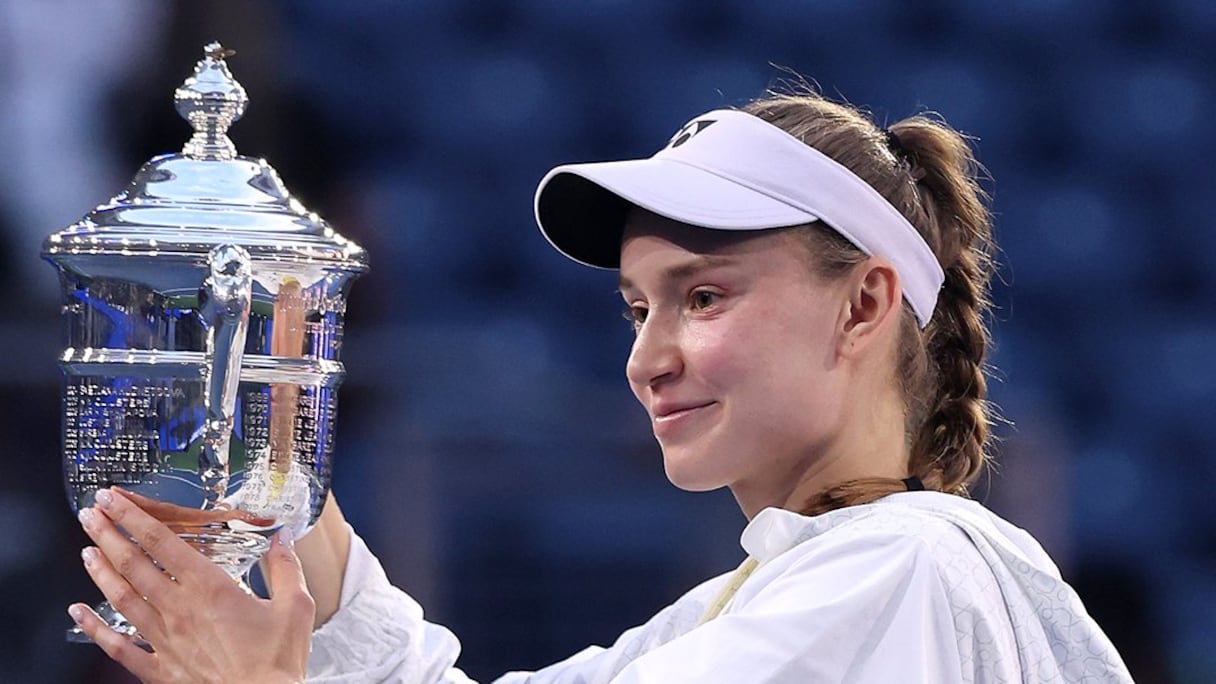
Elena Rybakina claimed her first US Open title on Saturday, September 12, defeating two-time champion Aryna Sabalenka 6-4, 5-7, 6-2 after already taking her place at No. 1 in the world rankings.
The 27-year-old Kazakh defeated the 28-year-old Belarusian for the second time in a Grand Slam final this season, following their meeting at the Australian Open in January.
The victory gives Rybakina her third Grand Slam title, following her 2022 Wimbledon triumph, and her eighth win in 18 meetings with Sabalenka, further establishing the Belarusian as her main rival on the tour.
“Matches against Aryna are always difficult. We push each other to be better after battles like these,” Rybakina said at her post-match press conference.
The rivalry between the world’s top two players is increasingly taking on the feel of a classic. Rybakina has played three of her four Grand Slam finals against Sabalenka, winning two and losing the 2023 Australian Open final.
“Congratulations on your incredible year. I wish I had played a little better, but I guess there’s always next year,” Sabalenka said through tears on the podium after the defeat.
The latest loss further exposed Sabalenka’s struggles in Grand Slam finals. She has won four major titles but has now lost five finals.
No better than a quarterfinal
A year before losing to Rybakina in Melbourne, Sabalenka was also beaten in the Australian Open final by American Madison Keys before suffering a heavy defeat four months later against Coco Gauff at Roland Garros, where she committed no fewer than 70 unforced errors. Gauff also defeated her in the 2023 US Open final.
Born in Moscow but representing Kazakhstan on the tour since 2018, Rybakina had never gone beyond the quarterfinals at the US Open, reaching that stage in 2025, across eight previous appearances. Her retirement from the Cincinnati tournament shortly before the US Open because of pain in her left foot had also raised fears of another early exit.
“I’ve been coming here for ten years and I had never managed to do it. I’m falling in love with New York,” Rybakina said before receiving the trophy and the $5.5 million winner’s check, a record prize.
On Arthur Ashe Stadium, everything seemed to go Rybakina’s way in the first set, in which she did not commit an unforced error until the seventh game.
Even with only 28% of her first serves landing in, Sabalenka never had a break point in the opening set. She eventually dropped her serve after a double fault and was unable to erase Rybakina’s lead.
Broken racket
The momentum shifted somewhat in the second set, as the Kazakh produced more unforced errors, 13 compared with eight for Sabalenka. The Belarusian responded with determination, saving two break points early on before her risk-taking paid off as she levelled the match at one set apiece.
But Rybakina had never lost a match in New York after winning the opening set, holding a 13-0 record before the final. That run continued as she quickly took control of the deciding set, capitalizing on 12 unforced errors from Sabalenka.
Sabalenka looked increasingly frustrated, as she has in previous Grand Slam final defeats. She repeatedly hid under her towel, complained to her box and shouted in frustration after missed shots.
Despite the crowd’s support for the two-time defending champion, Rybakina broke twice before sealing the title with her 12th ace of the match.
With tears in her eyes, Sabalenka congratulated her rival before smashing her racket while sitting on her bench.
“It’s really difficult to control your emotions when you lose a Grand Slam final after trying to win three in a row. I just wanted to let it all out,” Sabalenka said.
After more than two years at the top of the WTA rankings, Sabalenka has now been replaced by Rybakina, who also takes over her crown as New York’s champion.
Rybakina has also become the third woman in the 21st century to win both the Australian Open and US Open in the same year, after Angelique Kerber in 2016 and Aryna Sabalenka in 2024.