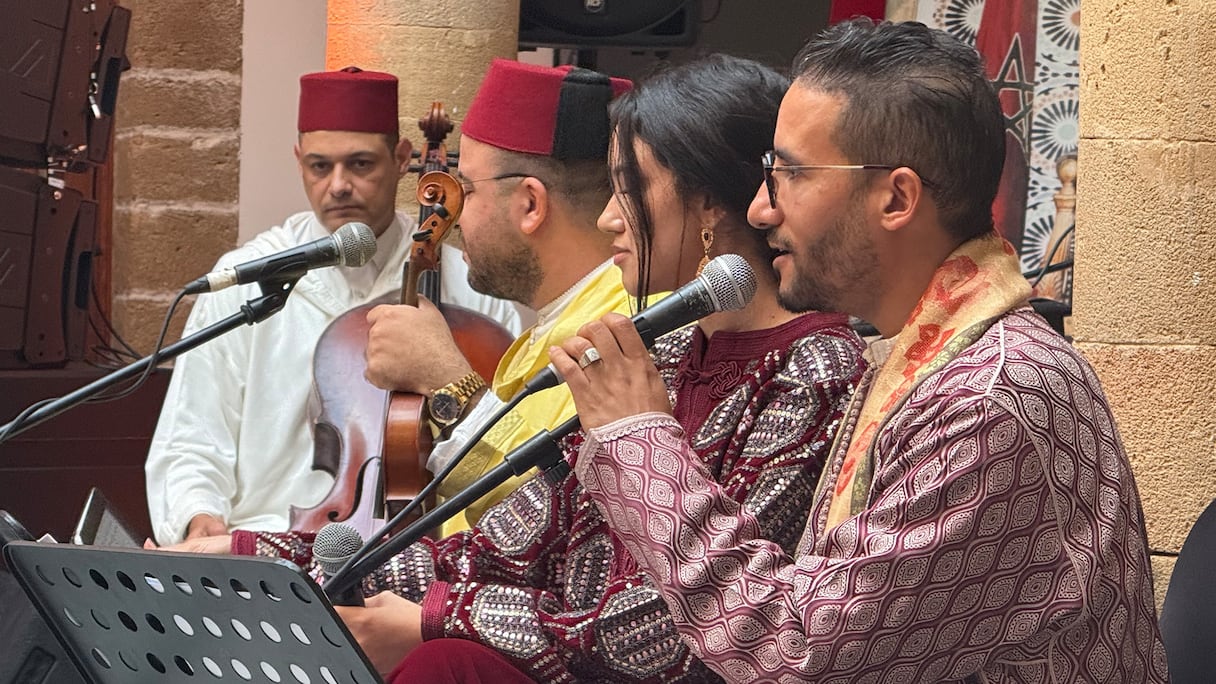
Dar Souiri, Saturday, October 31, near Bab El Sbaa in Essaouira. A celebration of unity is under way. It is 3:30 p.m., and music lovers and guests attending the 21st Atlantic Andalusias Festival are just half an hour away from the concert Marhba Billi Ja Andna (“Welcome to Those Who Have Come to Visit Us”), featuring Nouhaila El Kalai, Anas Belhachemi and Hicham Dinar.
These three outstanding voices of Morocco’s musical heritage had already caused a sensation at the opening concert two days earlier, on the main stage beneath the marquee erected in Bab El Menzeh Square, opposite the city’s port. That afternoon, crowds had gathered at Dar Souiri to hear the voices and experience the stage presence of performers whom some were discovering for the first time. Yet Anass Belhachemi, Nouhaila El Kalai and Hicham Dinar are familiar names to regulars at this festival dedicated to Andalusian music and Morocco’s Jewish heritage.
“I was 13 in 2013 when I first stepped onto the stage of this festival. Thirteen years have passed, and I am delighted to be taking part again. I thank the festival’s artistic director, my teacher Abdesslam Khaloufi, for placing his trust in me,” Nouhaila El Kalai said.
Still young, the singer already enjoys considerable popularity. Her talent is striking. At the end of the concert, several women surrounded her as she made her way backstage to change out of her beautiful burgundy-red medieval-style caftan. “Nouhaila, tbarkellah alik, you are magnificent! We first saw you here when you were still a little girl…” Moved and grateful, she nodded in acknowledgement and responded with a radiant smile.
Two other performers are equally familiar to Essaouira residents and festival regulars: Hicham Dinar and Anass Belhachemi.
Together, they perform several pieces from the Chgouri repertoire, a musical tradition shared and mastered by Moroccan Jews and Muslims alike. Indeed, many Moroccan musicians practice what is known as Matrouz: a single musical composition sung partly in Hebrew and partly in Moroccan Darija. The result is an overwhelming success.
“I grew up with this festival. I remember this outstanding musical event from the time I was young. I have taken part in almost every edition, without exception. I sing Chgouri. We perform side by side with Moroccan Jews: they sing in Hebrew and we sing in Darija. That is Matrouz. And now we are beginning to sing in Hebrew too, while they sing in Darija. It is a beautiful blend,” Hicham Dinar said.
“Celebrating and experiencing this bond”
It is precisely this palpable spirit of coexistence at Dar Souiri that several Israelis of Moroccan descent, whose parents or grandparents were born and raised in Morocco, have come to rediscover.
“My grandfather comes from Essaouira and my grandmother from Marrakech. I was born in Israel, but Moroccan culture and songs are an integral part of my identity. I came to celebrate this heritage of Andalusian music. There are very strong similarities with our own music. It is important for us to celebrate and experience this bond,” said El Adl Benkhalifa.
He learned Darija through workshops run by Yonai Fassi, who was himself born in Fez. “I teach the Moroccan dialect to people aged between 18 and 75. This is the first time I have brought an entire group here to Morocco to meet Moroccans and immerse themselves in the spirit of Tamaghribit, Moroccan identity. There is no better place than this festival to experience that atmosphere and reconnect with the identity of their parents and grandparents,” Fassi told Le360.
For the 35-year-old, one thing is beyond doubt: the Atlantic Andalusias Festival presents the world with a beautiful image of Morocco, one in which Jews and Muslims live and sing together.
