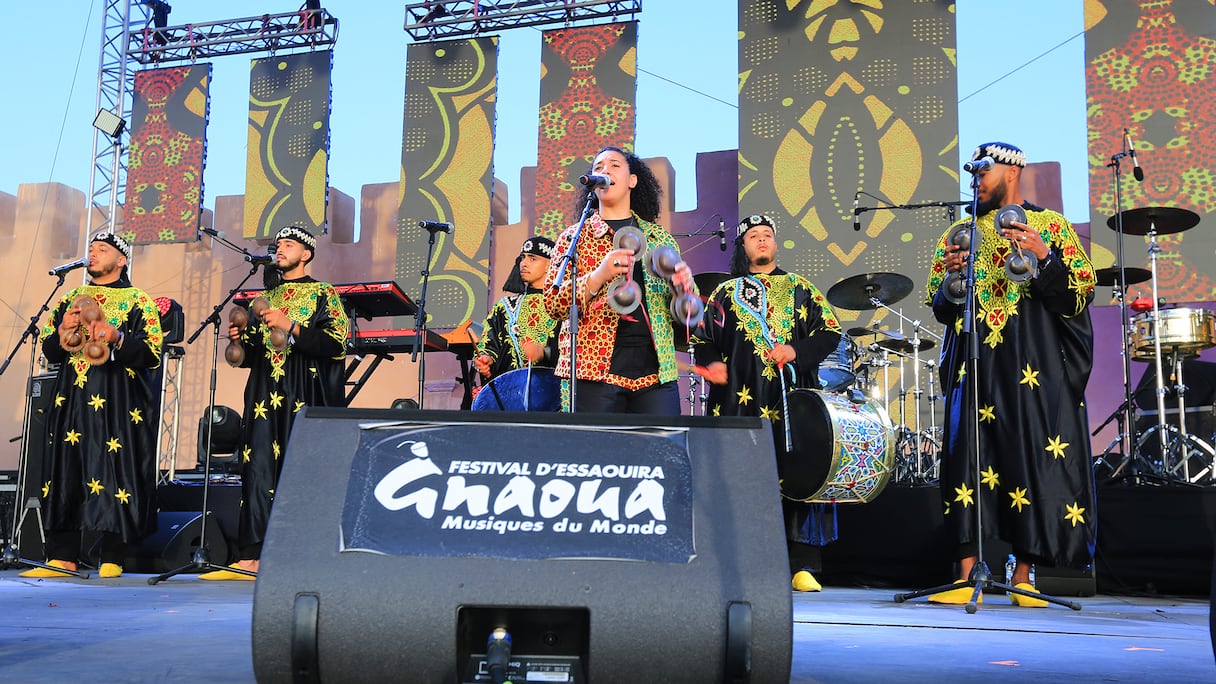
Organized by the Essaouira-Mogador Association, the festival will bring the two traditions together on the closing night, Saturday, October 31. The idea was first explored in 2022 at Dar Souiri with Yair Harel. This year, the HaPiyut Ensemble will join Maâlma Hind Ennaira, a leading figure in Essaouira’s Gnaoua scene, for a performance titled “Piyut & Gnaoua.” The Gnaoua musicians have contributed their melodies and rhythms, which will meet the voices of Piyut performers singing texts from Yaguel Yaakov, a collection of liturgical poems written in Morocco by the Abihssira family.
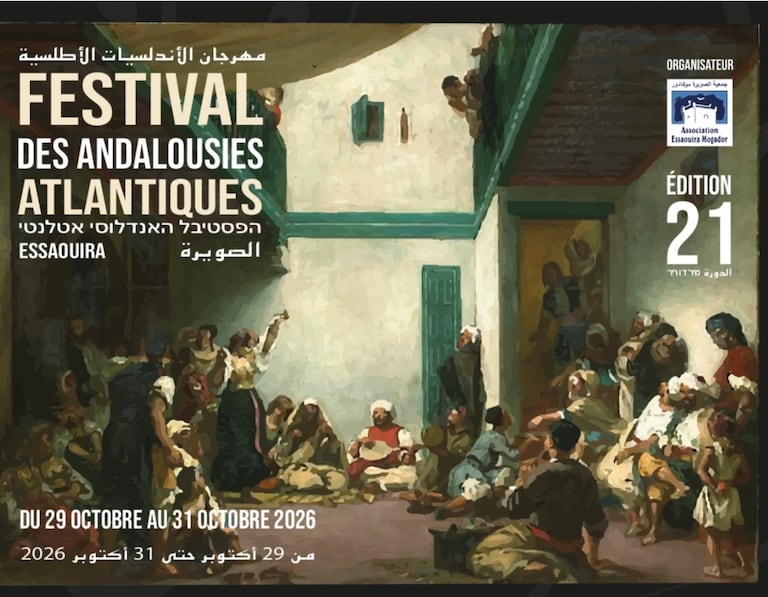
Thursday, October 29: A new chapter in a shared musical heritage
The opening concert on the main stage under the festival tent will feature Moshé Louk, performing in Essaouira for the first time. The nephew of Rabbi Haïm Louk, a major figure in Moroccan Jewish music and a familiar voice at the festival, he will carry forward a musical legacy passed down through generations.
He will share the stage with Marouane Hajji, one of the leading voices of Moroccan Arab-Andalusian music. Their performance will focus on Matrouz, an artistic tradition that brings Jewish and Arab musical heritage into dialogue without erasing the identity of either. The two singers will pay tribute to Rabbi Haïm Louk and Abderrahim Souiri, two artists who have left their mark on the festival.
Nouhaila El Kalai will also return to the stage where she first appeared before festival audiences at the age of 13. After a long absence, she will perform alongside Hajji in a closing duet that brings together an established artist and a performer whose career is still unfolding.
The Andalusian Orchestra, led by violinist Elad Levi, will share the stage with Moroccan musicians brought together under the direction of violinist Anass Belhachemi.
Read also : Crafts, fashion and music bring Moroccan culture to life at festival near Paris
At midnight, the program will continue at Dar Souiri with the HaPiyut Ensemble. The group brings together 18 artists from three generations, united by their commitment to Piyut, a traditional form of Jewish liturgical poetry intended to be sung, recited or chanted. Initially guided by Rabbi Haïm Louk, the ensemble continues to pass the tradition on to younger generations. Its work was recognized this year in Israel with the prestigious Landau Prize for Arts and Sciences.
Friday, October 30: A Moroccan Lila
From 10 a.m. to 1 p.m., Bayt Dakira will host the Forum des Andalousies, bringing together festivalgoers, artists, researchers, intellectuals, writers and journalists around the theme “The importance of place, the importance of connection.” The forum is designed as an open space for discussion, without barriers or borders, punctuated by short musical interludes.
In the afternoon, Dar Souiri will host Hamid Ajbar’s “The Breath of Al-Andalus,” a journey through Andalusian poetry that moves from love to exile and from exile to mysticism. Mohamed Aaboud will perform mawwals, Andalusian songs and pieces traditionally sung by women in Tangier during their evening gatherings. He will be accompanied by an orchestra featuring both male and female musicians, a still-uncommon configuration in Andalusian music.
At Bayt Dakira, guitarist Mercedes Luján will explore the role of women in flamenco guitar. The program will then feature Shira u’tfila, which will trace the journey of a Sephardic Haggadah from Spain in 1492 to Sarajevo. The manuscript was saved during World War II by a Bosnian Muslim and has since become a symbol of coexistence.
The evening’s main-stage program will celebrate two generations of Malhoun through performances by Majda Yahyaoui and Souhaila Sahraoui. They will be accompanied by the Al Assala Orchestra of Meknes, conducted by Rachid Lahkim, and joined by the troupe of Lhaj Saïd Berrada, a leading figure in the Issawa tradition.
The result will be a Moroccan Lila, an evening centered on music, celebration and shared memory. The program includes songs such as “Lghzal Fatma,” “Rfeq Ya Malki,” “Kalima Adima,” “Al Bouraqiya” and “Lalla Ghita Moulati.” Through these familiar pieces, the evening will celebrate Tamghrabit, the sense of Moroccan identity expressed through sharing, generosity, celebration and the passing down of traditions. It is an occasion where audiences may arrive to listen but often end up singing along.
At 11 p.m., Samia El Antri will return to the stage where the festival first introduced her to audiences at the age of 15.
At midnight, Dar Souiri will host “Around the Table: Our Nouba, Our Voices, Our Memory,” a gathering held in the spirit of Shabbat, without microphones or amplification. Avraham Edri will lead the Paytanim of Matrouz, while Hamza Jorti will direct Essaouira’s Madihiyine. Together, they will perform Andalusian noubas, alternating between Arabic and Hebrew. Audience members will be invited to join in, moving between the two languages rather than remaining passive spectators.
Saturday, October 31: The HaPiyut Ensemble meets Maâlma Hind Ennaira
The Forum des Andalousies will continue at Bayt Dakira. In the afternoon, Dar Souiri will host “Marhba Blli Ja Andna,” named after a signature song by the late Mohamed Laaroussi. The program will explore three strands of Morocco’s musical heritage: Nouhaila El Kalai will represent Chaâbi Fassi, Anass Belhachemi will perform music from the Jbala region and Taqtoqa Jabalia, while Hicham Dinar will draw on the repertoire of Moroccan Jews. Mohamed Aaboud will also perform.
Mercedes Luján and Shira u’tfila will meet audiences again at Bayt Dakira.
That evening, Spanish dancer and choreographer Olga Pericet will make her debut at the festival, in partnership with the Three Cultures of the Mediterranean Foundation in Seville and the Regional Government of Andalusia. One of the most adventurous figures in contemporary flamenco, Pericet received Spain’s National Dance Award in 2018 and a Max Award for best dance performer.
Her performance will conclude with an invitation to Hamid Ajbar and his musicians to join her on stage. Flamenco dance will meet Arab-Andalusian sounds in a program drawing on the artistic legacy of figures including Ibn Zaydoun and Wallada, Al-Mouatamid, Ibn Arabi and Al-Shushtari.
Read also : MOGA’s Essaouira summit tackles visa barriers, weak networks and recognition for electronic music
From 10:45 p.m. until midnight, the HaPiyut Ensemble and Maâlma Hind Ennaira will present “Piyut & Gnaoua,” realizing a long-held vision of André Azoulay: to see the two traditions meet on stage.
Both are deeply rooted in Moroccan history, yet they have developed alongside one another without previously sharing a stage in this way. The Piyut performers will bring the voices of Moroccan Jewish liturgical singing, while Ennaira and her musicians will contribute the ritual rhythms and trance associated with Gnaoua music.
The performance is built around a meeting of traditions rather than a blending that erases their differences. Each will retain its own identity while making room for the other, creating a new musical dialogue between two distinct Moroccan legacies.
