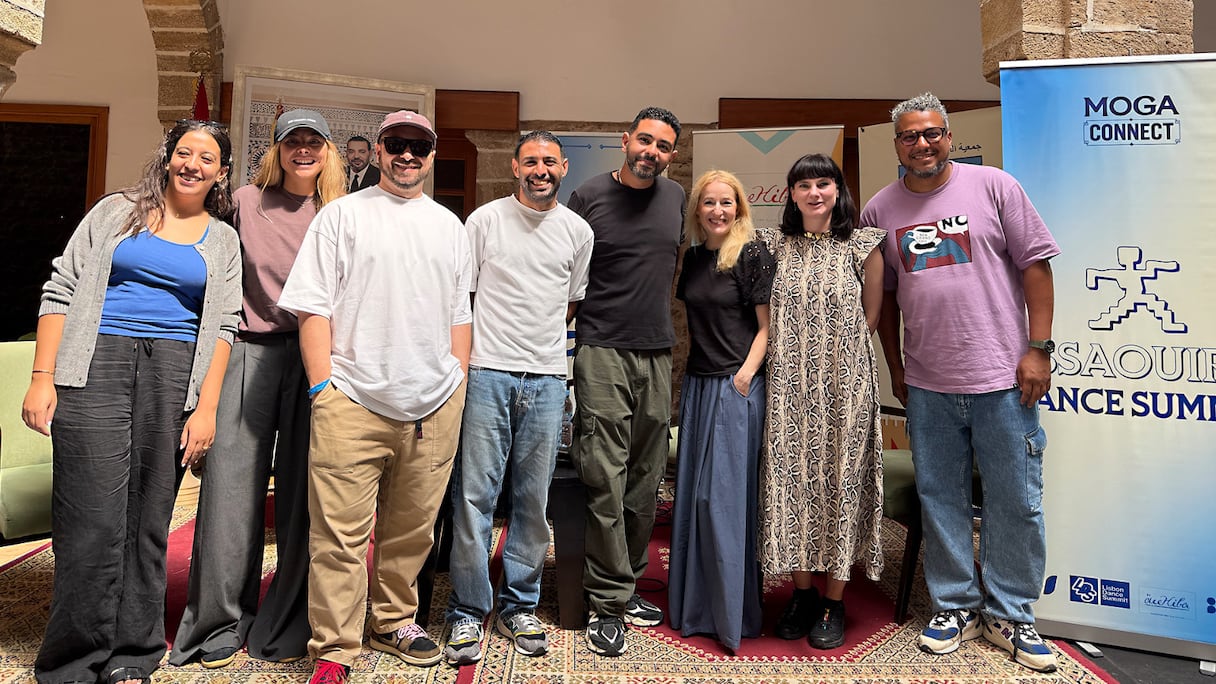
Co-organized by MOGA, Lisbon Dance Summit, Hiba Foundation and 4S, with support from the British Council, the Essaouira Dance Summit is the festival’s first professional component. It is part of MOGA’s 10th anniversary edition, following the event’s launch in Essaouira in 2016 and its subsequent expansion to Costa da Caparica, Portugal.
The summit’s purpose was set out at the opening by Marwane Fachane, director general of Hiba Foundation and moderator of the panels, who called for moving beyond “this reductive vision of the party.” There are “real careers” in electronic music, he stressed, adding that artists need support and platforms to develop them.
The event’s founder, Matthieu Corosine, linked the summit to MOGA Connect, a series of conferences and roundtables that the team hopes to continue outside the festival. Daox, the event’s co-founder and artistic director, described the summit as “the first building block” of a project that should become “more concrete and practical.”
Building an international career from home
One of the summit’s main takeaways was that international opportunities often begin with an artist’s activity in their home market. Kathleen O’Malley, international director at Ultra Records, said labels first look at what an artist is doing in their own country before looking for “a spark” on social media or streaming platforms in other markets.
A viral track alone is not enough. Speakers stressed the importance of consistency and a coherent artistic identity. London-based DJ and producer Robin M said he had experienced neither a major release nor a defining booking, but had continued to progress by performing mainly his own productions, which he can “take everywhere.”
Digital data has also become a tool for identifying potential markets. Meike Nolte, a consultant who previously worked at Believe and Beatport, said Spotify and Instagram statistics can help identify territories where an artist’s music is gaining traction. Artists can then use that data when approaching a local club or promoter, provided they retain ownership of their data.
Read also : Essaouira brings global artists and young audiences together through reggae music
Social media remains “a tool,” Daox said, rather than something that should turn artists into influencers. O’Malley encouraged artists to create their own formats instead of waiting for invitations. “If Tiny Desk doesn’t call you, create your own,” she said.
Professional representation comes later, with no single formula for building a career. Booking agencies want to see an artist’s progression, while experienced managers, who typically receive around 15% to 20% of an artist’s income, can remain out of reach until the artist is generating enough revenue.
The role of a label, O’Malley said, is to “amplify the story the artist is already writing.”
Visas remain a major barrier to mobility
The push for international exposure faces a persistent obstacle identified by Moroccan participants: obtaining visas.
Daox cited his own experience. In 2008, his first international booking, at Paris’ Rex Club, was canceled because he could not obtain a visa. More recently, he was invited to perform in Seoul but was refused three times despite submitting a complete application before finally receiving the visa on the eve of the event.
According to Daox, established artists now have access to circulation visas for their main markets. The problem is more acute for emerging artists, who “need to get out of Morocco to develop their networks.”
Participants pointed to several ways of strengthening visa applications, including official letters from labels, contacting professional networks before paying a lawyer and providing media coverage that consular officials can consult online.
The Hiba Foundation said it only issues support letters to artists who have gone through its programs. It also referred to an idea raised by other sector players for a “cultural visa corridor.”
Collectives and professional networks
The second panel shifted the focus from individual artists to the scene supporting them. For Lisbon-based DJ Billi, collectives are “to a large extent the foundations” of a music scene. Their community work, she noted, “doesn’t necessarily show up in the statistics.”
MOGA itself relies heavily on such networks. Corosine said the festival’s lineup is “almost exclusively made by collectives.” The festival also acts as a meeting point: Moroccan collective Reload established a collaboration with a collective from Nice at MOGA and is now expected to program a night in the French city.
“The festival takes place over five days, but its impact extends throughout the year,” Corosine said.
Lisbon offers an example of how such an ecosystem can develop. Jesper Skibsby, co-founder of Lisbon Dance Summit, described an electronic music culture that has been established since the 1990s. The arrival of international DJs, encouraged by a favorable tax regime, was followed by the development of a professional network of managers, agencies and labels.
Such growth takes time. Billi said institutions should provide resources, including spaces, funding, digital visibility and international connections, within long-term relationships.
“If you always give to the same people, you don’t build an ecosystem,” she said.
Jhobei, co-founder of UK label Bizarre Trax, made a similar point about exchanges between the United Kingdom and Morocco. A one-off exchange of artists is not enough, he argued. Labels and professional networks need to be connected over several years.
The discussions pointed to the same challenge at different levels. Internationalizing Morocco’s electronic music scene depends on more than artists’ ability to produce music or build an online following. It also requires local structures capable of supporting them and professional networks that can develop over time.
Seeking recognition as a cultural and economic sector
Institutional recognition remains another challenge. One participant called on public authorities to help the sector demonstrate “that we are not just party organizers.”
“It’s not just partying, it’s culture,” he added, pointing to the sector’s economic model as well as its social and tourism impact.
Read also : Film, theater, music and debate headline Tangier’s Riad Sultan October program
In Morocco, Corosine acknowledged the support of public authorities, saying the festival “would not have happened” without it. He nevertheless believes institutions still have “a bias” toward the sector.
According to Corosine, the publication last year of MOGA Essaouira’s economic impact study changed the conversation. The issue was no longer about asking for money, he said, but about inviting institutions to invest.
The festival’s experience in Portugal has followed a similar approach. In Costa da Caparica, the team approached municipal authorities not for funding but for a form of legitimacy. A protocol has since been signed with the city of Almada, which included MOGA in its bid for Portugal’s 2028 Culture City title.
For Corosine, international expansion only makes sense when it remains connected to the local scene. He pointed to the more than 35 Portuguese artists invited to Costa da Caparica this year as an example.
“If there are no roots, all you’re doing is sending checks to headliners,” he said.
