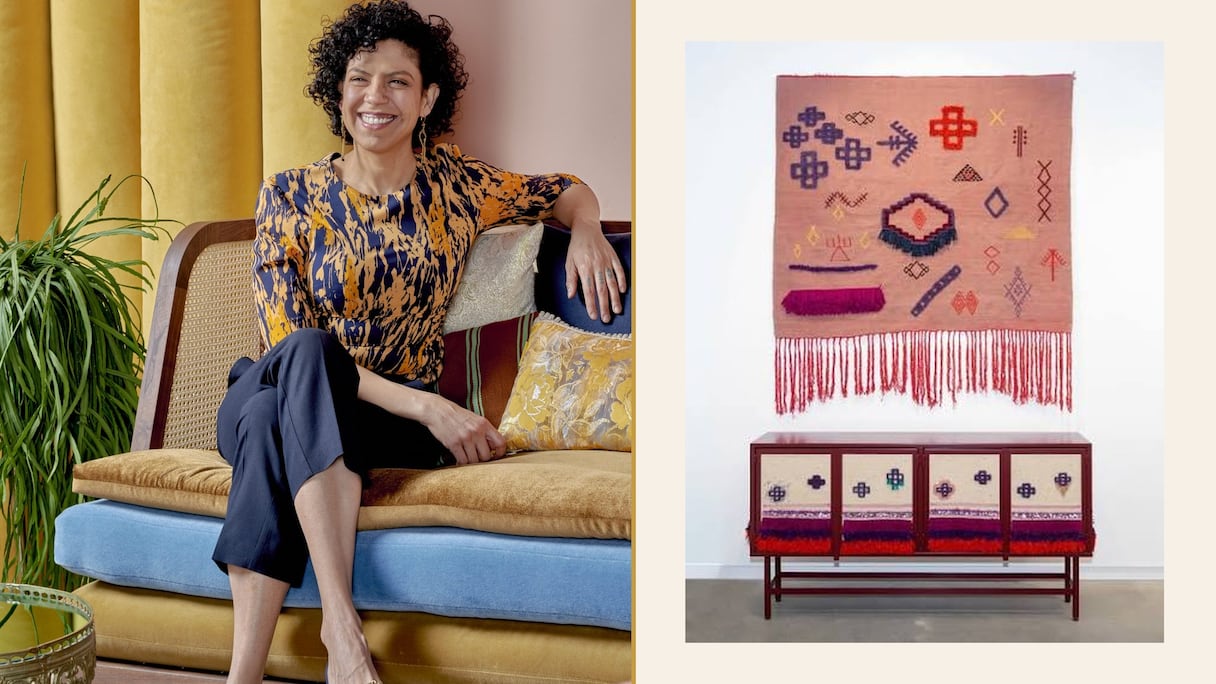
From September 26, the Gouda Museum in the Netherlands will host the first solo exhibition dedicated to Mina Abouzahra, a Dutch designer of Moroccan origin.
Titled Woven Letters, the exhibition will showcase furniture and carpets that weave together Moroccan craftsmanship and Dutch design, each telling personal and cultural stories.
At its heart, the exhibition challenges the notion of Moroccan carpets as mere decorative objects. In Amazigh tradition, textiles are imbued with rich symbolism, representing femininity, fertility, marriage, protection, and death.
Woven by women, each piece becomes a record of an intimate story, with life’s major stages expressed through motifs and colors in a visual language passed down through generations.
The exhibition will feature several new creations, including Bénédictions, a cabinet rich with symbolic meaning. Traditionally, this piece of furniture accompanies a young Moroccan bride’s transition to independence, serving as the only personal item she takes when leaving her family home.
For this project, Abouzahra collaborated with two Dutch craftspeople: Tsugi Woodworks, which crafted the wooden structure using Japanese joinery techniques without glue or nails, and Het Borduurburo, which produced the embroidery adorning the textile panels.
Other notable pieces include the Sofa Goity, a stack of mattresses that pays tribute to family ties and intergenerational living in Morocco, and the Abouzahra X Rietveld chair, a reinterpretation of a design by Wim Rietveld, son of renowned designer Gerrit Rietveld. This piece combines the austerity of postwar Dutch design with the richness of handwoven Moroccan textiles.
The centerpiece of the exhibition is the monumental tapestry Lettre, which draws on a tradition specific to Taznakht. When a young Amazigh woman marries and leaves her family, she remains without direct contact with them for a year.
During this period, she weaves a tapestry in which colors and symbols express her inner state. Her father visits her only once before taking the work back to her mother, who “reads” the woven letter through the language of weaving.
The exhibition complements Murs des Merveilles, the Gouda Museum’s major autumn exhibition devoted to the history of local weaving. For this occasion, Abouzahra worked with Gouda communities to create contemporary cushions woven in Taznakht, reinterpreting the traditional cushions of the city’s guilds.
This project creates an unexpected link between Dutch textile history and Morocco’s living weaving tradition, made all the more significant by the fact that nearly one in 10 Gouda residents has roots in the northern Rif mountains and Amazigh culture.
About Mina Abouzahra
Born in the Netherlands to Moroccan parents, Mina Abouzahra grew up between two cultures. During her studies at the Higher School of Wood and Furniture, she discovered the traditions of her parents’ homeland, a craft heritage that continues to shape her work today.
Her creations are now part of several museum collections. In 2022, she received the Dutch Creativity Award and the European Design Award. “Through my work, I preserve my cultural heritage and express my Moroccan identity,” she said.
Since 2013, Abouzahra has run a design studio between Amsterdam and Taznakht in southern Morocco, where she collaborates with a cooperative of women weavers who preserve centuries-old Amazigh traditions. She also advocates for fair working conditions and fair pay for these craftswomen.
