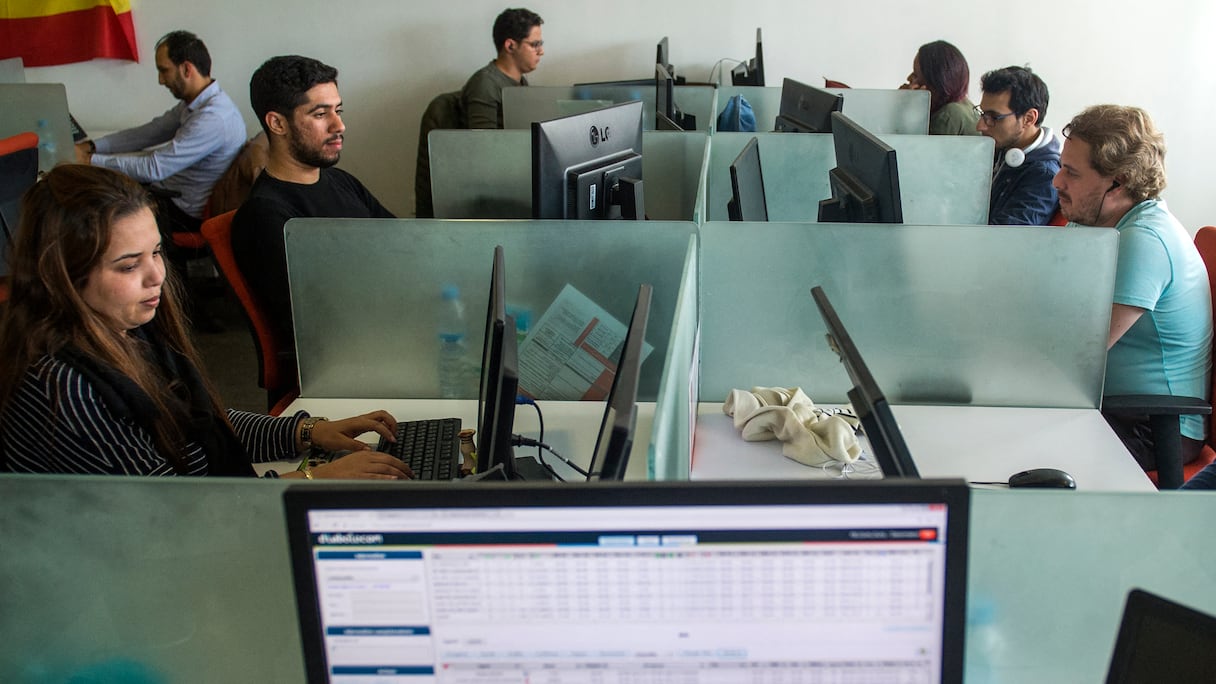
On Tuesday, August 11, a law banning unsolicited telemarketing across all sectors came into force in France. From now on, calling a French consumer without their consent is illegal. Businesses can only dial a number if they have written proof that the person has agreed to be contacted or if the call is part of an existing contract.
Bloctel, France’s previous do-not-call registry, is also being phased out. Consumers are no longer responsible for shielding themselves from unwanted calls. Instead, businesses must justify every call they make.
For French consumers, this change is a relief. For Moroccan call centers, 80% of whose activity depends on the French market, however, it is a major shock. According to Younes Sekkouri, Morocco’s minister of economic inclusion, small businesses, employment, and skills, between 40,000 and 50,000 jobs are now at risk, particularly in small- and medium-sized companies, which account for over 60% of the sector.
However, these figures should be treated with caution. Ayoub Saoud, secretary-general of the National Federation of Call Centers and Offshoring Businesses, believes the figures could be an underestimate. Neither Morocco’s High Commission for Planning nor the Employment Observatory, which falls under the relevant ministry, has precise data on the sector. “There is an incomprehensible lack of government statistics,” he said.
The situation on the ground is even harder to assess. While more than 600 call centers are officially licensed to operate, many others work informally, outside the purview of the authorities. This means that thousands of employees are not included in any official statistics. Saoud warned that if those businesses were to shut down, their employees could be left without any form of protection.
According to Younes Sekkouri, Morocco’s call center sector generates between 10 and 12 billion dirhams in added value each year. The sector directly employs nearly 120,000 people and indirectly creates around 50,000 jobs in related sectors, such as transportation and logistics. Investment reached 1.3 billion dirhams in 2023.
Read also : France to ban unsolicited telemarketing calls from August 11
However, these figures mask a deeper vulnerability that has been building for years: an entire sector that is heavily dependent on a single market without serious diversification or a safety net.
For Ayoub Saoud, the new law was not unexpected.
“It is the culmination of a gradual tightening of regulations that French lawmakers have pursued for years, driven by public frustration with unwanted calls from call centers in Africa,” he said. Bloctel was the initial response, but it was deemed insufficient," he said.
Consumer organizations subsequently pushed the issue until the final legislation was adopted.
“We are talking about a law that affects telemarketing. It’s a segment that many people underestimate, but it’s central to the business model of many small and medium-sized companies,” he said.
These companies, located in Casablanca, Rabat, Marrakech, Tangier, and other places, conducted sales campaigns on behalf of French clients, offering energy-saving plans, telephone subscriptions, and insurance products.
Their business model was relatively simple: an agent, a list of numbers, and daily sales targets measured by performance indicators (KPIs), which directly determined their pay.
That model has now been disrupted. “Once they can no longer make calls, the agents have no way to work,” said Saoud.
Less than 15% of revenues, according to FMES
Youssef Chraibi, president of the Moroccan Federation of Outsourcing (FMES), however, argues that the impact should be put into perspective.
“Contrary to a widely held perception, telemarketing has not been the core activity of the sector for a long time. Prospecting activities now account for less than 15% of revenues in Morocco’s call-center sector,” he said.
Most of the industry’s activity has shifted toward customer service, technical support, back-office operations, digital services, BPO (Business Process Outsourcing, or the outsourcing of operational or support activities to a specialized external provider), content moderation, data-related jobs and services linked to artificial intelligence.
Moreover, call centers represent only one of the five ecosystems that comprise Morocco’s offshoring industry.
“Employment is directly correlated with revenue in the offshoring sector. This means that no more than 15% of jobs in the call-center segment should be affected. The segment employs 90,000 people out of the 150,000 employed across the entire offshoring industry,” Chraibi said.
While the impact may be limited for the industry as a whole, it could nevertheless prove devastating for companies that failed to adapt in time.
“These are mainly specialized companies that are most exposed because their business model depends heavily on this activity. Often small, they are sometimes reliant on a single client,” he said.
Some operators are presenting leads — pre-qualified contacts who have agreed to be approached — as a possible way out for those workers and companies.
However, the economics change dramatically. “Leads are confirmed contacts, but they’re expensive,” Saoud said.
For small and medium-sized companies operating on narrow margins, this transition could be unsustainable. Owners, managers, and employees may find themselves unable to cover their fixed costs. According to Saoud, some companies may shut down before the end of the month.
French regulation is not the only challenge facing the sector. Artificial intelligence is also reducing staffing levels, and the pace is accelerating.
Saoud warned that automated tools for handling calls, qualifying contacts, and managing simple sales interactions are gradually replacing human agents in the least skilled positions.
Youssef Chraibi sees little point in trying to preserve the old model.
“I don’t believe the appropriate response is to artificially keep an activity on life support when its business model is challenged by changes in regulations and consumer expectations. The challenge is not to preserve past activities at all costs, but rather to support the transition toward sustainable occupations that represent the future of our industry,” he said.
However, the National Federation of Call Centers and Offshoring Businesses takes a different view. It argues that such a transition is a luxury that small companies cannot afford.
The government has announced a strategy focused on market diversification, moving up the value chain, and retraining programs in partnership with the Office of Vocational Training and Employment Promotion (OFPPT). But Saoud remains skeptical.
“Nothing has been put in place so far. These segments cannot replace the French market. When you depend on a single market for 80% of your business, you lose control. We are now at the mercy of international developments and the extraterritorial reach of foreign laws,” he said.
