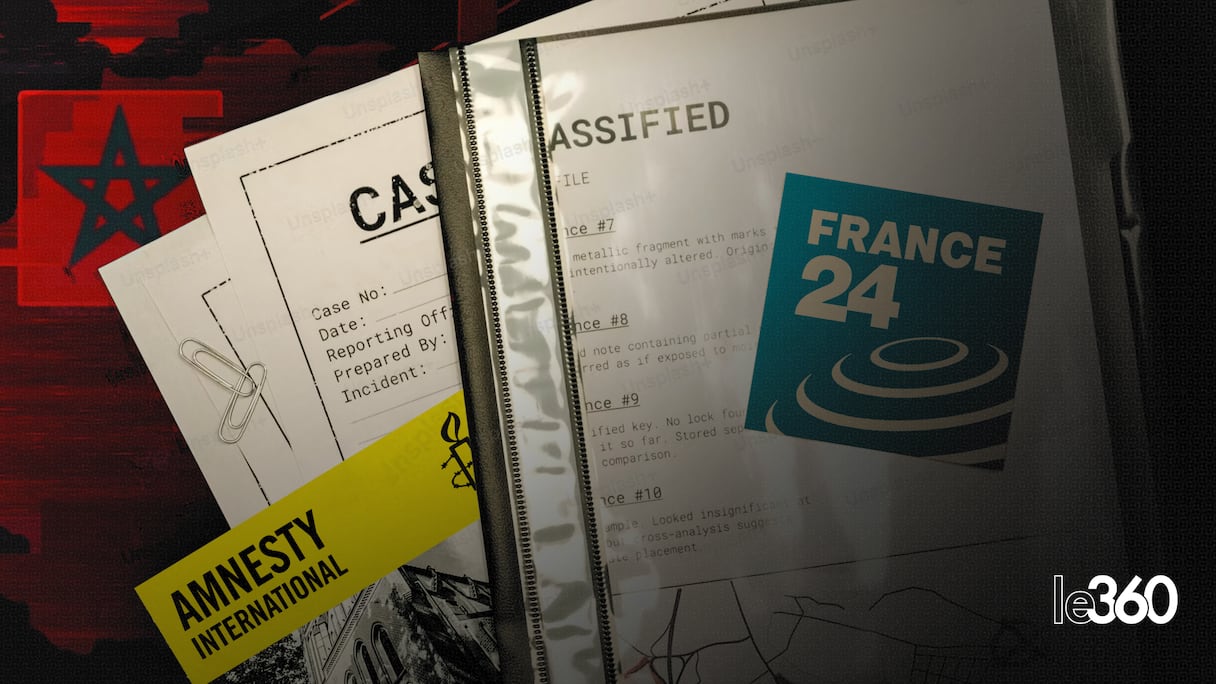
Some obsessions eventually expose their own deceit. How else to explain the selective blindness and dogged persistence of certain French media outlets, France 24 among them, whenever Morocco is in their sights—while everything else, absolutely everything else, is conveniently forgotten?
By reproducing, without critical scrutiny or analytical distance, the contents of yet another report by Amnesty International’s Belgian section on the Pegasus affair, these newsrooms are once again playing a familiar tune, recycling the same tired ingredients to build a case against Rabat. Far from upholding the standards of journalism, this approach increasingly resembles an orchestrated smear campaign, built on transparently contrived accusations and sources whose fragility is matched only by the credulity of those who amplify them.
To construct their case, these outlets have no qualms about placing absolute and wholly undeserved faith in an enigmatic figure presented under the pseudonym Safir. Conveniently cast as a providential whistleblower from within Morocco’s intelligence apparatus, the man is nevertheless known to have operated on the fringes of the intelligence services, with an obscure record in subordinate roles. To invest the claims of such a low-level figure with this degree of evidentiary weight betrays a curious sense of journalistic priorities—provided, of course, that the purpose is to tarnish the image of a partner country.
By fixating on his second-hand testimony, Morocco’s accusers endlessly resurrect the old Pegasus story and claims that the spyware was used by Moroccan services to silence dissenting voices—a tale repeated ad nauseam despite the Moroccan authorities’ consistent and categorical denials that they ever possessed or used the technology. Amnesty International’s Belgian section has thus found a convenient new lever with which to stir the same old pot, eagerly assisted by media outlets seemingly locked in a permanent search for anti-Morocco sensationalism.
Read also : Pegasus, Season Two: Anatomy of a media spin-off that bombed spectacularly
Yet the technical and legal weaknesses of such accusations have been laid bare by rigorous analyses that these same media outlets are careful not to examine too closely. As political analyst Lahcen Haddad noted in a series of posts on X, the Amnesty International report may raise serious allegations, but it is neither a judicial ruling nor a definitive verdict. Haddad forcefully points out that the mere presence of a telephone number in targeting records does not prove that an infection actually occurred, just as a technical trace of Pegasus does not formally identify the entity or individual that ordered an alleged attack. Technical attribution is, by its very nature, distinct from proof of unlawful political intent. Demanding that the report’s authors make their underlying evidence and chain of attribution independently verifiable is no more than common sense—yet it is brushed aside by media inquisitors seemingly more interested in making headlines than establishing the facts.
The blindness of Parisian observers becomes truly indefensible when set against their culpable amnesia over their own country’s conduct. Locked into an obsessive fixation on Morocco, the French media discreetly forget that France itself has been implicated in far more serious, documented and incriminating cases involving cyber-surveillance and the export of spying technologies. The explosive 2023 Predator Files investigation exposed how France actively supported and assisted regimes described as dictatorships in tracking and spying on their own populations.
Led by the European Investigative Collaborations consortium, with Mediapart among its participants, the investigation laid bare the thoroughly cynical and unscrupulous methods of the French company Nexa Technologies, formerly known as Amesys, and its alliance with Israeli businessman Tal Dilian through the Intellexa consortium.
This so-called made-in-Europe cyber-surveillance industry distinguished itself by marketing and selling the cream of the spyware crop—Predator—to a host of authoritarian states around the world, from Libya and Egypt to Vietnam. The ramifications of this state scandal even reached circles closest to France’s executive branch, leading investigators all the way to Paris and, notably, to one Bruno Le Maire, then minister for the Economy, Finance and Industrial and Digital Sovereignty. Faced with a scandal of such major geopolitical reach, the absence—or at the very least the scarcity—of substantial coverage by France’s leading media outlets raises obvious questions. It amounts to an outright omertà.
What we are left with, then, is a glaring double standard: a demonstrable, one-sided campaign against Morocco, devoid of tangible evidence, set against a complicit indulgence towards the security excesses of France and the European Union. This policy of selective outrage enshrines the insidious notion that France and its European allies may grant themselves the right to tolerate and practice anything they please, while Morocco is denied even the most basic right to security and sovereignty. This media diplomacy of diversion, built on the instrumentalization of partisan activist reports, does no credit to the press that indulges in it. On the contrary, it reveals a chronic inability to come to terms with the strategic emancipation of a Global South country, reducing international investigative journalism to little more than an instrument of influence.
