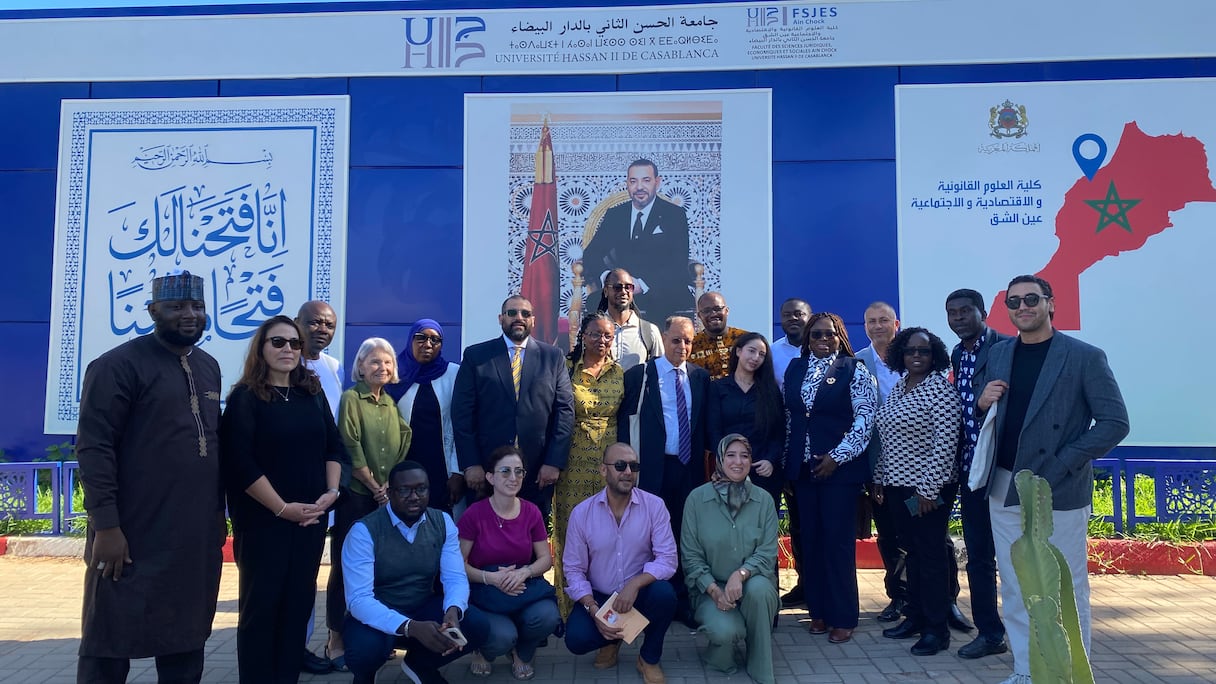
The two-day workshop, held on October 13 and 14, 2026, at Hassan II University’s Faculty of Legal, Economic and Social Sciences in Casablanca, brought together around 20 experts convened by the Global Council for Social Innovation (GCSI), a coalition of more than 60 governments. The participants are reviewing the 103 indicators that make up the Global Social Innovation Index (GSII).
The goal is not simply to add more indicators, but to assess whether existing measures capture the realities they are intended to reflect and identify gaps, said Mohamed Htitich, the council’s research and data lead. Each component is being examined to determine whether it should be retained, revised or dropped based on how closely it relates to social innovation.
Much of the language and methodology used to measure social innovation, the GCSI says, was developed in and for wealthier countries. The review aims to ensure that the index reflects how social innovation actually works across the Middle East, North Africa and sub-Saharan Africa, including through cooperatives, the social and solidarity economy, community and faith-based support networks, Islamic social finance and the informal sector.
Read also : Morocco climbs to record 54th in 2026 Global Innovation Index
Wamuyu Mahinda, a Kenyan senior adviser for English-speaking Africa at the GCSI, said many solutions developed by communities and social entrepreneurs remain limited to individual projects, organizations and communities.
“How do we move from promising innovations to changes in policies, financial systems [...] and public services that shape people’s lives?” she asked.
The council’s presentation placed the review against a backdrop of mounting pressure on public resources. It cited 61 conflicts involving at least one state in 2024, according to the Uppsala Conflict Data Program, global public debt of $102 trillion, according to the United Nations Conference on Trade and Development, and the first decline in official development assistance in six years, according to the OECD.
In this context, the quality of public decisions becomes even more important, the presentation argued. Indicators should help governments understand where progress is being made, where barriers remain and what needs to change.
Measuring the conditions for social innovation
Fouzi Mourji described the GSII as an attempt to bring together information that existing indicators from institutions such as the World Bank, UNESCO, the World Health Organization and the International Labour Organization assess separately.
“These are useful studies, but they are compartmentalized. The ambition of this index is to create a kind of weighted average of all these indices,” he said.
Read also : Morocco ranks second in latest assessment of African countries’ innovation capacity
The index covers 242 economies from 2000 to 2023. Because social innovation is a process that cannot be directly counted at the national level, it separates the conditions that enable it from the outcomes it produces.
The first group covers five foundations: society, measured through 15 indicators; infrastructure, 15; the economy, 11; governance, 15; and the innovation ecosystem, seven. The second examines outcomes for people, using 30 indicators, and for the planet, using 10.
The 103 measures are converted to a scale of zero to 100. The two groups remain separate so researchers can compare the conditions a country has in place with the results it achieves.
The index therefore does not produce a single overall score. Combining everything into one number would conceal more than it revealed, Htitich said. The aim is to assess how effectively countries turn favorable conditions into tangible outcomes.
What the statistics miss
Whether the indicators reflect conditions in the Global South emerged as a central issue during the discussions. Two areas drew particular attention: informal solidarity networks and governance.
Both expose the limits of applying standardized measurement frameworks developed largely in wealthy countries to societies with different economic and social structures.
Read also : Morocco, US eye joint research on crop varieties, cattle breeds
Barbara Ibrahim, who lives and works in Cairo and serves on the board of an international association of civil society researchers, illustrated the problem through informal exchanges within Egyptian communities.
Families unable to pay for home care, she explained, may ask a neighbor to look after an elderly parent and compensate them with rice grown on their land. Such arrangements involve work, income and economic exchange, yet they may not appear in official statistics.
Capturing these activities is possible, Ibrahim said, but requires costly household surveys. Poorer countries are often less able to collect such data, leaving a significant part of their social and economic activity unrecorded.
The GCSI’s own working document acknowledges that social structures across much of the Global South rely on extended families, community obligations, faith-based mutual aid and informal reciprocity. Standard measures of civic participation may barely register these forms of support.
The same problem affects the measurement of social innovation ecosystems. In sub-Saharan Africa and the Middle East and North Africa region, the council says, social innovation relies heavily on cooperation and informal networks. Counting only registered organizations can therefore significantly underestimate the number of actors involved and the work they do.
As a result, social innovations that are common in these regions risk being undervalued in the index’s assessment of outcomes.
Governance presents a related challenge. Alongside society, it is considered one of the most difficult foundations to measure. The World Bank indicators used in this category are closely associated with income, and wealthier countries tend to score higher.
The GCSI acknowledges that this could lead the index to indirectly reward wealth and underestimate social innovation in lower-income countries. In cross-country comparisons, the indicators could therefore favor richer economies even when local communities in poorer countries have developed effective ways to address social needs.
Read also : Nine Euromed University of Fez researchers make Stanford–Elsevier 2026 global top 2%
During the workshop, one participant called for the index to account for “endogenous” governance, reflecting how local actors organize and manage initiatives on the ground. Beneficiaries, the participant argued, should be able to define their own criteria rather than have a framework imposed from above that may not reflect their circumstances.
The GCSI team acknowledged the tension. Although its definition of social innovation starts at the grassroots level, its current approach to measuring governance remains largely top-down.
Next steps for the global index
The workshop’s conclusions are expected to feed into version 3.1 of the Global Social Innovation Index, followed by an academic review involving reviewers from the three regions represented in Casablanca. A progress update is scheduled for the first week of November.
The same review exercise is then due to take place in Bangkok, Thailand.
The discussions have also left the organizers with a broader question about the tool itself: should it remain an index, or evolve into an observatory?
