The Sovereign stressed that this transformation has unfolded within a context of stability and institutional effectiveness, enabling the country to achieve positive results across multiple sectors.
“Thanks to security, stability, and institutional efficiency, positive indicators are on the rise across sectors, thus boosting economic growth and reinforcing national sovereignty,” the King said, recalling the 4.9% growth recorded in 2025 and the favorable outlook for the current year.
This momentum also extends to the agricultural sector, which benefited from a favorable growing season following abundant rainfall.
“The country emerges from these favorable conditions with stronger water and food security,” the King noted, highlighting the progress achieved in a sector that remains strategic to the national economy.
Industry, however, remains one of the principal engines of Morocco’s ascent. The Sovereign emphasized that the Kingdom has consolidated its position as an “attractive hub for industrial, tourism, and financial investment,” notably through the development of high value-added industries.
Read also : Throne Day speech: Stability, industrialization, technology and social equity underpin Morocco’s success
Today, the automotive, aerospace, renewable energy, and agri-food industries have become essential pillars of Morocco’s productive economy, thanks to their ability to attract investment, create wealth, and generate employment. The automotive sector stands as the clearest illustration of this transformation.
“The Kingdom has become the leading exporter of cars in Africa, with a production capacity of nearly one million cars a year,” the King recalled, adding that the automotive and aerospace industries now account for more than 40% of the country’s exports, overtaking the phosphate sector.
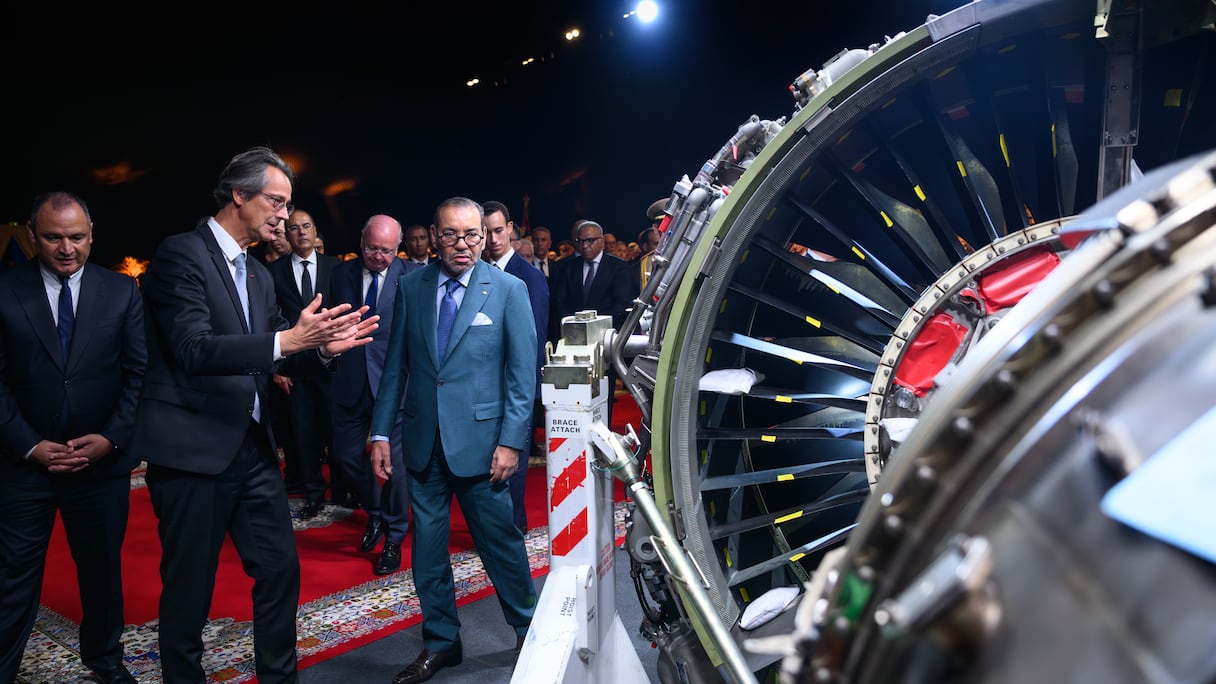
The same transformation is taking place in aerospace, where the Kingdom aims to move further up the global value chain. The Sovereign pointed to the launch of new industrial facilities designed to enable Morocco to join “the exclusive circle of countries possessing the largest industrial centers in the field of aircraft engine and landing gear manufacturing.”
In the industries of the future, Morocco is equally determined to stay ahead of global technological shifts. The development of an integrated electric battery industry reflects the Kingdom’s ability to “anticipate future technological transformations” and integrate into the production chains of strategic industries.
Read also : Throne Day Speech: How Morocco became a reliable, respected and influential global partner
The energy transition represents another central pillar of this strategy. Morocco’s renewable energy projects are intended to make clean energy
“a pillar of our energy security, as well as a catalyst for attracting industries banking on the use of competitive, carbon-free energy.”
This ambition is being further advanced through the rollout of the Morocco Green Hydrogen Offer, whose operational implementation has already reached an initial milestone with the granting of authorizations for a first group of mega-projects.
Finally, tourism continues to confirm its role as a key driver of Morocco’s economic momentum. In 2025, the sector recorded a historic performance, welcoming nearly 20 million visitors, including members of the Moroccan community living abroad, thereby reinforcing its place among the Kingdom’s principal engines of growth.
Through these strategic sectors, Morocco continues along a path of transformation founded on productive diversification, investment attraction, and the steady strengthening of its economic sovereignty.
