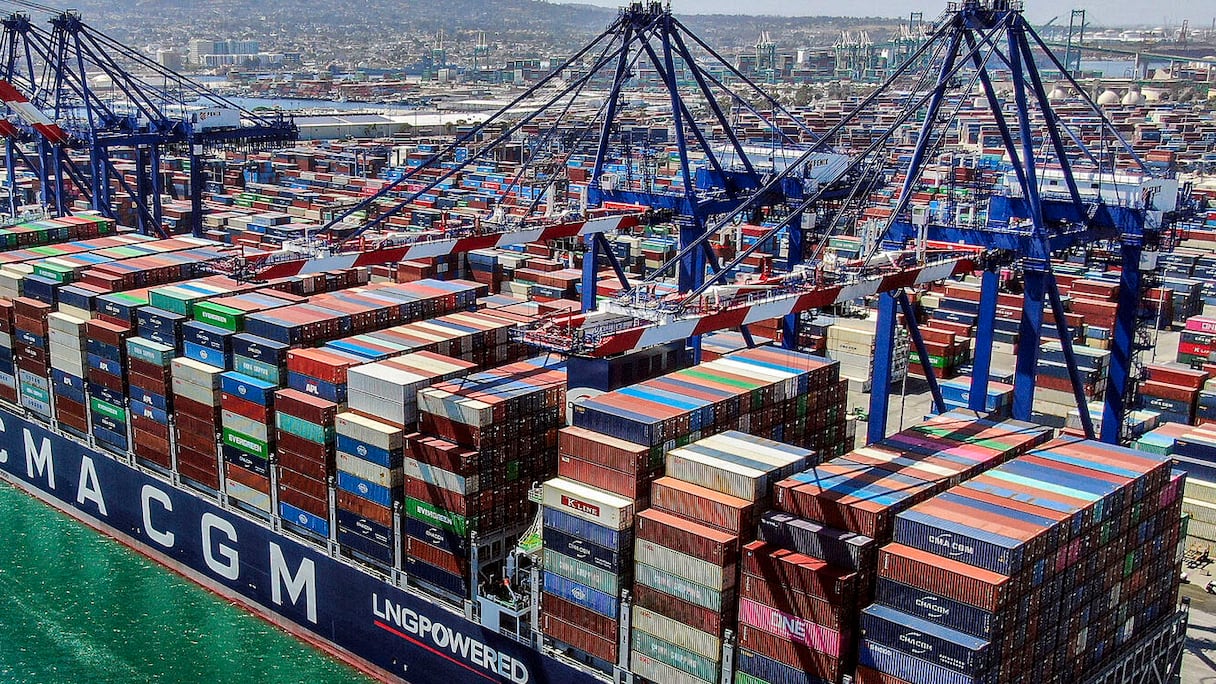
Starting September 15, 2026, shipping certain goods from Morocco to the United States will become more expensive.
French shipping company CMA CGM has included Morocco in its new Rate Restoration Initiative, which provides for an additional $250 charge per 20-foot container and $500 for 40-foot, 40-foot high-cube and 45-foot containers. According to the carrier, these increases will be added to the base freight rate and the various port and logistics charges already borne by exporters.
At first glance, the decision may appear to be another setback for Moroccan companies competing in international markets, where even a few dozen dollars per tonne can make a difference.
More fundamentally, however, it highlights the changing nature of Morocco’s industrial challenge. The country must now do more than produce competitively. As export volumes grow and markets become increasingly distant, it must also be able to move goods quickly, reliably and at the lowest possible cost.
This challenge is particularly significant in trade with the United States, where bilateral trade reached $7.39 billion in 2025, including $1.86 billion in Moroccan exports. CMA CGM also noted that Morocco continues to run a trade deficit with the United States, reinforcing the strategic importance of expanding Moroccan sales in the American market.
Tanger Med: Greater exposure, but above all a strategic advantage
The real issue, therefore, is not simply the additional $500 per container, but the timing of the increase.
Morocco is seeing several export sectors gain momentum, all of which depend on reliable international logistics to sustain their growth.
The Moroccan port complex handled 11.1 million TEUs in 2025, up 8.4%, while its transshipment activity continued to benefit from the reshaping of major international shipping routes.
This concentration of trade flows naturally makes Morocco more exposed to commercial decisions by major shipping companies. But it also gives the country an advantage that few African economies possess: the logistical scale needed to attract shipping lines, consolidate cargo volumes and provide manufacturers with global connectivity.
Read also : Tanger Med welcomes one of world’s largest container ships
CMA CGM’s increase should therefore be viewed with nuance. It highlights the pricing power of major shipping companies, but does not call into question the attractiveness of Morocco’s logistics platform.
On the contrary, as volumes passing through the country continue to grow, so does the ability of shippers, industry federations and major industrial groups to negotiate long-term contracts.
The French shipping company itself points to the possibility of framework agreements based on volume commitments. This could offer one of the most practical responses to rising freight costs.
Rather than facing shipping rates individually, Moroccan export sectors would benefit from further consolidating their cargo flows and strengthening their negotiating position with shipping companies. Tanger Med’s MedHub logistics zone already provides infrastructure that can support this type of consolidation.
The agreement with Washington remains a decisive advantage
Morocco’s position also needs to be assessed against a broader comparison with its competitors.
Mexican and Canadian producers clearly benefit from their geographical proximity to the US market. But since 2006, Morocco has also benefited from a free trade agreement with the United States that eliminates tariffs on nearly all industrial and agricultural products.
According to the document, bilateral trade has grown from less than $1 billion before the agreement entered into force to more than $7 billion today.
Higher shipping rates do not eliminate this institutional advantage. They simply reduce part of its economic benefit as transportation costs increase.
Read also : Tanger Med earns investment-grade ratings from Moody’s and S&P
This is precisely why logistics has become a strategic issue. Morocco has made significant progress in securing commercial access to major markets. Its next gains in competitiveness will increasingly depend on the movement of goods, port digitalization, cargo consolidation and the diversification of logistics infrastructure.
That process is already underway. The document notes that Morocco’s national logistics strategy includes significant investment in port infrastructure, while Nador West Med and Dakhla Atlantique are expected to gradually complement Tanger Med.
From logistics costs to economic sovereignty
Ultimately, CMA CGM’s decision sends a broader message. An export-driven economy can never fully control the cost of maritime transport. It can, however, reduce its exposure through greater volumes, competition among operators, high-quality infrastructure and more sophisticated supply chains.
Morocco still faces relatively high overall logistics costs, estimated at around 20% of GDP, significantly above levels seen in several European economies. Bank Al-Maghrib has also shown that fluctuations in maritime freight rates can gradually feed through into domestic prices.
But this constraint must be viewed alongside the transformation Morocco has undergone over the past two decades.
Few African countries simultaneously have a world-class port hub, an automotive manufacturing base, a leading position in the phosphate industry, trade agreements with both Europe and the United States, and a geographical location just a few kilometers from the European continent’s largest economic market.
Read also : Nador West Med fuels a new phase of development in Morocco’s Oriental region
This combination gives Morocco greater room for maneuver than CMA CGM’s announced price increase alone might suggest.
The additional $250 to $500 per container is therefore less of a shock than a warning. As Morocco moves further up global value chains, logistics performance is becoming just as important as labor costs, energy prices and taxation.
Morocco’s openness to international markets is one of its key advantages. The next step will be to ensure that its industrial and port capacity is not defined solely by the volumes it handles, but also by its ability to exert greater control over the conditions under which those goods reach major global markets.
In that sense, the current rise in freight costs could do more than temporarily weigh on Morocco’s export trajectory. It could accelerate a transformation already underway: from an export-oriented economy into an increasingly significant logistics power.