Spanish business leaders are increasingly viewing Morocco not merely as a neighboring market or a competitive manufacturing platform, but as one of the emerging industrial growth centers of the Mediterranean and Africa.
In an institutional declaration published on July 9, 2026, following a mission led by its president, Juan María Nin, the Círculo de Empresarios urged Spanish companies to seize what it described as a “historic and long-term opportunity for shared prosperity.”
The statement attributes this shift primarily to the transformation of Morocco’s productive base. According to the document, investments made over recent decades in transport, energy and telecommunications are beginning to generate multiplier effects across the economy. The key issue is no longer simply the scale of infrastructure development, but its ability to reduce logistics costs, facilitate trade and attract more integrated industries.
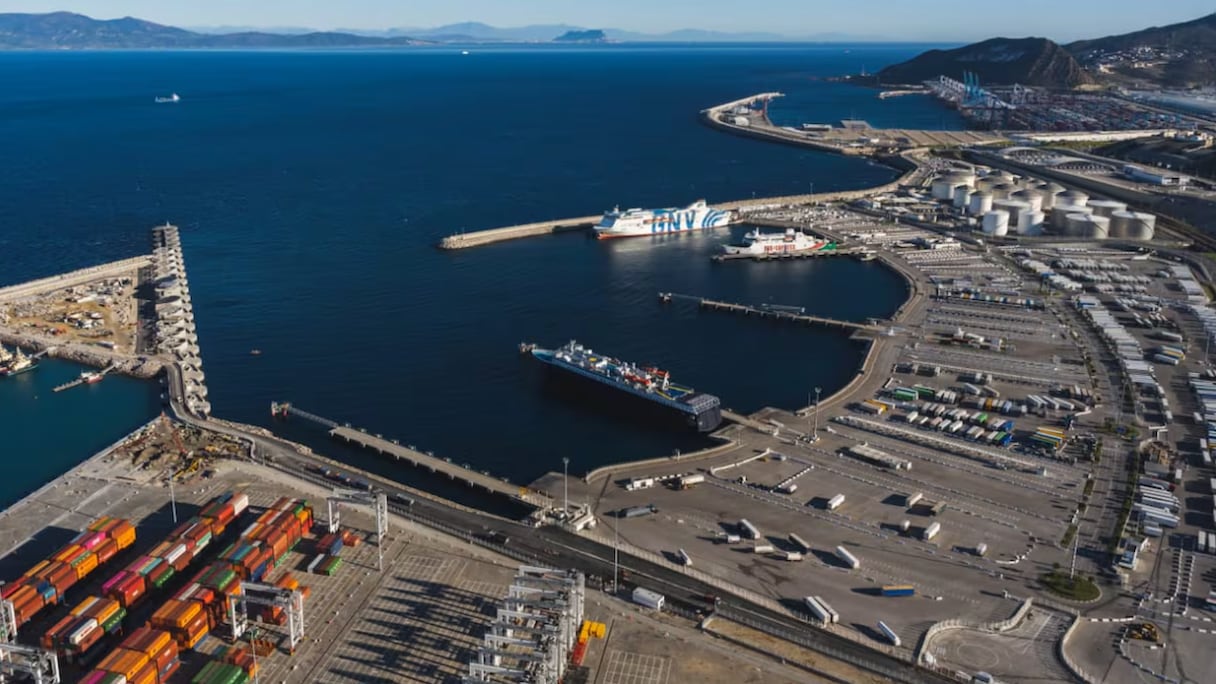
The declaration notes that Morocco’s motorway network has expanded nearly twentyfold over the past few decades, while its railway network now exceeds 2,000 kilometers. It also points to the launch of Al Boraq, Africa’s first high-speed rail line, alongside the development of Tanger Med Port and the port of Nador.
Read also : Cash in circulation hits record MAD 491 Billion in Morocco, central bank Says
According to the Círculo de Empresarios, these developments are gradually reshaping Morocco’s role in global value chains. The country is no longer defined solely by competitive production costs, but also by its industrial capacity, modern port infrastructure and proximity to European markets. The organization says the expansion of Morocco’s ports is helping integrate the country more deeply into international value chains.
The same reasoning extends to telecommunications. The report states that 4G mobile coverage now reaches 99% of Morocco’s population, supported by high mobile and fixed broadband penetration. It argues that this level of connectivity enhances productivity across manufacturing, financial services, logistics and digital industries by facilitating coordination between Moroccan operations and European headquarters.
Human capital becomes the next industrial challenge
The declaration stresses that Morocco’s attractiveness does not rely solely on physical infrastructure. It also highlights improvements in education and higher learning.
Between 2000 and 2023, dropout rates in public secondary education reportedly declined by between 63% and 85%, depending on the age group. Meanwhile, enrollment in tertiary education, including vocational training and universities, reached 48% in 2024, representing an increase of more than 30 percentage points compared with 2007.
According to the report, these advances respond to immediate economic needs. The expansion of the automotive, energy, financial and digital sectors requires a growing supply of technicians, engineers and skilled professionals. The next challenge, it says, will be ensuring that education and training programs match labor market demands so that industrial upgrading is not constrained by skills shortages.
The document also highlights the modernization of Morocco’s financial system, where commercial banks, payment providers and fintech companies operate alongside one another. Combined with the country’s phosphate sector and domestic investment strategy, this financial depth is seen as supporting the mobilization of capital toward more advanced industrial and technological activities.
Trade ties still have room to deepen
The report notes that Spain is approaching this transformation from a favorable position, remaining Morocco’s largest trading partner with annual merchandise trade exceeding €22.5 billion.
Morocco has also become the leading African market for Spanish companies and one of Madrid’s principal trading partners outside the European Union.
According to ICEX data cited in the declaration, more than 300 Spanish companies operate in Morocco, employing nearly 30,000 people across sectors including energy, automotive manufacturing, banking, textiles and agriculture. Morocco is also Spain’s largest investment destination in Africa, with an investment stock exceeding €2 billion.
Read also : Morocco remains Spain’s top non-EU fruit and vegetable supplier as imports continue to rise
However, the report argues that this level of investment still leaves significant room for growth relative to the intensity of bilateral trade.
It says the main challenge is to transform a relationship largely driven by trade flows into deeper productive partnerships involving industrial investment, skills transfer, applied research and joint development of African markets.
The Círculo de Empresarios adds that the two countries’ geographic proximity, strong trade ties and the presence of more than 900,000 Moroccans in Spain provide competitive advantages that are difficult for other countries to replicate.
Whether these strengths translate into deeper industrial cooperation, however, will depend on Spanish companies viewing Morocco not simply as an extension of their European production base, but as an industrial partner with its own long-term development strategy.
The coming decade, the organization concludes, will determine whether the “shared prosperity” it advocates leads to a joint move up the value chain or remains driven primarily by expanding trade.
