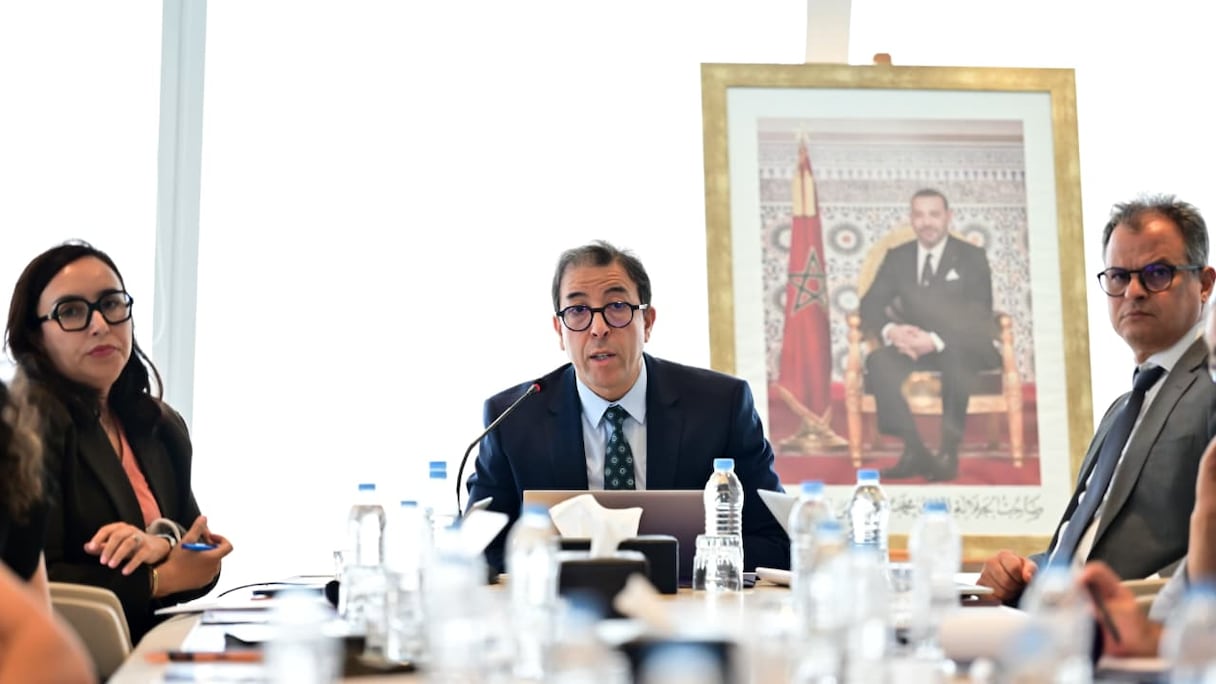
Bank Al-Maghrib (BAM) unveiled the 22nd edition of its annual banking supervision report on Tuesday in Casablanca, covering the 2025 financial year. The report reviews the central bank’s regulatory and supervisory activities, as well as developments across Morocco’s banking and credit institution sector.
Speaking during the presentation, Nabil Badr, Director of Banking Supervision at Bank Al-Maghrib, said the combined profits of conventional banks increased by 22%, while participatory banks, which have remained profitable since 2023, continued to improve their financial performance. Against this backdrop, the central bank renewed its call for prudence in the distribution of 2025 dividends in order to reinforce the sector’s resilience.
The report shows that Morocco’s banking system expanded slightly in 2025, growing from 92 to 95 institutions. The sector continues to be dominated by 24 banks, including five participatory banks, which account for 82.1% of total sector assets. The remainder consists of 30 finance companies, representing 6.7% of total assets, six offshore banks (2.1%), ten microcredit associations (0.5%), and 20 payment institutions, whose numbers continued to grow.
In terms of market share based on assets, privately owned Moroccan banks remain dominant with 73.2%, followed by majority state-owned banks at 22.1% and foreign-owned banks at 4.7%. Asset concentration among the three largest banks edged down from 61.9% in 2024 to 61.2% in 2025, while the five largest banks maintained a stable 76% share.
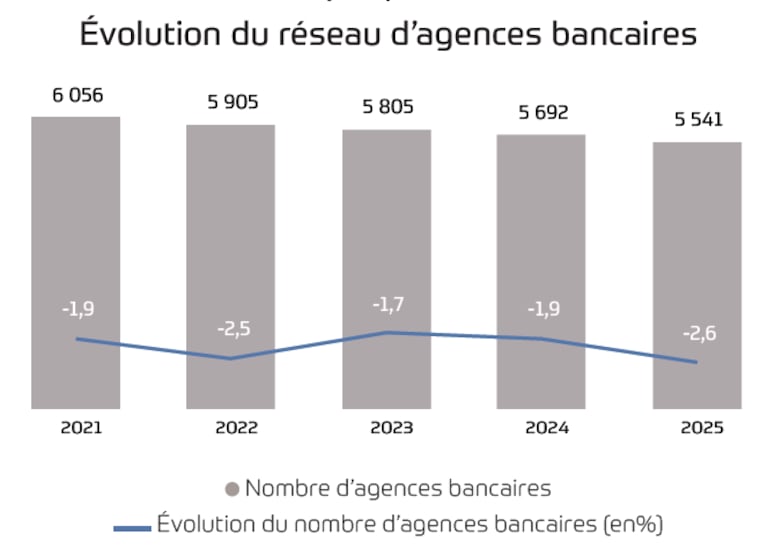
The branch network continued to shrink as digital banking gained ground. The number of bank branches fell by 151 to 5,541, while the microfinance sector reduced its network by 26 outlets, leaving 1,647 branches nationwide.
Digital and alternative banking channels, however, continued their rapid expansion. The number of automated teller machines rose by 201 to 8,298, while the network of payment institution agents grew by 2,116, reaching 34,337 agents by the end of 2025.
Banking penetration continues to rise
The proportion of resident adults holding at least one bank account increased by four percentage points during the year, rising from 58% to 62%.
The total number of bank accounts reached 39.8 million, an increase of 1.6 million over the year. These accounts are held by 19.3 million individuals, residents and non-residents alike, representing an increase of 800,000 account holders.
Payment accounts, driven by the expansion of payment institutions, recorded even stronger growth, reaching 16.3 million accounts, an increase of 2.5 million. Accounts with a MAD20,000 deposit ceiling, classified as Level 3, accounted for 39% of the total.
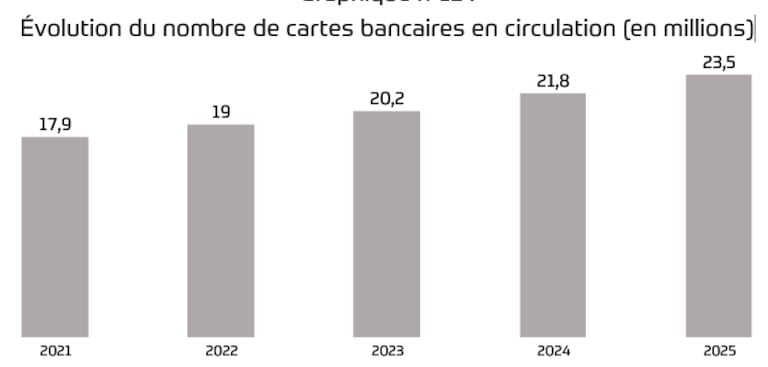
The number of bank cards in circulation rose by 7.7% to 23.5 million by the end of 2025. Cash withdrawals continued to dominate usage, representing 85% of transactions, compared with 86% the previous year.
Lending activity gathers momentum
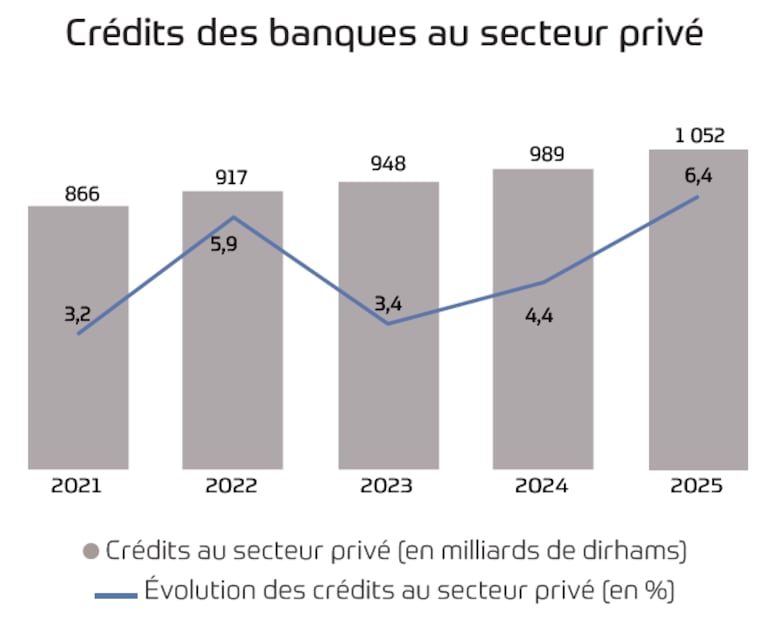
Outstanding bank lending reached MAD1.238 trillion by the end of 2025, representing annual growth of 6.5%, accelerating from 4.6% in 2024. The figures confirm the recovery that began in 2022 following the slowdown recorded in 2021.
Corporate lending was the main driver of growth. Outstanding credit to non-financial companies rose by nearly 20% to MAD579.2 billion, while household lending increased at a more moderate pace of 2.3% to MAD330.5 billion.
By loan category, investment lending recorded the strongest expansion, climbing almost 23% to MAD348.9 billion and emerging as the principal engine of credit growth in 2025. Loans to finance companies also rose sharply, increasing 15% to MAD76.6 billion, while consumer lending grew by 3.8% to MAD58.3 billion and housing loans by 1.5% to MAD225.9 billion.
By contrast, working-capital loans declined by 2% to MAD251.1 billion, while factoring receivables fell by more than 11% to MAD23.9 billion.
Customer deposits reached MAD1.372 trillion, up 7.6% year on year. Growth was driven primarily by current accounts, which increased by more than 10% to MAD1.006 trillion, while term deposits declined by more than 5% to MAD127.3 billion.
Government-backed lending programs also continued to support the economy. As of the end of May 2026, the Crédits Oxygène program had benefited nearly 33,600 businesses, with MAD8.2 billion disbursed and an outstanding portfolio of MAD5.3 billion.
The Intelaka program supported more than 34,500 businesses, with MAD12.8 billion disbursed and outstanding loans of MAD1.63 billion. Meanwhile, the Relance program assisted nearly 33,000 companies, disbursing MAD34.8 billion and maintaining an outstanding portfolio of MAD10.3 billion. Rural beneficiaries accounted for between 17% and 18% of participants across these schemes.
Bank profits surge
On a standalone basis, banks generated net banking income of MAD73.9 billion in 2025, up 8.7%, driven mainly by net interest income of MAD43.8 billion and fee income of MAD10.7 billion.
The cost of risk fell by more than 25% to MAD9.8 billion after increasing sharply in 2024.
Higher recurring revenues combined with lower provisioning costs lifted net profit by 22.2% to MAD19.2 billion.
Participatory banks continued their upward trajectory, with aggregate net profit doubling during the year to MAD199.4 million. Their combined net banking income reached MAD1.268 billion. The sector now comprises 210 participatory bank branches, nearly 297,000 accounts, MAD32.8 billion in participatory financing and MAD18.8 billion in deposits.
On a consolidated basis, Moroccan banking groups increased total assets by 7.6% to MAD2.597 trillion, while group net profit rose by 16.1% to MAD24.7 billion, reflecting solid performances both domestically and across international operations.
Domestic activities accounted for 68.4% of the consolidated earnings of Morocco’s three pan-African banking groups in 2025, up from 65% in 2023, while the contribution from sub-Saharan Africa eased slightly to 30.8%. These groups operate 1,659 branches abroad, including 1,520 in Africa. France remains their largest market outside the continent, with 23 branches.
Asset quality improves
The report notes a modest improvement in banks’ loan portfolios during 2025.
The non-performing loan ratio edged down to 8.26% from 8.38% a year earlier, with outstanding impaired loans amounting to MAD102.3 billion. The provisioning coverage ratio stood at 67.9%, slightly below the 68.7% recorded in 2024.
Capital adequacy indicators remained comfortably above regulatory thresholds. The average Tier 1 capital ratio stood at 13.5%, well above the required minimum of 9%, while the average overall capital adequacy ratio reached 16.1%, compared with a regulatory minimum of 12%.
Liquidity also remained strong, with the average monthly liquidity coverage ratio reaching 172% in 2025 against a regulatory minimum of 100%.
Exposure to leverage and interest rate risk within banking portfolios remained well contained. The regulatory leverage ratio improved slightly to 8.03%, up from 7.98% in 2024, while the interest rate risk indicator (IRRBB) improved to -7.22% from -7.92%.
The microfinance sector also closed the year in positive territory, reporting net profit of MAD164 million. Outstanding loans increased by 11.1% to MAD10.6 billion, although the number of beneficiaries slipped by 6,000 to 740,000. The sector’s non-performing loan ratio nevertheless increased to 4.8%.
Fifteen sanctions imposed in 2025
Bank Al-Maghrib carried out on-site inspections that resulted in 15 sanctions, including seven disciplinary measures and eight financial penalties affecting six banks, one finance company, one payment institution and one microfinance institution.
The inspections focused on corporate governance, cyber-risk management, anti-money laundering and counter-terrorism financing systems, asset quality and customer relations.
The year also saw significant progress in reforms designed to strengthen the framework for handling banking crises. On June 30, 2026, the House of Councillors gave final approval to legislation reforming Morocco’s bank resolution framework through Law No. 87.21, amending Laws No. 103.12 and No. 40.17.
The legislation designates Bank Al-Maghrib as the national resolution authority and establishes a Resolution College chaired by the BAM governor. The body will approve preventive resolution plans for credit institutions with the aim of safeguarding critical banking functions and protecting depositors.
The prudential framework governing distressed loans has also been strengthened through the introduction of a new intermediate category known as “sensitive loans.” In parallel, Bank Al-Maghrib established the prudential framework governing the National Enterprise Guarantee and Financing Company (SNGFE).
Climate, cybersecurity and digital finance
Bank Al-Maghrib published two directives on climate-related financial risks, contributed to Morocco’s national green finance taxonomy and expanded its cybersecurity dashboard to cover the entire banking sector.
On digitalization, the central bank released its Fintech Journey Guide and launched work on an Open Banking regulatory framework in partnership with the Moroccan Professional Banking Association (GPBM) and the World Bank. The interchange fee ceiling applied by the Interbank Electronic Banking Centre (CMI) was lowered to 0.50% in July 2026.
In the area of anti-money laundering and counter-terrorism financing (AML/CFT), the central bank intensified its risk-based supervisory controls ahead of Morocco’s third mutual evaluation by the Middle East and North Africa Financial Action Task Force (MENAFATF), scheduled for November 2026.
The number of complaints handled by Bank Al-Maghrib jumped 56.3% in 2025 to 3,591, while the Moroccan Banking Mediation Centre processed 6,674 cases, an increase of 31.3%.
The central bank also carried out mystery-shopping exercises at around 500 bank branches and strengthened fee transparency through its online bank charges comparison platform.
