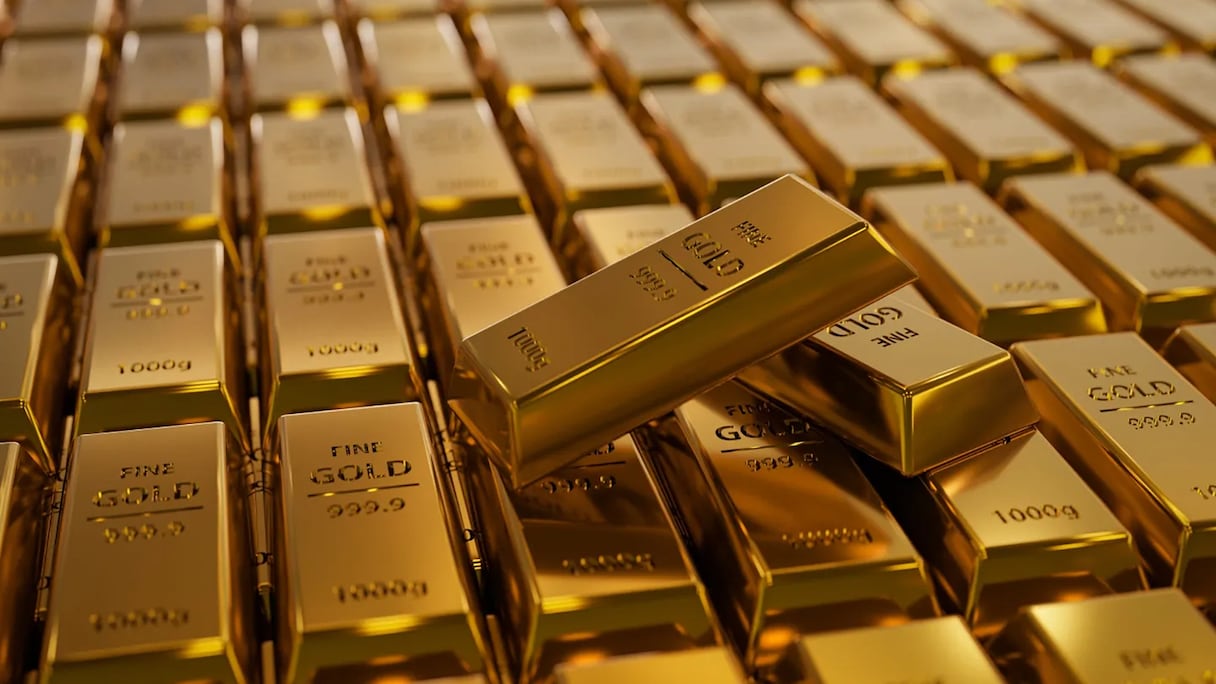
The market value of Bank Al-Maghrib’s gold reserves surged 49% in 2025, even as the central bank kept its holdings virtually unchanged, reflecting the sharp rise in international gold prices.
According to the central bank’s annual report, presented Monday to King Mohammed VI by Governor Abdellatif Jouahri in Tetouan, Morocco held 711,078 ounces of gold, or about 22.1 tonnes, at the end of 2025, broadly unchanged from the previous year.
The value of those holdings, however, climbed to MAD28 billion by the end of December 2025, up from MAD18.8 billion a year earlier.
The increase was driven entirely by higher gold prices. The value of one ounce of gold rose from MAD26,415 at the end of 2024 to MAD39,447 a year later.
The figures underscore Bank Al-Maghrib’s conservative approach to reserve management. Rather than increasing its gold holdings, the central bank has maintained a stable stock, unlike several central banks that have stepped up bullion purchases in recent years.
According to the latest rankings published by the World Gold Council, Morocco ranks 62nd globally in official gold holdings.
Its reserves remain well below those of regional peers, including Algeria (174 tonnes), Egypt (130 tonnes), Lebanon (287 tonnes), Saudi Arabia (323 tonnes), and Turkey (535 tonnes).
The United States remains the world’s largest official holder of gold with 8,133 tonnes, followed by Germany (3,350 tonnes), Italy (2,452 tonnes), France (2,437 tonnes), China (2,313 tonnes) and Russia (2,305 tonnes), based on World Gold Council data through the end of March 2026.
Speaking at an earlier press briefing, Jouahri said Morocco’s gold reserves remain consistent with international standards.
“Bank Al-Maghrib follows common international practice in managing its reserves,” he said.
He explained that the central bank’s reserve management strategy is built around three priorities: security, liquidity and return.
Security comes first, with investments concentrated in low-risk assets typically rated AAA or AA. Liquidity is the second priority to ensure reserves can be mobilized quickly when needed, while return ranks third.
Jouahri also noted that although gold is considered a safe-haven asset, it is less flexible than foreign currencies because it cannot be deployed as readily for immediate interventions in the foreign exchange market, limiting its usefulness during periods of market stress.