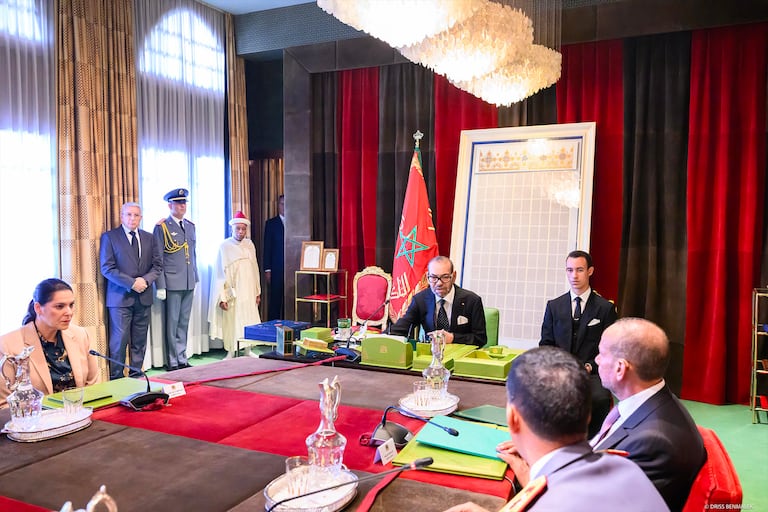
Morocco is taking another major step towards establishing its own defense industry. The working session chaired by King Mohammed VI at the Royal Palace in Rabat on Wednesday, November 18, marks a further milestone in the development of this strategically important sector.
The ambition goes well beyond supplying the Royal Armed Forces and security services. The aim is to establish an industrial and technological base capable of designing, manufacturing and maintaining equipment while developing domestic expertise and securing a place in international value chains.
The initiative builds on Morocco’s broader industrial strategy. Drawing on the Kingdom’s achievements in automotive manufacturing, aerospace and electronics, it seeks to move the economy towards industries with greater technological sophistication and higher added value.
An undertaking that began in 2020
The foundations were laid with Law No. 10-20, adopted in 2020, governing defense and security materiel and equipment, weapons and ammunition. This legislation established the regulatory framework needed to develop an industry that had previously depended heavily on foreign supplies.
The new roadmap is intended to take the country beyond legislation and towards a fully fledged industrial ecosystem. It will encompass the entire value chain, from research and development to design, production and integration, as well as maintenance, testing and storage.
There is a strategic imperative, too. By developing its own industrial and technological capabilities, Morocco hopes to reduce its reliance on foreign suppliers for certain equipment, components and technologies considered essential to national security. The expansion should also encourage technology transfers, research and innovation, with potential benefits for civilian industries.
Read also : Morocco’s 2027 budget: How defense spending breaks down
The strategy rests on several complementary mechanisms. The first is a dedicated strategic agency responsible for setting the sector’s direction and supporting investors. Among its tasks will be facilitating industrial projects and ensuring that the various elements of the strategy work together.
The second pillar is an industrial holding company designed to organize industrial ecosystems, mobilize public and private capital, and foster the emergence of national industry leaders. The objective is to move beyond a collection of individual projects and build an integrated industrial base capable of meeting domestic needs while competing in export markets.
The third pillar is skills development, centered on a specialist defense industry academy. Working closely with manufacturers, the academy will provide advanced training and draw on civilian and military expertise, as well as the skills of Moroccans living abroad.
The expertise accumulated within the Royal Armed Forces will be an important asset in this endeavor. Bringing that knowledge together with businesses and research institutions should facilitate the transfer of expertise and the development of solutions tailored to the country’s needs.
From Nouaceur to Benguerir: A new industrial geography
The geographical expansion of the industry forms the strategy’s fourth pillar. Two defense industrial acceleration zones have already been launched in Nouaceur and Sidi Yahya. Two further large-scale zones are planned for Benguerir and Benslimane.
These sites are intended to provide the infrastructure and operating conditions needed to attract investors and develop specialized manufacturing activities. They will also broaden Morocco’s industrial footprint, spreading investment into new economic centers.
Beyond their industrial purpose, the zones will play a role in regional development by creating skilled jobs and nurturing local expertise. The government also intends to streamline investment procedures and encourage greater participation by Moroccan private-sector businesses.
Read also : U.S. congressional delegation led by Mike Rogers discusses defense cooperation in Morocco
Several projects show how the strategy is gradually moving from planning to implementation. These include the production of WhAP 8x8 armored vehicles in Berrechid, the manufacture of 30mm turrets for those vehicles within the Nouaceur industrial ecosystem, and the production of medium- and large-caliber ammunition in Sidi Yahya.
Drones are another growing area, with manufacturing and maintenance projects under development in Benslimane. Other initiatives focus on research and development, autonomous systems, technology integration and counter-drone capabilities.
These initial investments are intended to lay the foundations for a broader industrial network bringing together manufacturers, subcontractors and Moroccan suppliers. A central challenge will be enabling domestic companies to take on an increasingly substantial role in production, rather than remaining confined to final assembly.
The technologies that will shape tomorrow’s industry
The roadmap identifies several priority sectors. Drones and autonomous systems, land and naval systems, defense electronics, cyberdefense and artificial intelligence are all expected to shape future investment.
These fields are particularly attractive because of their dual-use potential, serving both military and civilian purposes. Expertise developed in electronics, software, artificial intelligence and autonomous systems can also find applications elsewhere in the economy.
Success, however, will depend on Morocco’s ability to develop its own engineering, design and research capabilities. Having strengthened its appeal to foreign investors and established itself within international production chains, the Kingdom now wants greater control over the technologies embedded in equipment manufactured on its soil.
Read also : DGSN and Dubai Police join forces against terrorism and cross-border crime
Financing is another decisive element. The Hassan II Fund for Economic and Social Development will contribute four billion dirhams towards implementing the strategy.
The funding will support infrastructure development and industrial projects as part of a wider framework designed to attract Moroccan and international private investment. The new industrial holding company will be tasked, in particular, with helping to structure projects and mobilize the necessary financing.
Strategic and technological partnerships will also be central to the effort. Beyond providing capital, these alliances are expected to facilitate knowledge transfers, access to new technologies and the integration of Moroccan businesses into global value chains.
The defense industry therefore has an economic and industrial diplomacy dimension. By building on its existing industrial strengths and the experience of the Royal Armed Forces, Morocco intends to deepen its strategic partnerships, open up new markets and expand its international standing in the sector.
By 2035, Morocco aims to create nearly 50,000 direct and indirect jobs, meet approximately 40% of the requirements of the Royal Armed Forces and security agencies, and generate more than 65% of the sector’s revenue from exports.
These targets reflect the ambition to make defense manufacturing a new engine of economic growth and industrial diversification. The challenge will be to move beyond simply establishing factories and progressively develop homegrown capabilities in design, research and technological know-how.