PAM wants to start bringing more of the informal economy into the formal system from 2027, but Fouzi Lekjaa says businesses should not mistake that for another tax drive.
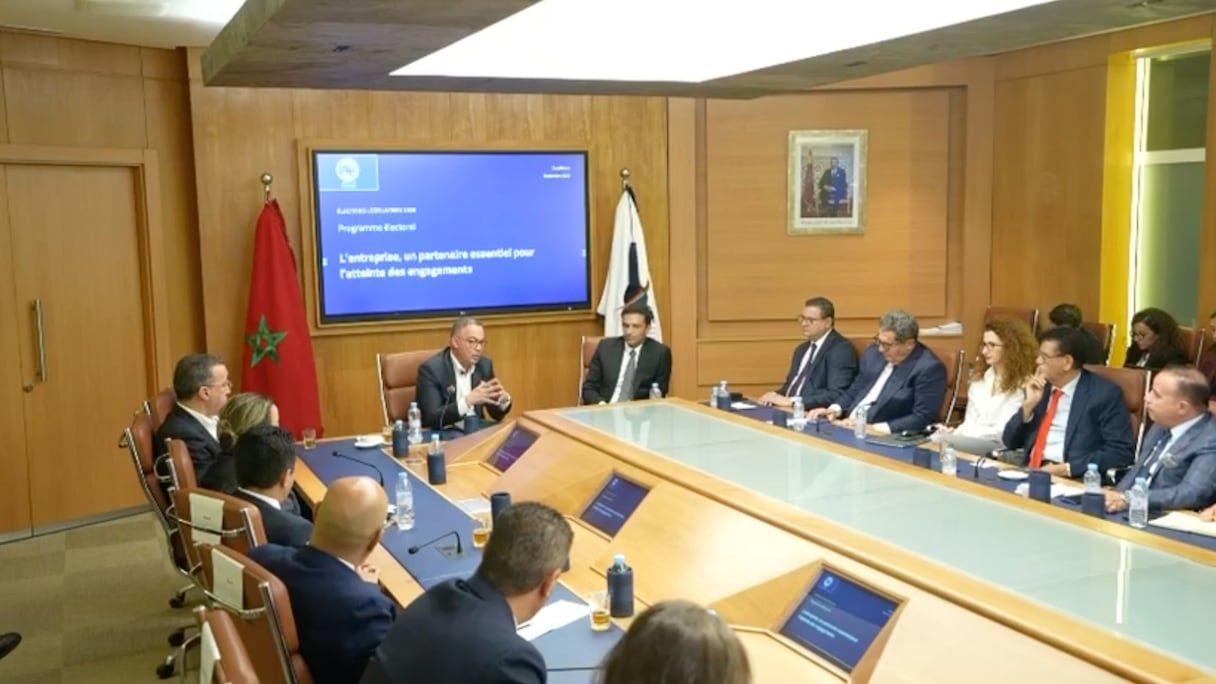
“We don’t want to tax the informal sector, we don’t want to gain tax revenue from it,” the PAM political bureau member told the CGEM on Thursday as he set out the economic side of the party’s program for the September 23 elections.
The idea, he said, was to give operators “a clear and transparent framework” in which to work, while opening the door to subsidies and incentives that could help them develop their businesses.
PAM wants the process to begin through the 2027 Finance Law and go hand in hand with greater use of banks and electronic payments as part of a broader target for 2030.
For Lekjaa, however, it is the private sector rather than the state that should do much of the pulling.
“For us, business is a conviction, an essential partner,” he said, describing the private sector as the “locomotive” for development, wealth creation and jobs.
The state’s role, in that arrangement, would be to create the conditions in which private investment can grow.
Lekjaa told business leaders this was not a position PAM had discovered for the election campaign. He pointed to the country’s heavy public investment in recent years—which he said had risen by MAD110 billion over the period he cited—while arguing that the next step required a stronger role for private capital.
He cited transport links between Marrakech, Fez and Meknes and better connections to airports among areas where further work was needed. Air traffic, he said, had already reached 36 million passengers and could rise further as airports are renovated ahead of the World Cup.
There were bigger sums on the social side.
Lekjaa put the budgetary effort devoted to social policies at MAD280 billion, while noting that the health budget had risen from MAD19 billion to MAD42 billion and education spending from MAD58 billion to MAD97 billion.
But he questioned whether spending alone was enough. In education, he pointed to a target set around two decades ago for the private sector to account for 25pc of provision. Its share today, he said, was only 13pc.
Lekjaa said the reasons for that gap needed to be examined, including the incentives offered to private operators, the rules governing the sector and the question of fees.
Social protection posed a different problem. Farmers, artisans and seasonal tourism workers, he argued, could not always be treated like workers with a regular monthly income.
Those unable to afford their contributions should have them covered by the state, he said, while those with sufficient means should pay their own way.
Lekjaa also took aim at what happens between producers and consumers—and particularly at the money made by intermediaries along the way.
Using agricultural produce as an example, he questioned how a product bought from a farmer could reach consumers at several times the original price.
“There is no trade that absorbs five times the value of the investor,” he said, contrasting such margins with those found in the distribution of products such as milk and soft drinks.
For Lekjaa, the person putting up the money and taking the risk should remain at the heart of the economic equation.
Employment brought another set of figures. He put labor force participation at 69pc for men but only 19pc for women, describing the gap as one of the country’s major challenges.
He also cited nearly three million young people who are “outside the system," as PAM looks for ways of dealing with youth unemployment and economic exclusion.
Lekjaa said the party’s 46-page manifesto was drawn from around 1,200 pages of work, including simulations and modelling. The fuller work, he added, would be shared with the CGEM and other political parties for discussion and possible changes.
