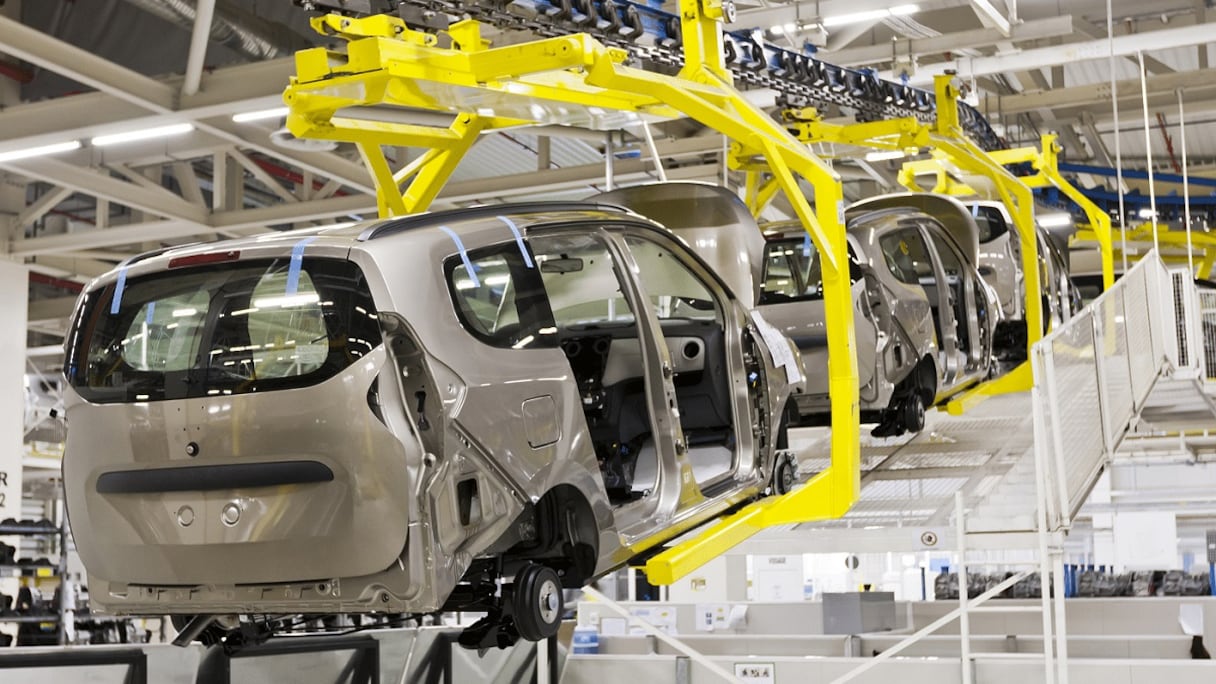
Renault Group produced nearly 200,000 vehicles at its Moroccan manufacturing plants during the first half of 2026, maintaining stable output while reinforcing the Kingdom’s position as one of the automaker’s key global production and export hubs.
The French carmaker’s factories in Tangier and Casablanca assembled a combined 199,948 vehicles between January and June, a marginal increase of 0.1% compared with the same period last year, according to Renault Group Morocco.
The performance reflects the resilience of the group’s industrial operations in Morocco and their ability to serve both international markets and growing domestic demand.
Read also : Morocco’s automotive exports reach MAD 93.65 Billion
Morocco remains an export powerhouse
Renault’s Tangier plant, the group’s largest manufacturing site in Africa, produced 151,493 vehicles during the first six months of the year. Of those, 143,862 vehicles, or 95% of production, were exported.
Meanwhile, the SOMACA plant in Casablanca assembled 48,455 vehicles, with exports accounting for 23,396 units, or 48% of total output, while continuing to supply Morocco’s domestic market.
Overall, Renault exported 167,258 vehicles from Morocco during the first half of 2026, representing 84% of production across both factories.
Morocco takes on greater engineering role
Beyond production volumes, Renault highlighted a significant milestone in the evolution of its Moroccan operations.
The first half of the year saw the launch of production for the renewed Dacia Sandero, Sandero Stepway, Logan and Jogger ranges.
For the first time, Moroccan engineering teams were responsible for developing and building the prototype vehicles before they entered mass production. The achievement followed a training program involving more than 1,000 employees, reflecting the country’s expanding engineering capabilities within Renault’s global manufacturing network.
The group’s electrification strategy will also gain momentum later this year when the Tangier plant begins production of the hybrid version of the Dacia Sandero, further strengthening Morocco’s role in Renault’s transition toward lower-emission vehicles.
Read also : Renault to produce the new hybrid Dacia Sandero in Morocco
Expanding local supply chains
Renault said it continues to deepen its industrial ecosystem in Morocco through a growing network of local suppliers.
Local sourcing reached €2.5 billion in 2025, up 4.5% from the previous year, while the local integration rate—excluding mechanical components—rose to 67.3%.
Under the second phase of its industrial ecosystem strategy, Renault aims to increase local sourcing to €3 billion and raise the local integration rate to 75% by 2030.
Market leader in Morocco
Renault Group also retained its position as the leading automotive manufacturer in Morocco during the first half of 2026.
In a national market that expanded by 17.6%, the group sold 49,820 vehicles, capturing a 37.8% market share.
Dacia remained Morocco’s best-selling automotive brand with 27,140 vehicles sold, an increase of 15.2%, giving it a 20.6% share of the market.
Its flagship models dominated sales rankings, with the Logan leading the market at 10,901 units, followed by the Sandero with 10,020 units, while the Duster ranked seventh with 3,982 vehicles sold.
The brand also recorded a monthly sales record in June, delivering 6,400 vehicles.
Renault retained second place nationally with 22,680 vehicles sold, up 11.8%, representing a 17.2% market share.
The brand’s strongest performers included the Renault Express, Morocco’s third best-selling vehicle overall with 7,065 units, followed by the Clio (6,928) and the Kardian (5,390).
Renault also ranked second in Morocco’s light commercial vehicle segment, with a 13.1% market share and 1,965 units sold, led by the Express Van, Master and Trafic.
The group introduced four new Renault models during the first half of the year—the New Master, New Captur, New Clio and New Rafale—and plans to continue expanding its lineup later in 2026 with the launch of the Renault Boreal, a new C-segment SUV developed under the company’s International Game Plan.
