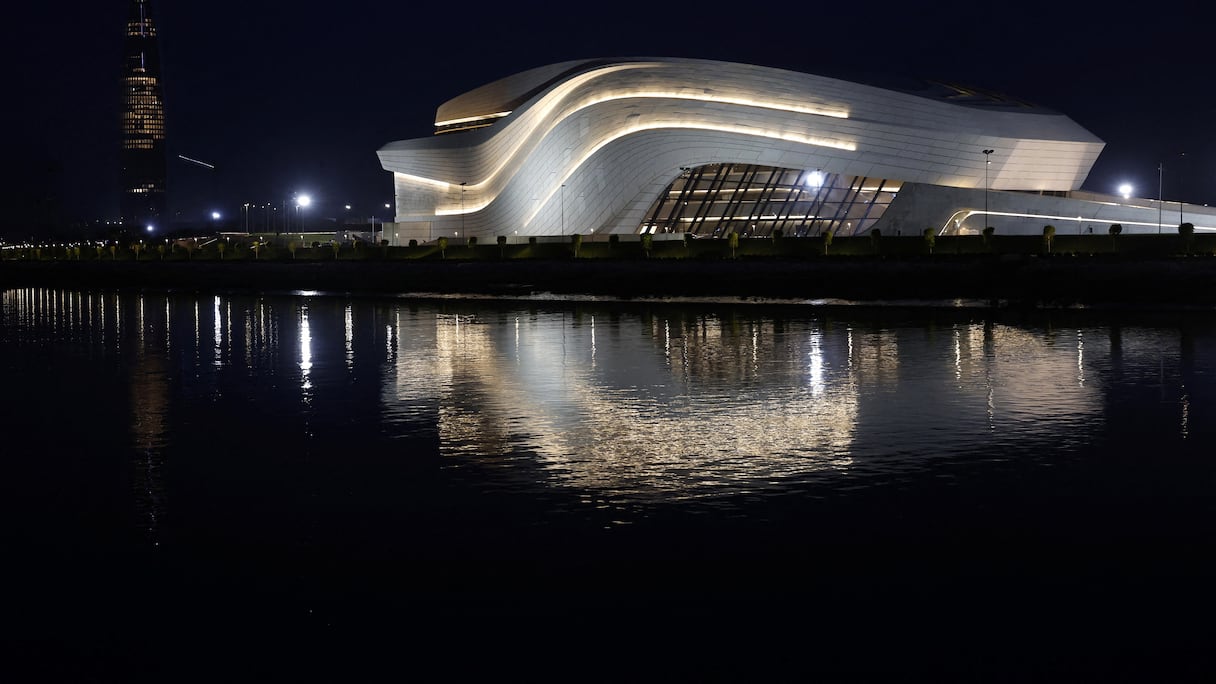
The New York Times has spotlighted the Rabat Royal Theatre, describing the landmark—built under the vision of His Majesty King Mohammed VI—as an iconic cultural institution that elevates Morocco’s capital into an elite group of must-visit global cultural destinations.
Designed by the late Iraqi-British architect Zaha Hadid, the theatre stands on the banks of the Bouregreg River, where, according to the newspaper, its sweeping curves resemble “a swelling wave” flowing over the performance halls before descending toward an entrance that opens into spaces reminiscent of canyon walls.
In the feature, architecture critic Joseph Giovannini praised the building’s interior, pointing to its ribbon-like staircases that climb four-story walls and opera boxes overlooking a crystal-shaped auditorium. The design, he wrote, extends “the scenography beyond the stage itself.”
Quoting Ibrahim El Mazned, deputy general manager and artistic director of the Rabat Royal Theatre, The New York Times said the venue reflects Morocco’s commitment—under the vision of King Mohammed VI—to culture and the creative industries as drivers of development, while strengthening cultural exchanges with Africa and the rest of the world.
The newspaper noted that the theatre aims to serve as an international platform for Moroccan, Arab, and African music, dance, and theater, alongside major global productions.
Read also : Nike dresses the Air Force 1 in Morocco’s colors with its new “Family Reunion” edition
According to The New York Times, the Rabat Royal Theatre now joins a select group of world-renowned cultural landmarks—including the Guggenheim Museum in Bilbao, designed by Frank Gehry, and the opera houses of Sydney and Oslo—that have helped establish their cities as major destinations on the global cultural map.
Giovannini also observed that while Morocco has long been celebrated for its rich architectural heritage, the country is now firmly embracing 21st-century design. He highlighted the use of advanced digital design software and 3D modeling technologies, which made the theatre’s complex curves and ambitious engineering possible.
The article concludes that Hadid, the first woman to receive the prestigious Pritzker Architecture Prize, designed the Rabat Royal Theatre at the height of her career. It describes the venue’s indoor and outdoor performance spaces as the culmination of her artistic vision, made possible through technological innovation, giving the ultra-modern building the appearance of “a Brancusi-like sculpted environment”—a reference to the pioneering 20th-century modernist sculptor Constantin Brancusi.
