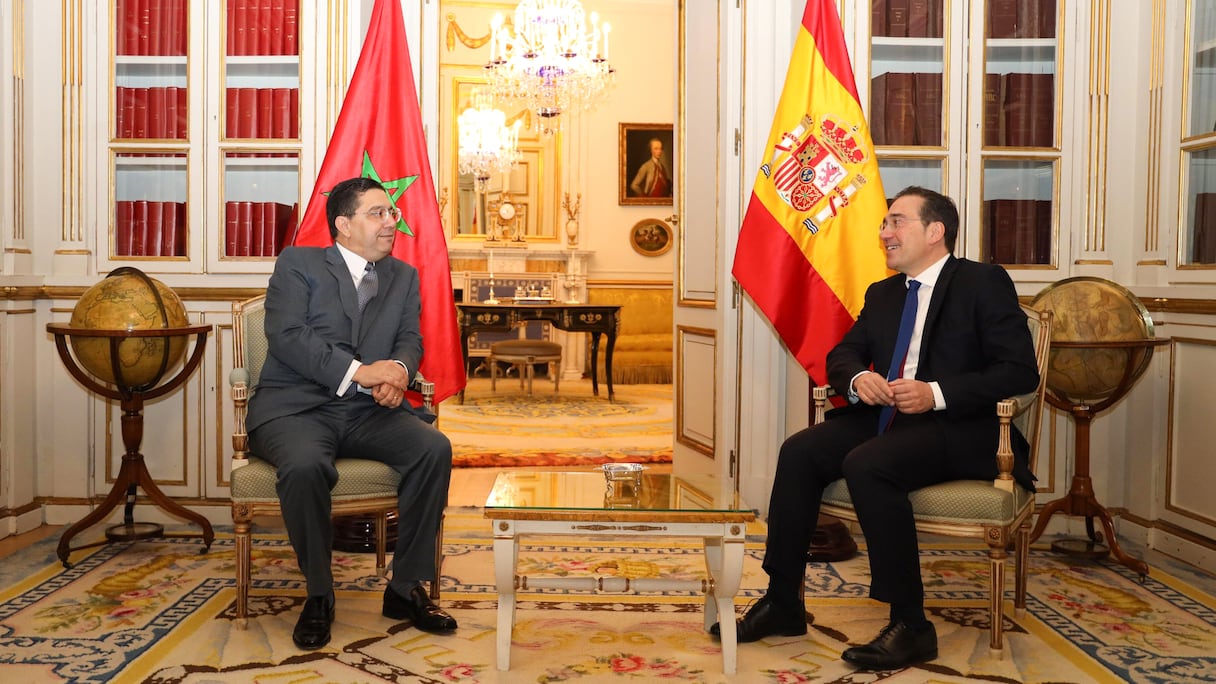
At a time when geopolitical balances in the western Mediterranean are under close scrutiny, an overwhelming majority of Spaniards are calling for stronger ties with Morocco, which they consider essential to stability and border security. This is one of the key findings of the latest poll published by the Center for Sociological Research (CIS).
Established in 1995 as a successor to the Public Opinion Institute founded in 1963, the Center for Sociological Research is a Spanish public institution attached to the Presidency of the Government and the Ministries of Justice and Relations with the Cortes. It is responsible for the scientific study of Spanish society and regularly conducts public opinion surveys, as well as monthly and thematic polls. Its data provide an essential political and social barometer for assessing citizens’ views on major national and international issues.
Cooperation with Morocco becomes a strategic priority
Conducted among 4,042 people at the beginning of September, the CIS study highlights a clear consensus within Spanish society: 86.3% of respondents attach “a lot or quite a lot” of importance to maintaining good relations with Rabat, while only 10.1% attach little or no importance to them.
Read also : Morocco-Spain relations: Morocco refuses to be made a scapegoat in political score-settling
This pursuit of calm and stability is directly reflected in security policy. The need to strengthen border surveillance enjoys broad support, with 82.2% of respondents considering the measure necessary. Faced with migration challenges, citizens are also turning to Brussels: 89.4% are calling for greater involvement by the European Union to support the Spanish government in managing the crisis in Ceuta.
The status of Ceuta and Melilla: between rootedness and voices of ambiguity
While Spanish sovereignty remains overwhelmingly supported, with 77.1% of respondents reaffirming that Ceuta and Melilla are “just as Spanish as any other region” of the country, the question of their geopolitical particularity remains divisive.
A significant proportion, 14.3% of those surveyed, considers the two cities to have an “ambiguous and special” status. For this segment of public opinion, their particular status cannot be ignored and calls for consultations and direct agreements with Rabat, with a view to calming or institutionalizing this dual border reality.
The poll also reveals a climate of mistrust surrounding regional dynamics. For 67.7% of participants, an invisible hand or an outside force sought to worsen bilateral relations between Madrid and Rabat. These figures paint a picture of Spanish public opinion toward an unavoidable neighbor, caught between the need for pragmatic cooperation and the persistence of complex territorial sensitivities.
