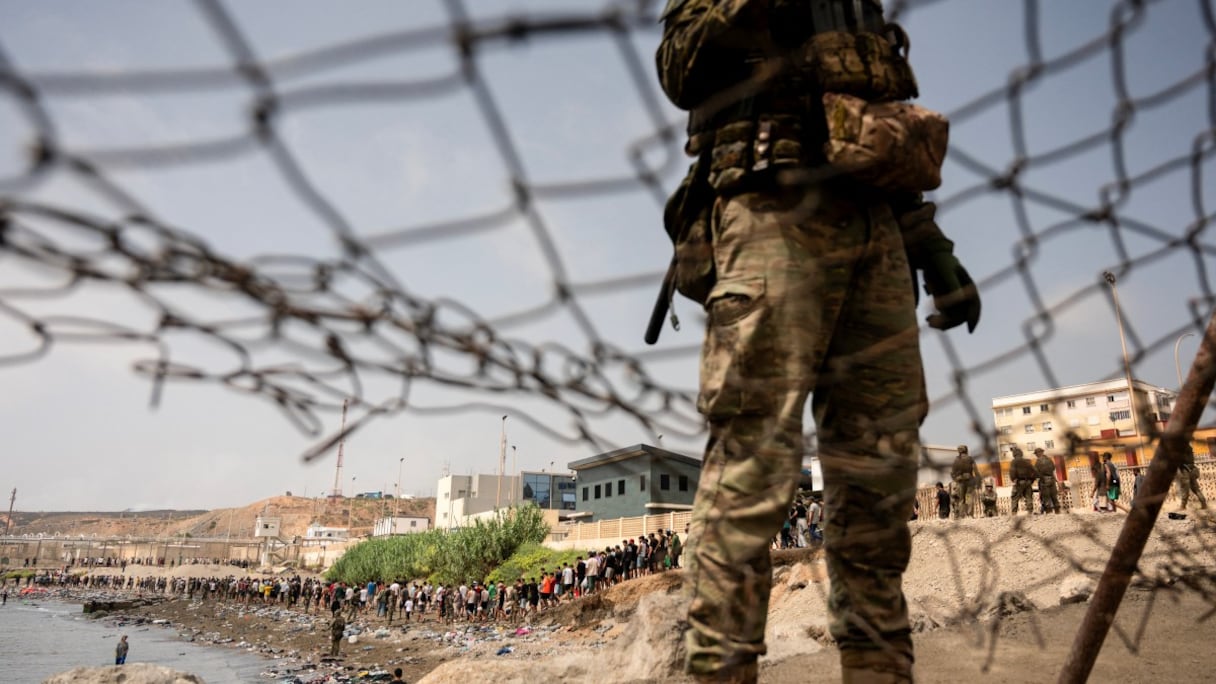
The accusations were categorical. The evidence, however, remains nowhere to be found. After several months of investigation, Spain’s National Intelligence Center (CNI), the country’s principal intelligence agency, says it has found nothing that would allow it to attribute the organization of the mass arrivals of migrants in Ceuta on July 30 and 31 to the Moroccan authorities.
That conclusion appears in a report submitted to the Audiencia Nacional, a Spanish court with jurisdiction over cases of national significance, which is investigating the events.
“To date, no evidence has been obtained” establishing that the mobilization was “instigated, planned or coordinated” by Morocco, the document states. According to Spanish intelligence, calls to travel to Ceuta circulated on social media, but investigators were unable to identify a single organizer.
These findings shed important light on a controversy that had taken on considerable political significance in Spain. Above all, they warrant a closer examination of how the accusations against Rabat originated and how certain police hypotheses were presented to the public.
How a police hypothesis became an accusation against Rabat
It all began in September, when the Spanish newspaper El Español published information drawn from a report by the National Center for Immigration and Borders (CENIF), a division of Spain’s National Police. The newspaper presented the document as establishing that Moroccan forces had planned and carried out the migrant crossings into Ceuta.
Yet the report referred, in particular, to the possibility of migrants having received “active guidance,” a hypothesis that was not, in itself, sufficient to establish the existence of an operation organized or coordinated by the Moroccan authorities. The distinction is crucial.
That nuance did not prevent the controversy from escalating. The interpretation published by El Español fuelled a political offensive targeting both Morocco and Pedro Sánchez’s socialist government.
The People’s Party (PP), Spain’s main right-wing political party, demanded the resignation of the interior minister and the holding of early elections. Podemos, a radical-left party, also called for explanations and measures against Rabat.
But this interpretation of events was quickly challenged by the leadership of Spain’s National Police itself. Francisco Pardo, its director-general, clarified in a communication addressed to the interior minister that no police report attributed the planning or execution of the events in Ceuta to Moroccan forces.
He also clarified the nature of an alert issued by CENIF on July 29. Contrary to what had been suggested, it was not a specific warning of an impending mass arrival of migrants but a routine risk notification.
Read also : Ceuta affair: Documents meant to shed light only add to the confusion
Documents subsequently declassified by the Spanish government likewise failed to substantiate the accusations against Morocco.
Among the roughly 40 reports and communications made public were CNI intelligence notes referring to calls for mobilization on social media. Some of the groups concerned had as many as 180,000 followers.
That figure had itself fuelled the controversy. La Moncloa, the seat of the Spanish prime minister’s office, had to clarify that it represented the potential reach of the messages being circulated, not an estimate of the number of people likely to travel to Ceuta.
In other words, the fact that Spanish intelligence services had detected calls for mobilization did not establish who was behind them, still less that Morocco had organized them.
It is precisely on this point that the CNI’s latest report now provides an answer. At the conclusion of its investigations, Spanish intelligence says it has found no evidence establishing that the Moroccan authorities instigated, planned or coordinated the migrant movements of July 30 and 31.
In September, the involvement of the Moroccan authorities was presented as a certainty, triggering a political storm in Spain. Two months later, the CNI finds that the evidence supposedly supporting that accusation has still not been found.
