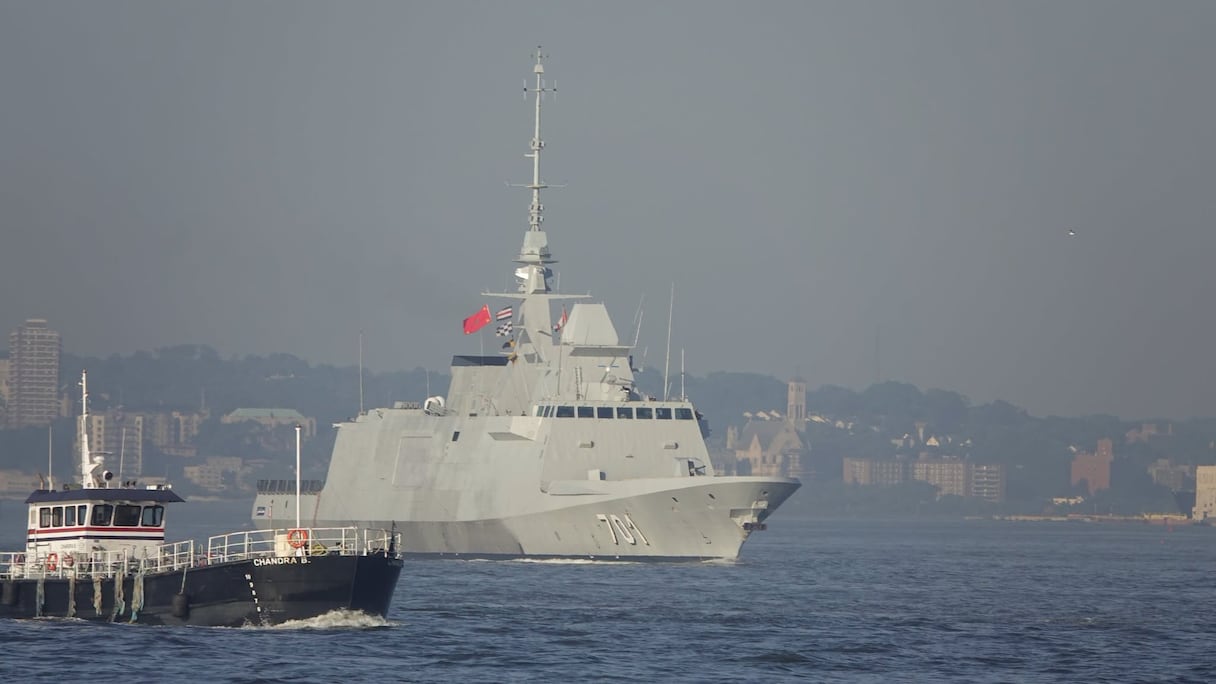
Anyone reading the October 12 article in El País about the Moroccan Royal Navy’s alleged violation of Ceuta’s “territorial waters” could easily come away believing that an exceptionally serious incident had taken place, that Morocco had acted with hostile intent towards Spain, and that Ceuta possessed territorial waters whose boundaries were clearly defined.
Yet a closer reading, informed by international law and the political and legal realities of the dispute between Morocco and Spain over the waters surrounding Ceuta and Melilla, reveals a succession of inaccuracies and insinuations. Crucially, the article offers none of the evidence needed to establish that Moroccan naval vessels actually entered Spanish territorial waters unlawfully.
The article’s central claim can be reduced to a single sentence: At least one frigate and several Moroccan Royal Navy patrol vessels allegedly sailed “in waters under Spanish sovereignty without requesting authorization.” The incident supposedly occurred in the weeks following the mass crossing into Ceuta in July.
According to subsequent reports, Madrid responded by reinforcing its naval presence around the city, notably with the arrival of the patrol vessel Rayo from Las Palmas on August 3, and by making high-level diplomatic representations to Rabat.
Those accounts also describe a narrowly avoided collision between Spanish and Moroccan patrol vessels, while the newspaper’s sources characterize the alleged incursions as “deliberate” and “repeated.”
On October 12, Spanish Prime Minister Pedro Sánchez told reporters that he broadly confirmed the published account, while stressing that communication between the two navies had been “very fluid” and that no similar incident had occurred since. But political confirmation is no substitute for a legal determination. And that is precisely the fundamental legal question El País fails to examine seriously.
A maritime boundary that has yet to be agreed
How can the journalist assert that Morocco violated Ceuta’s territorial sea while acknowledging that the waters surrounding the city have never been delimited by international agreement? At the very least, these two assertions require a legal explanation. The article provides none.
Admittedly, the absence of a bilateral maritime delimitation agreement does not necessarily mean that Ceuta has no territorial sea. Equally, however, it does not follow that every Moroccan naval presence in waters claimed by Spain automatically constitutes a violation of Spanish sovereignty. Establishing such a violation would require proof that the vessels entered a maritime area legally attributable to Spain, together with their precise coordinates and the applicable delimitation criteria.
The article supplies neither. Instead, it relies on anonymous sources whose characterizations of Moroccan intentions as “deliberate” and “repeated” are presented as established facts, when they are merely one side’s interpretation.
Put plainly, before accusing Morocco of violating Ceuta’s territorial sea, one must first demonstrate that Moroccan Royal Navy vessels actually entered waters legally falling under Spanish sovereignty. Yet the article itself acknowledges that the waters around Ceuta, like those around Melilla, have never been delimited through an international agreement with Morocco.
There is a reason for that. First, Morocco does not recognize Spanish sovereignty over the two enclaves and disputes the maritime claims arising from it. Second, that very sovereignty dispute explains why the two countries have never reached an agreement defining their respective territorial seas. This has direct implications for the legal assessment of the reported events. Yet the article leaves it out.
No one disputes that Ceuta can, in principle, generate a territorial sea of its own. But recognizing that entitlement also means taking account of its particular geography: an enclave whose coastline adjoins that of a sovereign state, Morocco, which likewise has the right to a territorial sea extending up to 12 nautical miles. This is a fundamental consideration that El País fails to address.
Under Article 15 of the 1982 United Nations Convention on the Law of the Sea (UNCLOS), to which both Morocco and Spain are parties, where the coasts of two states are adjacent or opposite each other, neither is entitled, unless they agree otherwise, to extend its territorial sea beyond a median line every point of which is equidistant from the nearest points on the two states’ baselines. The rule allows an exception where historic title or other special circumstances justify a different boundary.
In the absence of an agreement, as is the case with the waters surrounding Ceuta and Melilla in relation to Morocco, both states must therefore take this delimitation rule into account. This does not deprive either country of a territorial sea. It means that neither can unilaterally extend its boundaries beyond what international law permits. Importantly, the median line can serve as a legal reference even without a bilateral agreement. The absence of a treaty does not, therefore, necessarily make it impossible to determine whether a vessel’s entry into another state’s waters was lawful. But that determination requires the vessel’s exact position and an assessment of the relevant geographical and legal circumstances.
Spanish legislation follows the same principle. Article 3 of Spain’s Law 10/1977 of January 4 establishes a territorial sea extending 12 nautical miles. Article 4, however, expressly recognizes that, in relation to neighboring states, it cannot extend beyond an equidistant median line unless otherwise agreed. In other words, Spanish law itself acknowledges the limitation that the newspaper overlooks.
It follows that even if Morocco and Spain reached an agreement delimiting their respective territorial seas, there would be no basis for assuming that Ceuta would automatically enjoy a 12-nautical-mile territorial sea in every direction. Any delimitation would necessarily have to account for the proximity of Morocco’s coastline and the relevant rules of international law.
Thus, Ceuta’s ability, in principle, to generate a territorial sea by virtue of its geography does not give Spain an unrestricted right to determine all its boundaries unilaterally in relation to Morocco. Nor does it justify accusing the Moroccan Royal Navy of violating those waters without establishing exactly where its vessels were sailing and why the waters concerned should legally be regarded as Spanish.
That is the central weakness of the El País article. Before concluding that a violation occurred, it is necessary to determine whether the vessels actually entered waters legally attributable to Spain. The article fails to do so. Why did the journalist not publish a map showing the exact positions of the Moroccan Royal Navy vessels and the maritime boundary they supposedly crossed, according to the Spanish sources cited? Such information would allow readers to establish whether the alleged incursions really occurred in waters legally subject to Spanish sovereignty. Without it, readers are expected to accept a legal conclusion without being able to examine its basis.
Until Morocco and Spain agree on the delimitation of the maritime areas surrounding Ceuta and Melilla, the dispute over the extent of their respective claims will persist. Spain’s assertion of sovereignty over the two enclaves does not relieve it of the obligation to provide a legal justification for the maritime boundaries it regards as its own.
Prior authorization, transit passage and innocent passage
The El País article makes another problematic assertion. It claims that Moroccan Royal Navy vessels sailed “without requesting authorization in waters under Spanish sovereignty.”
First, before asserting that Morocco was required to seek permission, two things would have to be established: that the vessels were in waters legally belonging to Spain, and that the activities they were carrying out actually required such authorization. Spanish sovereignty over Ceuta does not, by itself, settle the question of where all the enclave’s adjacent maritime boundaries lie.
Second, geography is once again decisive. Ceuta lies on the southern shore of the Strait of Gibraltar, one of the world’s busiest international shipping routes. Under Part III of UNCLOS, vessels of all states, including warships, enjoy a right of transit passage through straits governed by that regime. This right provides broader protections than innocent passage, notably because the coastal state cannot suspend it. If the Moroccan vessels were simply transiting the strait, this regime would be relevant. The article offers no evidence to establish otherwise.
Moreover, even if Moroccan Royal Navy vessels were shown to have entered Spain’s territorial sea, international law recognizes the right of foreign vessels, including warships, to what is known as “innocent passage,” as provided for in Articles 17 to 26 of UNCLOS.
Innocent passage means navigation that does not prejudice the peace, good order or security of the coastal state. Article 19 of the Convention lists activities that may render passage non-innocent, including the threat or use of force, weapons exercises or manoeuvres, the launching or landing of aircraft or military devices, certain intelligence-gathering activities and other operations liable to compromise the coastal state’s security.
Yet El País does not specify the nature of all the maneuvers carried out by the Moroccan Royal Navy. Nor does it provide the information needed to determine whether any of those activities were incompatible with the right of innocent passage or capable of endangering Ceuta’s security. It is also worth recalling that UNCLOS does not generally require prior authorization for every instance of innocent passage by a warship, although some states maintain differing interpretations on this point.
That said, the right of innocent passage cannot be invoked to justify just any military manoeuvre. To qualify under this regime, navigation must comply with the conditions laid down by the Convention, including, as a general rule, the requirement that passage be continuous and expeditious. If Moroccan Royal Navy vessels conducted patrols, military manoeuvres or other activities incompatible with that right in waters legally attributable to Spain, the legal assessment would necessarily be different.
Even then, the Convention provides for a regulated and proportionate response. Under Article 30, where a warship fails to comply with the coastal state’s laws and regulations and disregards a request to do so, that state may require it to leave its territorial sea immediately. This is a far cry from the language of “invasion” and “violation” surrounding the episode. That is precisely why it is essential to establish exactly where the vessels were and what they were doing.
An allegation, not a legally established fact
Ultimately, the claim by El País that Morocco violated Ceuta’s territorial waters is not supported by a sufficiently substantiated legal case in the information the newspaper has presented. An accusation of this gravity requires the precise coordinates of the alleged incursions to be made public, an explanation of the applicable maritime delimitation rules, and evidence that the Moroccan Royal Navy vessels’ activities actually constituted a breach of international law.
As it stands, the article chiefly serves to fuel suspicions about Morocco’s intentions and encourage a confrontational narrative on the eve of King Felipe VI’s visit to Ceuta on October 13 and Melilla on October 14. This will be the first visit by a Spanish monarch to the two cities since Juan Carlos I travelled there in November 2007, prompting Rabat to recall its ambassador for consultations. The timing of the article’s publication inevitably raises questions about its political context.
There is, after all, a fundamental difference between reporting that, according to Spanish authorities, Moroccan Royal Navy vessels sailed in waters Spain considers to be under its sovereignty, and presenting that interpretation as legally established proof of a violation of Ceuta’s territorial sea.
The point is not to deny that Spain claims sovereignty over Ceuta, nor to dispute Madrid’s right to defend the maritime areas it considers its own. It is to insist on an essential distinction: a claim is not a legal finding. International law requires several fundamental questions to be answered in a logical sequence. Where exactly were the vessels? To which state were the waters legally attributable under the applicable delimitation rules? And what activities were the vessels conducting there?
The El País article answers none of these questions. It provides no geographical coordinates, no map, no delimitation criteria and no legal analysis. Instead, it relies on anonymous sources and employs the language of “violation” and “invasion” without the reported facts being sufficient to support either charge.
Ceuta and Melilla remain the most sensitive issue in relations between Rabat and Madrid. The waters surrounding them remain contested precisely because the underlying sovereignty dispute has never been resolved. Describing disputed maritime areas as though Spanish sovereignty over them were definitively established does nothing to settle their legal status. It merely hardens positions and encourages an escalation whose consequences neither Morocco nor Spain, nor the many communities living on either side of the Strait of Gibraltar, can afford.
If Spain believes its territorial sea has been violated, the serious course of action is to identify where the alleged violation occurred, produce the evidence and pursue the diplomatic and legal channels established specifically to resolve disputes of this kind. Publishing an account whose essential details remain impossible to verify, on the eve of a royal visit to the two cities, is no substitute for that process.
Until those fundamental questions are answered, the claim that Morocco violated Ceuta’s territorial waters will remain an allegation, not an established fact.
