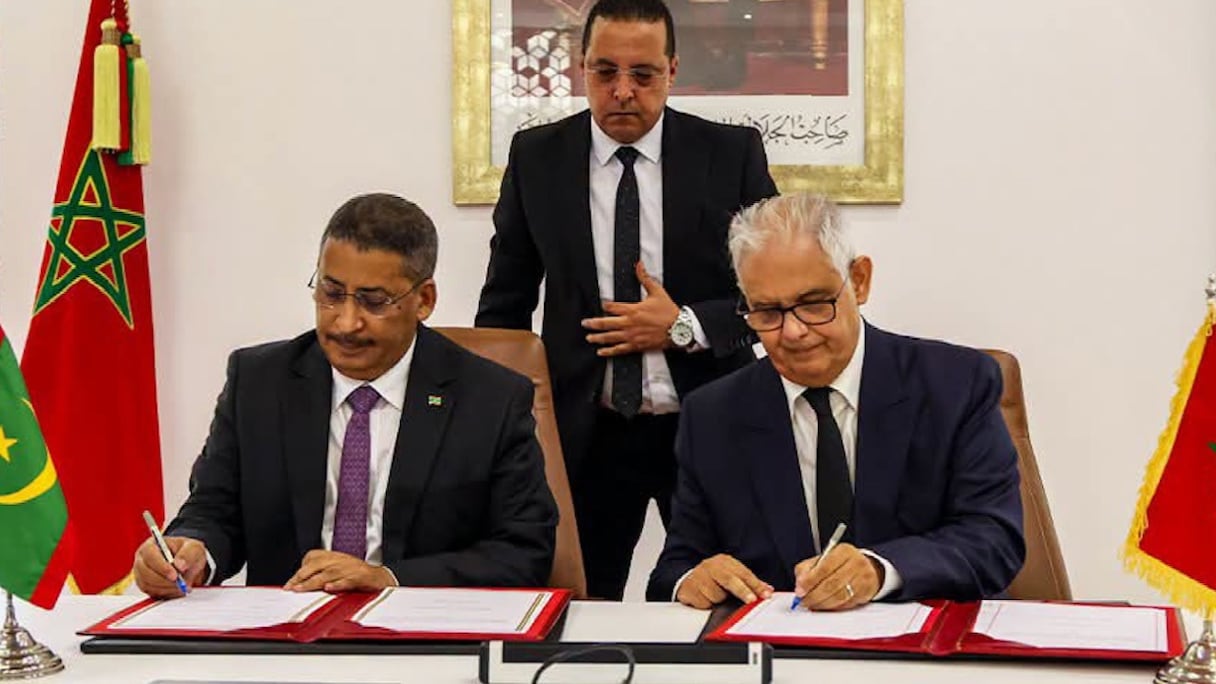
Equipment ministers Nizar Baraka and Ely Ould El Veirik signed an agreement in Rabat on Monday to rehabilitate and widen the road linking the El Guerguerat border crossing to the Mauritanian capital, Nouakchott, via Nouadhibou, the country’s economic capital.
Road networks between the two neighboring countries have been connected and secured since November 13, 2020, following an intervention by the Royal Armed Forces that restored the free movement of goods and people between Morocco, Mauritania and West African countries, putting an end to blockades by Polisario Front militias.
Read also : Morocco, Mauritania discuss road connectivity and strategic infrastructure projects
However, the heavy traffic the coastal road between Morocco and Mauritania has carried in recent years, with dozens and sometimes hundreds of trucks using it every day, has put a strain on the maintenance of this infrastructure stretching between sea and desert. The Morocco-Mauritania partnership was established to upgrade this section of the Tangier-Lagos route and rehabilitate the road from El Guerguerat to Nouakchott.
The framework agreement provides for an engineering consultancy, the mobilization of expertise from both countries, and a system to monitor and oversee the works. The agreement has received extensive coverage in the Mauritanian press.
The Zoom Info website described the framework agreement as one that “gives this road a regional dimension that goes beyond simple bilateral transport, creating a continuous land corridor linking Morocco, Mauritania and Senegal.”
Read also : Morocco, Vietnam veterans’ associations sign cooperation memorandum
The Mauritanian outlet noted that the road linking Nouakchott, Nouadhibou and PK55—the Mauritanian border post opposite El Guerguerat—runs for approximately 480 kilometres. It “represents the main overland artery for freight and passenger traffic between Morocco and Mauritania, while projects currently under way to the south [of Morocco] will extend the route towards Senegal.”
Zoom Info also said that once these projects are completed, “the contours of a strategic overland corridor will become clearly visible, linking Tangier to southern Morocco, then Nouadhibou, Nouakchott and Rosso, before reaching Saint-Louis and Dakar, thereby strengthening connections between North and West Africa through Mauritanian territory.”
The road is indeed a major regional artery, and its widening will complement road projects nearing completion in Morocco, where the Tiznit-Dakhla expressway running towards northern Mauritania is almost finished. At the same time, the motorway section linking Dakar to Saint-Louis, near Mauritania’s southern border, is nearing completion. Then there is the bridge being built across the Senegal River, which will further ease road transport between Mauritania, Morocco, Senegal and the rest of West Africa.
Read also : Morocco, Belgium sign agreement to expand triangular cooperation in Africa
Coming after the agreement on the road linking Smara to Bir Moghrein, Mauritania’s northernmost town, the new Morocco-Mauritania road deal is unlikely to go down well in Algiers. The Algerian regime has long maintained that Mauritania does not recognise the legality of the El Guerguerat crossing because no agreement between the two countries had ever been signed concerning it. Yet the crossing has established itself as a genuine economic lifeline for Mauritania, with a substantial share of the country’s imports now passing through it.
Indeed, in a futile attempt to compete with El Guerguerat—which Algiers has, for once correctly, viewed as tacit recognition by Nouakchott of Morocco’s sovereignty over the Sahara—the Algerian regime has multiplied its grand gestures through a string of projects with Mauritania that have gone nowhere. The border crossing between the two countries was stillborn, as was the free-trade zone. Even the Tindouf-Zouérate road, whose construction Algerian President Abdelmadjid Tebboune made a show of launching in February 2024 in the presence of his Mauritanian counterpart, who had travelled specially to Tindouf for the occasion, has itself been consigned to the mirages of the desert.
