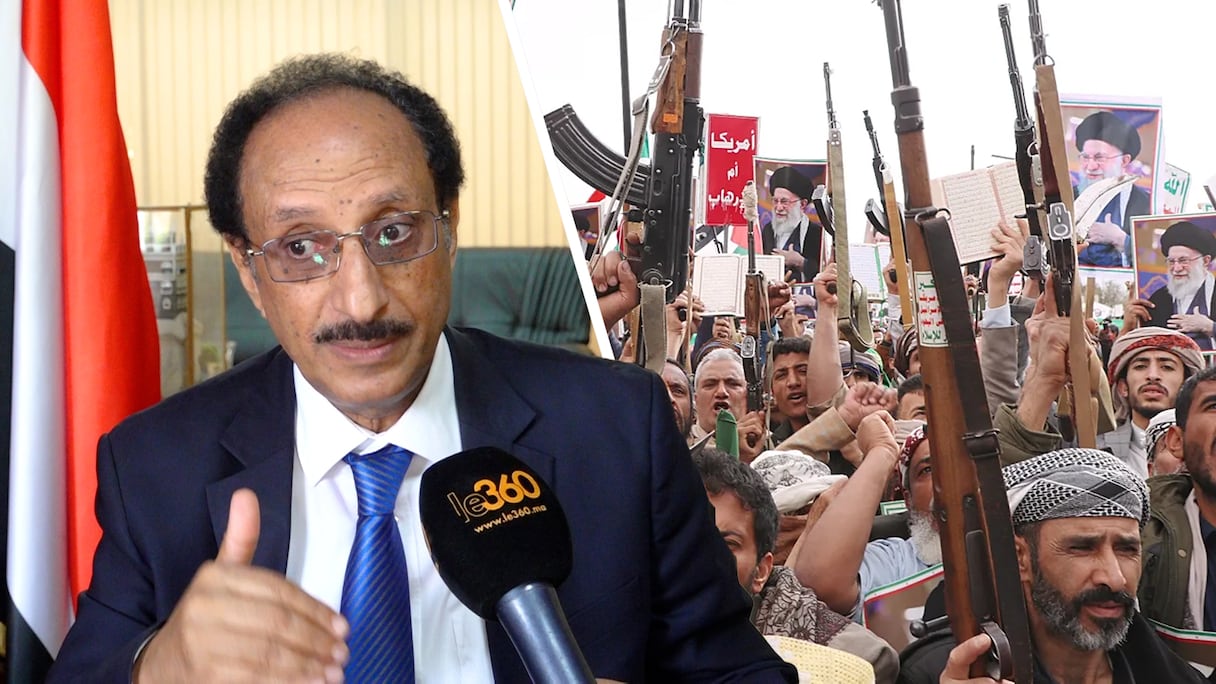
The Houthi takeover of Sanaa in September 2014 derailed Yemen’s political transition, according to Ezzadin Saeed Al-Asbahi, Yemen’s ambassador to Morocco. Speaking to Le360, the diplomat argues that restoring state authority and the government’s monopoly on the use of force are essential to any lasting, inclusive political settlement.
The transition, launched after the 2011 uprising, was intended to lead to a new constitution. With UN support, Yemen held a National Dialogue Conference between March 2013 and January 2014, bringing together the country’s main political and social groups, including the Houthis. The talks laid the groundwork for a federal state, although the territorial divisions proposed afterwards met resistance, particularly from the Houthi movement and southern representatives.
In September 2014, the Houthis, backed by army units loyal to former president Ali Abdullah Saleh, seized control of the capital. The conflict escalated further, prompting a Saudi-led coalition to intervene in March 2015 in support of the Yemeni government.
Al-Asbahi describes the takeover as a “forcible seizure of power against legitimate institutions” that undermined both the achievements of the National Dialogue Conference and plans for a federal state.
The Houthi movement, also known as Ansar Allah, or “Supporters of Allah,” takes its name from the Al-Houthi family, particularly Hussein Badreddin Al-Houthi, one of its founding figures. Emerging from the Zaydi religious revival in northern Yemen during the 1990s, it gradually developed into a political and military movement. Although rooted in Zaydism, a branch of Shia Islam, the movement does not represent all Zaydis.
Al-Asbahi, for his part, condemns what he describes as the movement’s “religious and sectarian” ideology, which he says rests on a claim to a divine right to rule. He argues that this vision is fundamentally at odds with Yemen’s religious, cultural and geographical diversity.
The ambassador also believes the Houthis’ ties with Iran have turned Yemen’s conflict into a regional confrontation. He accuses Tehran of supplying the movement with missiles and drones and using it to exert strategic pressure on neighboring countries and shipping routes through the Red Sea and the Bab el-Mandeb Strait.
UN experts have documented Iranian technical assistance and the supply of military components. Tehran, however, denies allegations that it has supplied weapons in breach of the arms embargo.
Read also : New book examines France’s longstanding blind spot on Iran
Al-Asbahi is equally critical of the results of previous peace initiatives, arguing that the Houthis have used periods of relative calm to strengthen their military capabilities.
The Stockholm Agreement, brokered by the United Nations in December 2018, provided for a ceasefire in Hodeidah, the redeployment of forces in the city and its ports, prisoner exchanges and arrangements concerning Taiz. It was not, however, a comprehensive peace agreement intended to end the war.
According to Al-Asbahi, military operations by government forces are aimed at restoring state authority and its monopoly on the use of force, paving the way for a renewed, inclusive political process. He also reaffirms his support for a federal system of government.
Morocco: A partner and a model
Turning to bilateral relations, the ambassador describes ties between Yemen and Morocco as “historic, strong and exemplary.” He points to Morocco’s support for Yemen’s internationally recognized government, as well as the country’s unity and sovereignty. In return, he says, the Yemeni authorities reaffirm their support for Morocco’s territorial integrity and sovereignty over the Sahara.
Read also : Oil prices surge more than 5% after Trump says Iran ceasefire is over
Beyond political dialogue, Al-Asbahi says Yemen is keen to draw on Morocco’s experience in transitional justice, reconciliation and advanced regionalization. He also hopes to expand academic and cultural exchanges, particularly through scholarships for Yemeni students.
Vocational training is another area of potential cooperation. In August 2024, a delegation led by the ambassador visited the Tamesna City of Trades and Skills to explore partnership opportunities with the Office of Vocational Training and Employment Promotion (OFPPT).
