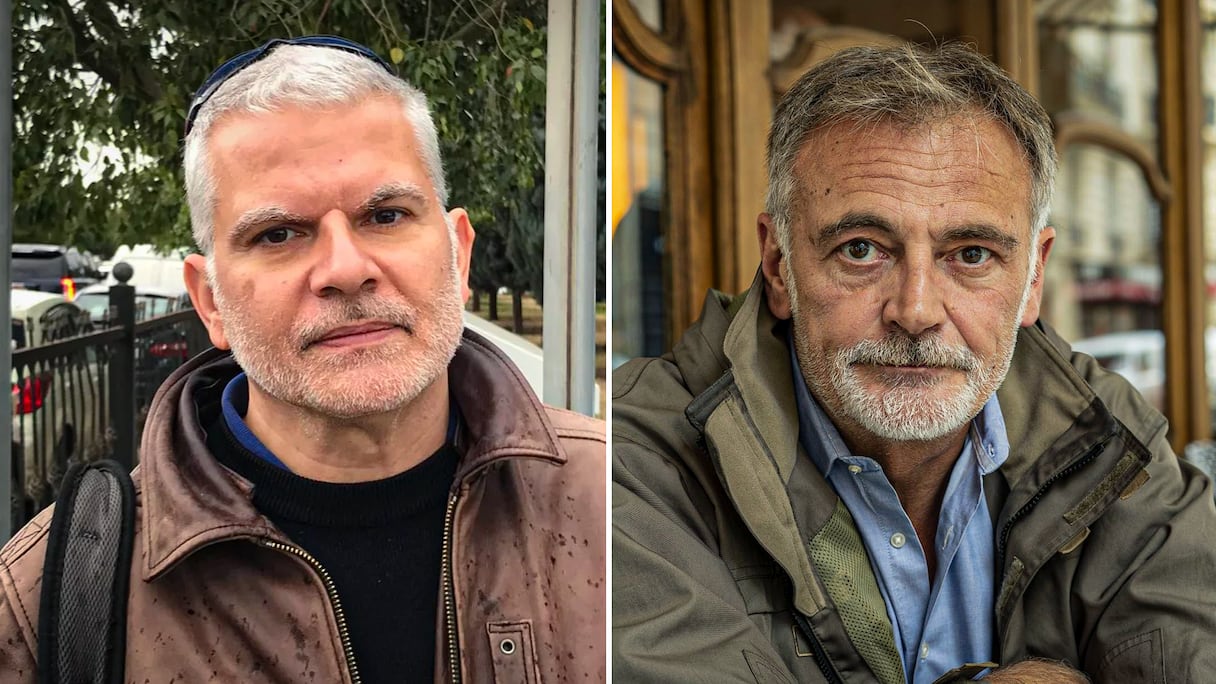
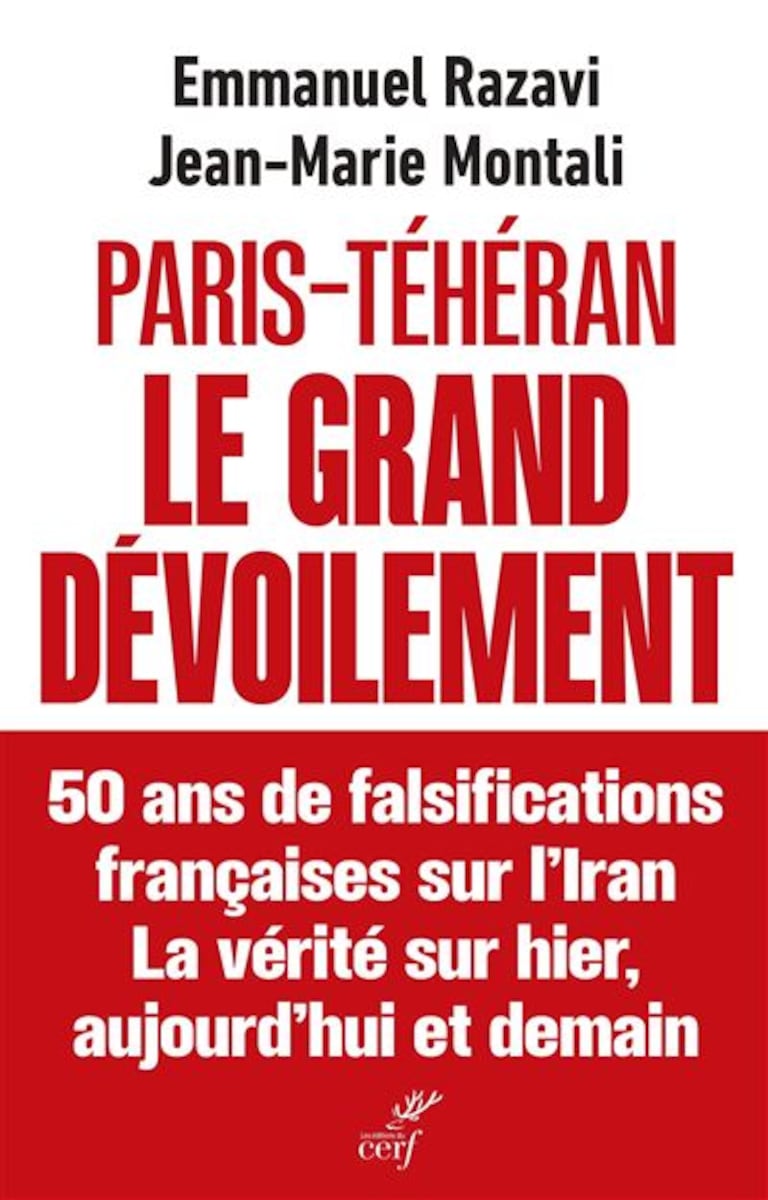
Published by Éditions du Cerf in March 2026, the 240-page book makes no attempt to hide either its viewpoint or its historical ambition. Authors Emmanuel Razavi and Jean-Marie Montali, who previously published the seminal “The Tehran Octopus: An Investigation into Iranian Spies and Influence Agents in Europe and the United States” (Cerf, June 2025), are not merely seeking to explain how the Islamic Republic came to power. They want to understand how part of France’s intellectual, media and diplomatic establishment helped make that victory conceivable, legitimate and, at times, even desirable, before carrying those mistakes into the present.
Their central theme can be summed up in one word: falsification. Not only through outright lies, but also through omission, framing, inaccurate translation, revolutionary romanticism and a determination to preserve a narrative long after the facts had already discredited it.
The book is structured as a journey backward from the lie to its consequences. The warning and preface establish its moral position; the first three chapters revisit Khomeini, the Pahlavi dynasty and the revolutionary alliances; the next two bring the argument into the present, before a conclusion written on the edge of unfolding events. Appendices on Marxist revolutions, Western social movements and Iran’s chronology broaden the perspective further. This structure gives the book coherence despite its abundance of testimony, portraits and historical digressions.
The founding lie: Khomeini and France’s intellectual icons
The heart of the indictment lies in Neauphle-le-Château, where Khomeini spent the final months of 1978. According to the authors, the future supreme leader staged a campaign of global seduction there, promising pluralism, freedom of expression, respect for women and an end to censorship. Yet his earlier writings, they point out, had already laid out the concept of rule by Islamic jurists, the primacy of divine law, the repression of minorities and a totalitarian conception of private life. The lie, they argue, therefore did not lie in a later transformation, but in the democratic mask Khomeini wore before seizing power.
Razavi and Montali present Sartre, Foucault, Simone de Beauvoir, Serge July and several others as emblematic figures in a broader intellectual blindness. Their criticism is not simply that these figures were mistaken, but that they preferred the coherence of their anti-imperialist convictions to the contradictions presented by the facts.
“Sartre, Foucault, whose names are still sanctified today, considered themselves free thinkers. They were taken for guides, but blinded as they were by their own ideological certainties and convinced that they were right against reality, they led us astray. They erected their totems — Dialectics, Progress, Revolution — over corpses that were still warm, or those yet to come, believing that a ‘new man’ would emerge from beneath the dead.”
The central accusation is one of intellectual laziness. The authors argue that all it would have taken was reading Khomeini instead of listening to him. His works on jurisprudence, lectures on Islamic government and fatwas had already foreshadowed the control of bodies, the criminalization of homosexuality, the subjugation of women and the reduction of politics to a theology of obedience.
“The sad truth is that these intellectuals, these journalists, out of laziness, stupidity or, worse still, ideological complacency or complicity, did not do their homework. Khomeini never hid his plans, his jihadist ambitions or even his social views. He had proclaimed them in every possible way and had even put them in writing, long before taking refuge in France.”
And again:
“Under the banner of the sacred, Khomeini therefore dreamed of an order so total that no desire, no breath could escape it. It was not merely a political or religious obsession: it became something organic. He had to tame desire, caresses and codify love, turning them into laws and prohibitions.”
The testimony of Mohsen Sazegara, a repentant co-founder of the Islamic Revolutionary Guard Corps, provides the most damning piece of evidence in this argument. He says Khomeini himself acknowledged resorting to deception during his time in France:
“Another of his flaws emerged when he went back on the many statements he had made during his exile in Neauphle-le-Château. When this was pointed out to him, he replied that at the time he had resorted to cunning and ‘deception.’”
The book’s thesis then becomes one of shared responsibility. The future ayatollah lied, but his lie would not have gained such power without the West’s desire to believe it, fueled by anti-Americanism, Third Worldism and hatred of the monarchy.
“In other words, Khomeini knowingly and deliberately lied to the entire world. But what is most troubling is not so much the lie itself, which could and should have been exposed very quickly, but the response it received. For that lie could not have flourished without a collective willingness to believe it blindly, out of naivety, complacency or ideology.”
Rediscovering Iran’s long history and reassessing the Pahlavis
To challenge the narrative of 1979, the authors place the Islamic Republic within Iran’s long history. Iran is neither Arab nor reducible to political Shiism. It is Persian, multiethnic and shaped by Achaemenid, Sasanian, Zoroastrian, Muslim and modern histories. This depth is not merely an exercise in scholarship: it allows the authors to interpret the theocracy as an attempt to mutilate Iran’s identity.
For the authors:
“Iran did not begin with Islam and cannot be reduced to Islam! The Islamic Republic is merely a parenthesis of barely 50 years in a millennia-old history that has remained alive and to which Iranians are deeply attached. Erasing a country’s history means mutilating it.”
Within this sweeping historical portrait, the Pahlavi dynasty is reassessed without being fully absolved. Reza Shah and then Mohammad Reza Shah modernized the army, education, infrastructure, law, industry and the status of women. But the book also acknowledges the brutality of the reforms, corruption, one-party rule and the Shah’s fundamental mistake of modernizing society without genuinely opening up the political system.
The Shah emerges as a visionary builder and a ruler unable to understand that imposed silence does not amount to consent. The modernity he brought also worked against him:
“He reigns, he moves forward, he decides. He modernizes as though advancing with a bayonet. Soon there are as many cranes in the sky as there are minarets.”
The Red and the Black
In this book, the revolution is never portrayed as a purely popular uprising. It was an unstable coalition of Islamists, Tudeh communists, Islamist Marxists, guerrilla groups, Palestinian networks and Soviet interests. The authors do not claim that Moscow created Khomeini, but rather that it exploited anything that could weaken a major U.S. ally. Yasser Arafat’s PLO, meanwhile, served as a conduit, providing training camps, military know-how, the movement of cadres and symbolic legitimacy.
Read also : US, Iran trade strikes in new threat to ceasefire
This reconstruction is guided by a broader theory of propaganda. A revolution also succeeds because it knows how to assign roles, create martyrs, sanctify violence and offer foreign audiences a narrative that is immediately easy to understand:
“Every revolution, even an Islamic one, comes with the creation of a narrative designed to shape public opinion. It is simply ‘propaganda,’ and propaganda never merely explains or justifies a struggle. It gives it moral and political legitimacy, sometimes by constructing narratives that have nothing to do, in any way, with reality.”
The political battle thus becomes a battle of images. The Shah must be turned into an absolute monster; Khomeini into a wise liberator.
“The methodology followed three steps: create an imaginary monster until everyone is convinced they have seen it, turn a real monster into an angel until everyone swears they have seen one... Then set the media machine in motion, describing an imagined SAVAK, exactly as the Islamic Republic would later do. SAVAK was an intelligence and security service comparable to those of many states.”
The “Foucault syndrome” and the making of a media narrative
The book gives particular attention to narrative errors that became accepted truths. Two episodes serve as case studies. The first is the fire at the Rex Cinema in Abadan, long attributed to SAVAK but which the book attributes to Islamist militants. The second is “Black Friday” on Sept. 8, 1978. The authors do not minimize the massacre, but show how a death toll of several dozen was turned by Foucault into several thousand:
“Based on information produced by the revolutionaries, he wrote in an article that ‘the army killed 3,000 to 4,000 people in Jaleh Square.’ Yet the historical estimates considered most reliable would later put the actual number killed at between 64 and 87. But inflating the figures distorts reality and gives a supposed measure of what was happening in Iran: a revolt against imperialism being crushed in blood.”
The criticism is aimed less at the individual error than at the method. Claude Tastet, who witnessed an interview conducted in Tehran by Foucault and two French journalists, describes leading questions and selective listening:
“They drank in what they wanted to hear. At the end of the interview, when the pilots questioned them in turn about the events, the journalists and Foucault evaded the questions and left without expressing the slightest compassion for what Iran was going through. They simply did not care.”
The most striking point is that several reporters from the period have since acknowledged their own ignorance. The book cites these admissions not to condemn an entire profession, but to distinguish those who revised their views from those who continue to treat the original error as sacrosanct:
“We knew nothing about Shiism. We had not read Khomeini’s writings; we did not understand the subject. Intellectuals were convinced that the religious figures would return to their mosques.”
The “Foucault syndrome,” then, refers to a lasting pathology: replacing contradiction with consensus and then presenting the absence of dissenting voices as proof. Contemporary falsification is often less crude than it was in 1978. It operates through omission.
“The silence of dissenting voices is mistaken for unanimity. We do not lie, at least not directly: the facts are not always falsified, but they are incomplete. It is not truth, but a flat opinion, without edges or friction or contradiction, and the public can then mistake the absence of debate for consensus.”
At the center of the book, a photographic section reinforces this argument. Khomeini in Neauphle-le-Château, the Shah leaving Iran, Arafat welcomed in Tehran, Ahmad Khomeini armed in a Palestinian camp, Basij militiamen, Revolutionary Guards trampling American and Israeli flags, followed by Farah and Reza Pahlavi and the Parisian diaspora: these images form a visual counter-chronology, from the revolutionary illusion to opposition to the regime.
An aging theocracy facing a living people
The second half of the book turns to the present. For the authors, the Islamic Republic is not a state that has experienced excesses or deviations; it is a system whose violence, corruption and lies are intrinsic to its nature. Its religious establishment has become a military and financial oligarchy dominated by the Revolutionary Guards, while a younger, more educated and more connected society has drifted away from it to the point of rupture:
“The regime and the people no longer understand each other. The gulf between them is far more than political or generational: it is existential. They live in different timeframes: the people talk about the future while the regime remains curled up around the past and its gains.”
Young people become the book’s central protagonists. Their resistance is not defined solely by street protests, but also by a parallel culture: underground music, secret parties where girls can spend time with boys, makeshift cinema, poetry, science, and the desire to love and create beyond the control of theocracy:
“Iranian youth no longer recognize themselves in the official culture. They create another one on the margins, and every unauthorized song, every film made with three bits of string, every book distributed under the table, every poem recited into the wind is a breath, an act of resistance. Iranian youth no longer want their poets, musicians and creators to be hanged.”
This vitality stands in contrast to the obscene enrichment of a ruling class that condemns the West in public while placing its wealth, children and property there. The contrast between bodies and capital gives the book’s strongest passages their stark force:
“The second truth is even more obscene: the country is dying while those close to the regime have continued to grow richer. In Iran, morgues are filling up. Abroad, coffers are filling up.”
The account of the 2025-2026 protests is built around testimony from witnesses, lawyers, doctors and activists. The figures cited are those compiled by the authors; their aim is less to present an already settled history than to document, in real time, what they describe as an internal war waged against the population:
“The events of Jan. 8 and 9, 2026, in Iran cannot be reduced to a simple law-and-order operation against an urban uprising. In reality, it was a large-scale military campaign against a civilian population, designed with a dual objective: mass physical elimination and the infliction of paralyzing psychological trauma on a national scale. Since the November 2019 uprising, security think tanks have continued to warn the regime about the explosive consequences of runaway inflation, poverty and unemployment.”
Reza Pahlavi and the diversity of a post-mullah Iran
The book rejects the idea that the fall of the regime would necessarily lead to civil war, partition or a Syrian-style scenario. According to Emmanuel Razavi and Jean-Marie Montali, that fear is one of Tehran’s most effective propaganda tools. To challenge it, the authors interview Reza Pahlavi as well as Kurdish, Baluch and Azeri representatives, liberals and civil society figures such as Nasrin Sotoudeh.
Reza Pahlavi occupies a prominent place in the book. Razavi and Montali do not present him as an automatic restorer of the monarchy, but as a possible unifying figure for the transition. His program, as presented in the book, is based on a transitional government, a constituent assembly, a choice between a republic and a constitutional monarchy, secularism, economic reconstruction and the restoration of relations with Arab neighbors, the United States and Israel.
Reza Pahlavi told Razavi:
“I have a simple goal: to give our nation, perhaps for the first time in its history, the opportunity to decide its own future. This must be done through the establishment of a democratic process, a constitutional process and a constituent assembly that will allow Iranians to decide what kind of political system they want for Iran. We will do precisely the opposite of what was done during the 1979 revolution, when the Islamic Republic was imposed on Iranians without anyone having the slightest idea what it meant.”
The sections dealing with minorities are essential because they allow the authors to distinguish the Shah’s son from his father and respond to those who reduce him to his dynastic inheritance:
“The answer to the question of gender minorities, as well as ethnic minorities, rests on the universal values of human rights, which protect against discrimination based on ethnicity, religion, behavior or sexual orientation, including the LGBTQ+ community. This means incorporating these protections into our laws to guarantee the rule of law. Beyond legal measures, this is a question of principles and education.”
The chapter’s strength, however, lies in its refusal to reduce the opposition to Reza Pahlavi. Baluch representatives advocate a secular transition, while Azeri representatives speak of federalism without calling for partition. Vahid Beheshti summarizes the book’s counterargument:
“This alarmist interpretation corresponds exactly to the Iranian regime’s argument, which weaponizes the fear of chaos to dissuade the international community from taking firm decisions. It is a narrative carefully disseminated to make people believe that any alternative would lead to the country’s collapse. Yet reality in Iran is quite different.”
The force of a book of conviction
“Paris-Tehran” is a counter-history written in haste, carried by reporters who openly acknowledge their anger and work by layering sources: press archives, historical works, interviews, clandestine testimony, portraits and firsthand scenes. It corrects a binary narrative in which the Shah was absolutely evil and the revolutionaries necessarily emancipatory. The events of 2025-2026 are told as part of a history that is still unfolding. The book does not claim to be definitive. It asks to be read as an indictment, made powerful by the evidence it assembles.
By the end of the book, one idea remains stronger than the controversies it is likely to provoke: the Islamic Republic cannot be equated with Iran. In Razavi and Montali’s account, it represents the seizure of the country’s history, religion, wealth and voice. What re-emerges is a people portrayed not as passive victims, but as the possible authors of their next chapter.
“Paris-Tehran: The Great Unveiling,” Emmanuel Razavi and Jean-Marie Montali, 240 pages. Éditions du Cerf, 2026. Available for pre-order at bookstores.
