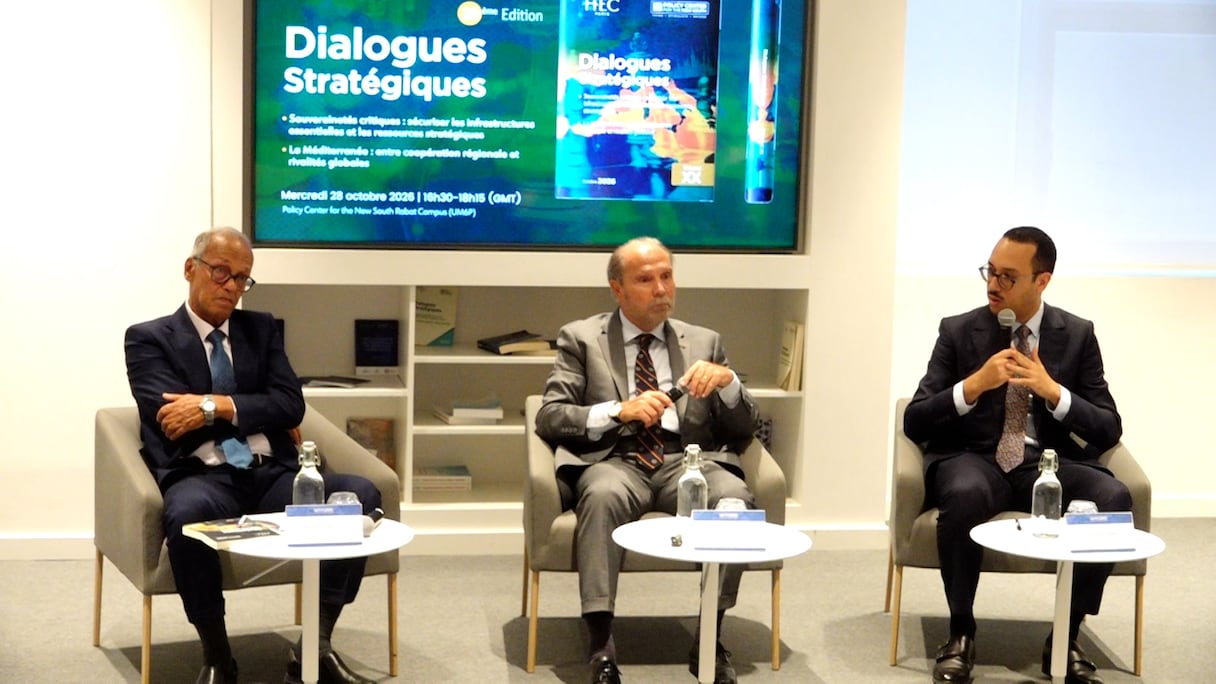
How can the infrastructure and resources on which economies depend be protected? And how can cooperation in the Mediterranean be strengthened despite the rivalries running through the region? These two questions frame the 20th volume of Strategic Dialogues, presented on Wednesday, October 28, 2026, at the Policy Center for the New South (PCNS) on the campus of Mohammed VI Polytechnic University (UM6P) in Sala Al Jadida. The joint publication by the Moroccan think tank and the HEC Center for Geopolitics builds on discussions held during the previous edition of their meetings.
Held twice a year since 2016, Strategic Dialogues brings together researchers, experts, practitioners and policymakers to discuss geopolitical and security issues shared by Europe and Africa. Their contributions are compiled in a publication intended to inform public policymaking.
Securing networks and getting more value from resources
The first section focuses on protecting critical infrastructure and securing access to strategic resources. Undersea cables and critical minerals are two examples. The former carry international digital communications, while the latter are essential to many technologies used in the energy transition. Protecting them raises questions about economic dependence and states’ ability to prevent supply disruptions.
According to a statement sent to Le360, the authors examine the opportunities available to African countries in this context. Their challenge is to improve their position in global value chains, notably by developing local processing of raw materials. This would allow more added value to remain on the continent, although industrial and economic obstacles remain.
Read also : Morocco, Mauritania discuss road connectivity and strategic infrastructure projects
Mediterranean cooperation faces persistent obstacles
The second section turns to the Mediterranean, where shared interests collide with imbalances between the two shores and competing strategies pursued by international powers.
Security cooperation, maritime disputes, energy issues and rivalries for influence are examined to understand what is holding back closer regional ties. The contributors also explore the conditions under which interdependence among Mediterranean actors could foster more balanced cooperation.
The two sections were presented by Pascal Chaigneau, director of the HEC Center for Geopolitics, and Abdelhak Bassou, a senior fellow at the PCNS, respectively. The discussion was moderated by Oussama Tayebi, a senior international relations specialist at the Moroccan think tank.
