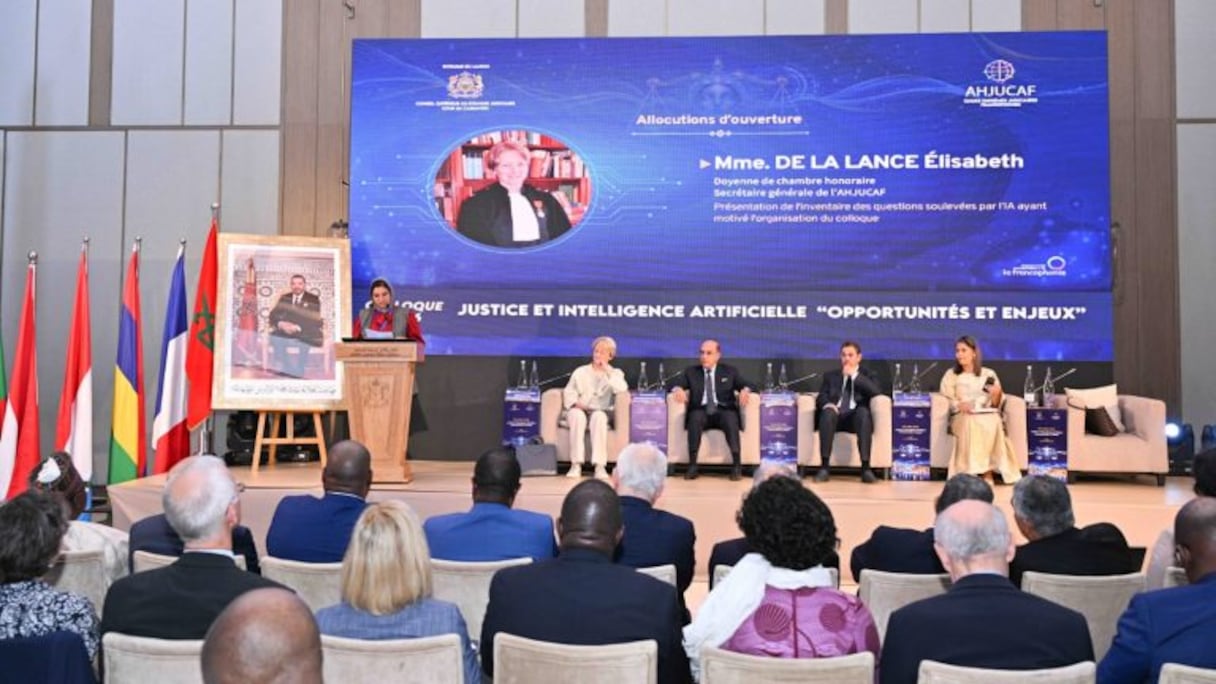
An international conference on “Justice and Artificial Intelligence: Opportunities and Risks” opened in Rabat on Wednesday, October 14, 2026. Organized by Morocco’s Court of Cassation in partnership with the Association of the Highest Courts of Cassation of Countries Sharing the Use of French (AHJUCAF), the two-day event focuses on the impact of emerging technologies on judicial systems.
The opening session was chaired by Mohamed Abdennabaoui, First President of the Court of Cassation, Delegate President of the Superior Council of the Judicial Power and president of AHJUCAF.
Hicham Belaoui, the King’s Prosecutor General at the Court of Cassation and head of the Public Prosecution, also attended, alongside representatives of the International Organization of La Francophonie.
The conference brings together more than 40 presidents and representatives of supreme courts, legal experts and practitioners from 24 countries across Africa, Europe, Canada and the Middle East.
The discussions form part of AHJUCAF’s ongoing activities and annual programs and examine how modern technologies could affect the operational capacity of judicial systems.
Read also : Morocco eyes hosting future UN Congress on Crime Prevention and Criminal Justice
Over two days, participants will examine the potential uses of artificial intelligence in the justice system, as well as the legal and regulatory frameworks needed to keep pace with rapid digital development.
The opening session included an institutional film explaining the technical foundations of artificial intelligence, its origins and development, and the data used by AI systems. The presentation aimed to make the technology easier to understand and clarify concepts that can otherwise seem opaque.
The scientific program includes sessions on the ethical, legal and technical aspects of AI and generative AI in legal professions. The first session examines the opportunities and limits of artificial intelligence and the risks associated with its tools, with experts from Canada, Belgium, Lebanon and Cameroon. It also looks at practical experience in digitizing judicial procedures.
Other sessions will present examples of ethical and responsible AI use, featuring a chamber president from France’s Court of Cassation and judges from Senegal. Participants will also discuss Morocco’s experience and approach to using AI to support the justice system and improve access to the courts.
The conference will conclude with a practical workshop featuring real-world cases and live exercises focused on the wider implementation of digital technologies.
Hosting the conference in Rabat reflects Morocco’s role in international judicial cooperation and provides a forum for dialogue between supreme courts on digitalization and modern justice, with a focus on safeguarding judicial independence, protecting litigants’ rights and upholding professional ethics.
