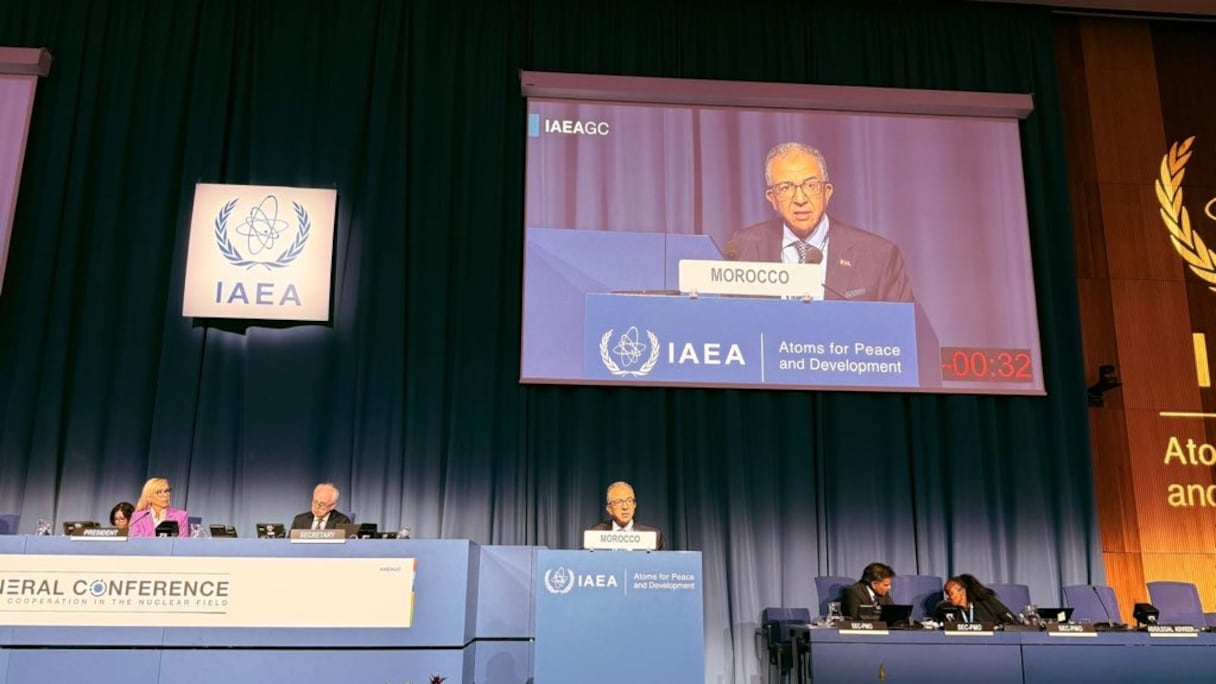
Speaking during the conference’s high-level segment on Wednesday, Morocco’s Permanent Representative to the international organizations in Vienna, Ambassador Azzeddine Farhane, said constructive dialogue, cooperation and effective multilateralism remain essential to maintaining trust and strengthening cooperation at the regional and international levels.
The conference, held from September 14 to 18, coincides with the end of Morocco’s two-year term on the IAEA Board of Governors. From Thursday, the Kingdom will take on the presidency of the African Regional Cooperative Agreement for Research, Development and Training Related to Nuclear Science and Technology (AFRA) for 2026–2027.
Farhane highlighted Morocco’s involvement in the IAEA’s governance, including its presidency of the agency’s 64th General Conference, its chairmanship of the Group of 77 and China in Vienna in 2022, and its membership of the Board of Governors from 2024 to 2026, during which it also served as vice president.
Read also : Morocco takes center stage at international cooperation fair in Ecuador
“For Morocco, membership has never meant simply occupying a seat, but contributing, facilitating and building bridges of communication,” he said.
On safeguards and non-proliferation, Farhane said Morocco supports the integrity of the IAEA’s verification mandate and full cooperation with its secretariat, while respecting the rights and obligations established under the international non-proliferation system.
He also highlighted Morocco’s coordination with the other Arab members of the Board of Governors, Saudi Arabia, Jordan and Egypt, including efforts to convene an extraordinary Board session following the attack on the Barakah nuclear power plant in the United Arab Emirates.
According to Farhane, the initiative sought to reaffirm the principle that nuclear facilities dedicated to peaceful purposes must not be targeted by armed attacks.
He also addressed the IAEA safeguards file concerning Syria, noting that consultations among the four Arab Board members contributed to reaching a consensus that allowed the Syrian file to be removed from the Board’s agenda while preserving the agency’s technical responsibilities.
Nuclear safety and peaceful applications
Farhane also outlined Morocco’s contribution to strengthening the international nuclear safety and security system.
He recalled that Morocco chaired negotiations in 2005 that led to the adoption of the International Convention for the Suppression of Acts of Nuclear Terrorism.
Twenty years later, on the sidelines of the IAEA’s 69th General Conference, Morocco brought together the IAEA, the United Nations Office on Drugs and Crime and other UN partners, including the UN Office of Counter-Terrorism, to mark the convention’s 20th anniversary and the adoption of an amendment to the Convention on the Physical Protection of Nuclear Material.
“Our objective was guided by a forward-looking vision aimed at strengthening the universality of these two instruments and their effective implementation, as well as strengthening international cooperation to address evolving threats to nuclear security,” Farhane said.
At the national level, he said Morocco had opted for transparency by voluntarily subjecting its nuclear and radiological framework to the IAEA’s peer-review mechanisms.
The Kingdom has hosted three IAEA review missions covering emergency preparedness and response, integrated nuclear infrastructure, and the integrated safety assessment of research reactors, as well as a mission under the agency’s Integrated Regulatory Review Service.
Farhane also stressed that the strength of the international nuclear safety and security system should be measured by its ability to deliver tangible benefits to populations.
He cited a Moroccan initiative within the Group of 77 and China concerning a resolution on the economic production of drinking water using small and medium-sized nuclear reactors, highlighting water security and the potential contribution of nuclear technologies in this area.
Focus on Africa
“Africa remains at the heart of Morocco’s commitment,” Farhane said, recalling that Morocco hosted the first African regional meeting dedicated to the IAEA’s ZODIAC initiative in Rabat in 2024.
Read also : Morocco, Vietnam veterans’ associations sign cooperation memorandum
The initiative aims to strengthen national capacities to detect, monitor and control zoonotic diseases.
Moroccan institutions and centers of excellence have also contributed to training, scholarships, scientific visits and knowledge-sharing for professionals from more than 40 African IAEA member states, covering areas ranging from nuclear medicine to regulatory capacity building.
As Morocco prepares to assume the AFRA presidency for 2026–2027, Farhane said the Kingdom’s commitment to the IAEA, Africa, the international nuclear safety and security system and effective multilateralism would continue.
He called for stronger multilateral institutions and a more equitable sharing among nations of the benefits of nuclear science and technology.
