It took nothing more than an invisible spark—a complete non-event—for Algiers’ propaganda machine to spiral into delirium. As the Atlas Lions shone on American soil during their Round of 32 victory over the Netherlands, the Algerian regime, consumed by its perennial resentment and its compulsive need to undermine every Moroccan success, believed it had found its latest opportunity.
The story? A supposed “national tragedy” manufactured in the laboratories of state-sponsored disinformation.
Subject to verification, as no corroborating evidence has emerged, the purported facts verge on the absurd. A young Algerian man, proudly wearing the Fennecs jersey, is said to have deliberately placed himself in the middle of a sea of Moroccan supporters dressed in red and green at a fan zone in Boston.
The videos circulating on social media—assuming they are authentic—and presented as scandalous by Algeria’s state media and its army of electronic trolls simply show an individual declaring that he wanted to support his “Moroccan brothers.” He is later seen lying on the ground—assuming it is indeed the same person—surrounded by Moroccan supporters, some of whom appear instead to be clearing space around him.
Abdelmadjid Tebboune Rallies Around Nothing
But in Algeria, absurdity no longer kills. It governs.
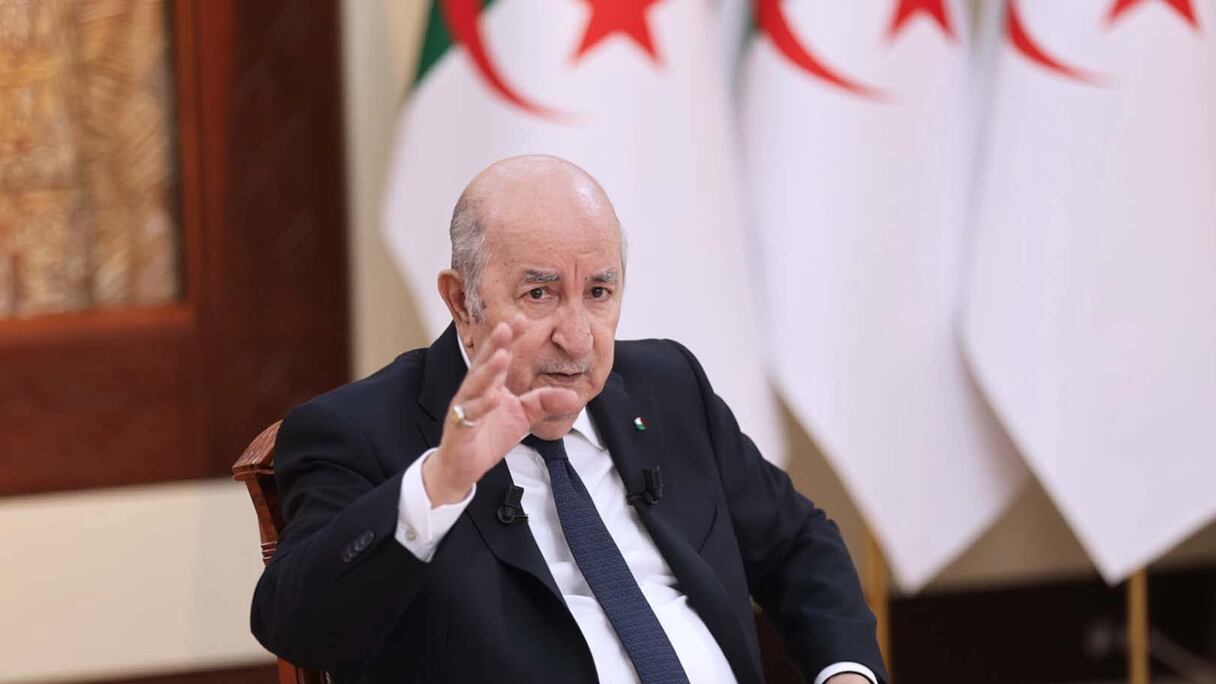
Seizing on this convenient pretext to spoil the festive atmosphere and Morocco’s growing international visibility in the United States, President Abdelmadjid Tebboune personally entered the media arena.
In a televised statement delivered with almost theatrical solemnity, the Algerian head of state said he was following “with close attention” the case of young Wassim, presented as an Algerian-American dual national and “the victim of an assault.”
The president expressed satisfaction that “the child” had been discharged from hospital, mobilized Algeria’s ambassador to Washington, Sabri Boukadoum, referred to American police investigations and even offered the young man an official invitation to attend Algeria’s Round of 32 match against Switzerland in Canada.
Meanwhile, as the mystery remains unresolved and fictional arrest figures continue to multiply by the minute across Algeria’s television channels and tightly orchestrated social media ecosystem, the strategy reveals itself for what it is: obvious, heavy-handed, and desperate.
When a president turns himself into the coordinator of a crisis unit over a fan zone incident on the other side of the world, it suggests that his regime has little left to offer its own people beyond exportable resentment.
The Pot Calling the Kettle Black
Before attempting to fabricate imaginary brutality on the part of Moroccan supporters, the Algerian regime would do well to look closer to home.
If there is one form of violence that has spread across the globe during this 2026 World Cup, it is that of its own supporters, raised on a steady diet of institutionalized resentment.
While the Algerian presidency laments Wassim’s fate in Boston, the world has instead witnessed the very real misconduct of Algerian supporters. The examples are numerous and, unlike the Boston incident, extensively documented.
Following the Algeria-Jordan match, Doha’s Al Dafna district descended into chaos. Restaurant chairs and tables were hurled as projectiles, while violent street brawls broke out.
The result was a large-scale intervention by Qatari security forces and the arrest of 25 people for offenses related to public security. In Doha, authorities have adopted a zero-tolerance approach toward such hooliganism.
On June 15, the day before Algeria faced Argentina, groups of Algerian supporters clashed in the heart of Manhattan, forcing the New York Police Department (NYPD) to intervene to protect tourists and families caught in the disturbances.
After the Fennecs’ 3-0 defeat to Argentina, the crisis took on a different dimension. Images of an Algerian supporter openly urinating on stadium seats while smiling into the camera circulated worldwide. The act echoed the behavior of Algerian influencer Raouf Belkacemi during the Africa Cup of Nations in Rabat, where he was later sentenced to three months in prison.
This pattern of behavior is not accidental but the direct product of state policy.
Confronted with a deep internal crisis and a tightly controlled public sphere, Algeria’s military-political establishment has turned football into a powerful instrument of political diversion.
By saturating public discourse with aggressive nationalism and cultivating a culture of resentment and victimhood, the regime has transformed its supporters into foot soldiers in an imaginary psychological war, as highlighted in a recent investigation by the Canadian publication Western Standard.
The “young Wassim” affair is merely the latest manifestation of that large-scale conditioning, this time publicly endorsed by the head of state himself.
But in seeking to portray Moroccan supporters as criminals in order to conceal both the destructive behavior of its own supporters and the failures of its national team, the Algerian regime only reinforces the image of its own moral bankruptcy.
Violence and falsehoods may travel across borders, but they ultimately project an indelible image of Algeria: that of a state acting as an arsonist while presenting itself as the victim. Perhaps in preparation for the national team’s anticipated defeat to Switzerland in the Round of 32—or for the disturbances in Canada, against which Western Standard has already issued serious warnings.
