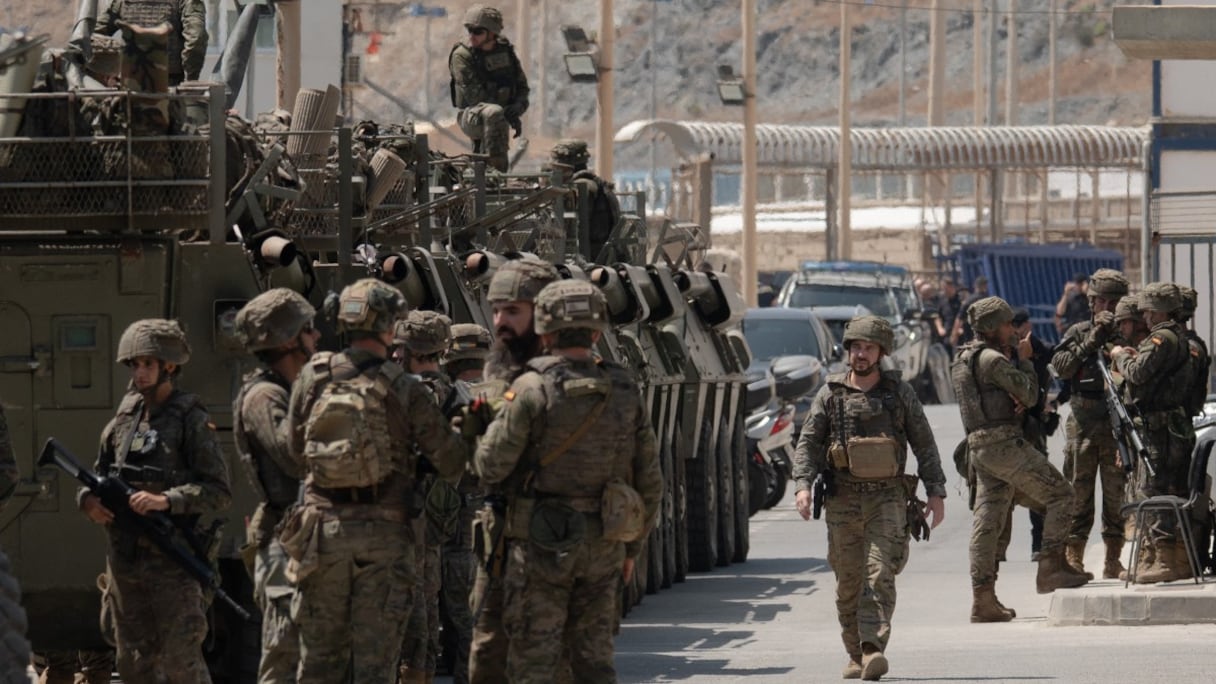
History has a long memory and a stubborn sense of irony: the city of Ceuta, which in 1415 served as a catalyst for European imperialism and colonial expansion on the African continent, today finds itself at the heart of the unraveling of the last vestiges of that same empire. The current migration crisis unfolding in the city offers ample illustration. In an uncompromising analysis published in the prestigious magazine Foreign Policy, Howard W. French delivers a truth that Spanish diplomacy—and, by extension, European diplomacy—has vainly sought to evade. Demographic realities and geopolitical realism will ultimately compel Spain to return this territory to Morocco. Retaining a colonial enclave on the African continent in the 21st century is a pure anachronism. Its return is no longer a question of “if,” but “when.”
Howard W. French, a Foreign Policy columnist, professor at Columbia University’s Graduate School of Journalism and longtime former international correspondent for the New York Times, brings to this debate the theoretical depth of his major works, notably Born in Blackness: Africa, Africans, and the Making of the Modern World and The Second Emancipation: Nkrumah, Pan-Africanism, and Global Blackness at High Tide. Examining the upheavals surrounding the occupied enclave, the American scholar dismantles the myth of permanent and timeless Spanish sovereignty.
An Inevitable Return
For Howard W. French, Spain will be forced to relinquish its claims over Ceuta under the combined pressure of political common sense and structural changes across the Mediterranean basin. Far from being a mere theoretical proposition, the territory’s return is emerging as an inevitable historical outcome. «I wager, however, that Spain will eventually come to understand, gradually and perhaps even soon, the wisdom of relinquishing its territorial claim in Africa out of pragmatism—a realism that has so far eluded the British in Gibraltar.»
This prediction rests on an inescapable underlying force: demographic shock. While the European continent sinks into unprecedented aging, with women in Spain and Italy now having barely one child on average, Africa is experiencing an exponential youth boom. Seeking to maintain an impermeable, militarized land border on the edge of Africa to protect an enclave of just a few square kilometers is a geopolitical absurdity destined to fail.
An Untenable Status Quo
Keeping Ceuta under Spanish control has now become untenable and financially ruinous. French lays bare the incongruity of a presence that now generates little more than recurring crises. «In reality, policing Ceuta against waves of immigrants entails considerable and permanent budgetary costs, as well as intra-European tensions.»
Read also : Ceuta, Melilla and the mirrors of history: the end of the status quo
The enclave’s legal and geographical status makes it a permanent political flashpoint. The author pointedly observes that possession of this sliver of land now provides little more than a «source of pride for Spaniards nostalgic for the remnants of their former empire,» while regularly destabilizing the European order. During migration surges, panic spreads through European capitals: «Italy, Spain’s close neighbor, quickly introduced controls on people arriving from Spain to ensure that no Africans were slipping through the North African enclave,» demonstrating how the very existence of a “Spanish” Ceuta weakens the Schengen area and continental solidarity.
The Blindness of Western Media
One of the major contributions of Howard W. French’s analysis lies in his scathing criticism of Western media coverage, which reduces a centuries-old historical dispute to a mere security incident. The author deplores this analytical poverty. «I was struck by the narrow lens adopted by many media outlets in covering events in Ceuta. Much of the coverage presented them as a straightforward, albeit serious, migration crisis, taking for granted the present geographical arrangement and the deep historical backdrop underlying today’s headlines,» he writes.
Yet separating Ceuta from its colonial foundations amounts to distorting reality. Citing his own research published in Born in Blackness, he argues that it is intellectually dishonest «to subscribe to the idea that Portugal acquired its imperial possessions in Africa in a fit of absent-mindedness [...] and that Ceuta is merely a curiosity and historical relic whose belonging to Europe the world should now accept without question.»
Spain’s Schizophrenia
The article highlights a fundamental contradiction at the heart of Spanish diplomacy. Madrid stubbornly denies Morocco the legitimate right to claim Ceuta and Melilla while displaying unwavering patriotic fervor in demanding that the United Kingdom return Gibraltar.
French points to this double standard. «Spain rejects Morocco’s historical and geographical arguments concerning the rightful ownership of Ceuta, yet makes very similar claims regarding Gibraltar,» he notes. Describing the Spanish presence on African soil as a «historical anomaly, of the kind that seems unlikely to endure,» the columnist demonstrates that the very arguments Madrid deploys against London irreparably undermine its own position vis-à-vis Rabat.
Against Spain’s certainties, history recalls Morocco’s foundational role in the geopolitics of the Strait. While Spain clings to a territorial dispute in North Africa, it was a dynasty from Morocco that originally built the citadel of Gibraltar that Madrid covets today. French underscores this historical paradox with biting irony. «Gibraltar was founded in the 12th century as a fortified lookout by the Muslim Almohad Empire.» Yet unlike Spain’s posture, frozen in the past, the author notes Morocco’s strategic maturity, recalling that this is «a claim that Moroccans sensibly abandoned long ago.»
The Origins of the Occupation
To restore Ceuta to its true historical context, Howard W. French traces the origins of the European presence back to 1415 and the Portuguese prince Henry the Navigator. Contrary to hagiographic accounts, the assault on the North African city was driven by very material economic greed. «What Henry sought was neither converts to Christianity nor even vast territories to annex to the Aviz kingdom. Rather, it was a share of the immense wealth in gold that had flowed into Europe for centuries from Mediterranean Africa and lands much farther south,» the scholar recalls.
In another irony of history, Ceuta’s passage from Portuguese control to Spanish sovereignty stemmed directly from a military rout suffered in Morocco itself. In 1578, during the Battle of the Three Kings (Oued El-Makhazen), King Sebastian I was killed, triggering a major dynastic vacuum: «The Portuguese succession crisis of the 16th century resulted from a broader invasion of Morocco, which ended in disaster when King Henry’s predecessor, Sebastian I, was killed along with much of his family.» Philip II of Spain then seized the Portuguese crown in 1580. When Portugal regained its independence sixty years later, «the Moroccan promontory known as Ceuta was ceded to the Spanish.»
The world has changed since then. Howard W. French sets out the political imperative now facing Madrid: cut the Gordian knot by returning the territory to the Kingdom of Morocco. He states this central argument unambiguously: «At this point, Spain should do what is required and return this geopolitically insignificant territory to Morocco, thereby eliminating the possibility that it might ever be used as a back door into the European immigration zone known as Schengen.»
For the Foreign Policy columnist, such a return would free Spain from an embarrassing anachronism and allow it to take the lead in forging a mature, renewed European policy toward the neighboring continent. Rather than continuing to indulge «the illusion that the movement of populations from Africa and elsewhere in the Global South can be managed indefinitely through policing alone,» Europe must rebuild its economic ties on more equitable foundations. The return of Ceuta would thus constitute an indispensable starting point for finally settling the colonial legacy and establishing shared prosperity between the two shores of the Strait.
