
During the 2025–2026 academic year, approximately 3.04 million students were enrolled in higher education in France, according to data from Statistical References on Education, Training and Research and the Directorate-General for Foreign Nationals in France, which falls under the Ministry of the Interior.
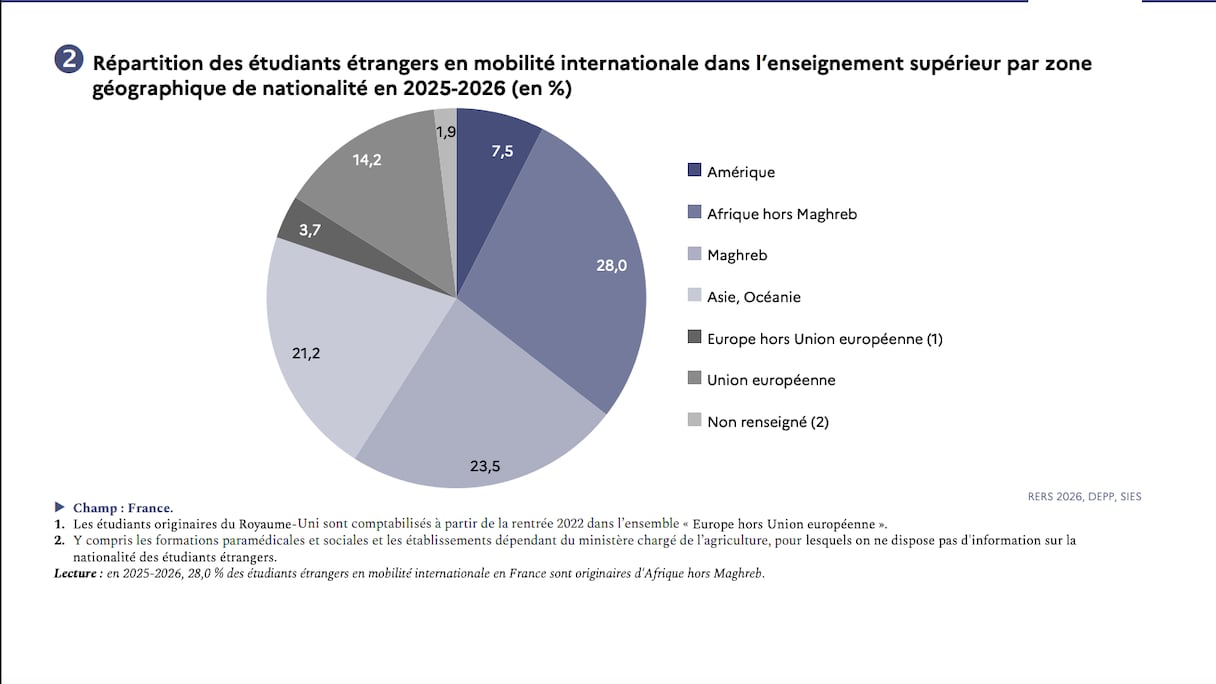
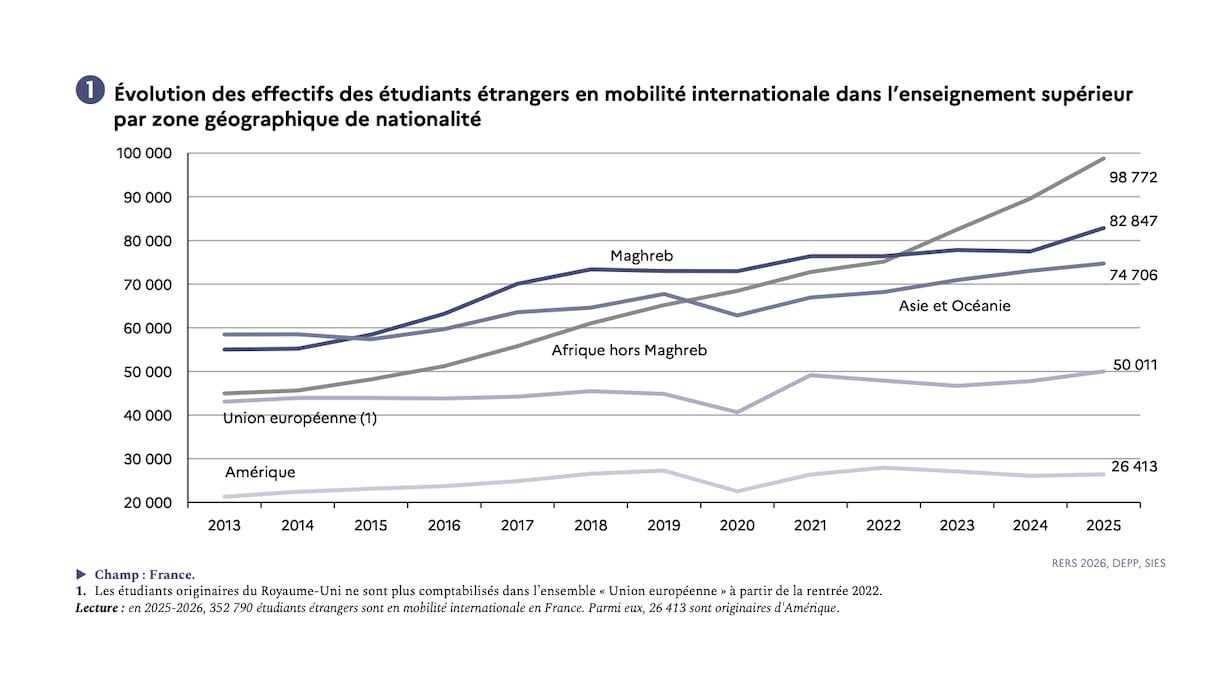
Of these, just over 352,790 were internationally mobile students—foreign nationals who had obtained their secondary school leaving certificate or an equivalent qualification abroad and had come to France specifically to pursue higher education. They represented approximately 12% of all students enrolled in French higher education institutions, including universities and specialized schools.
“After several years of steady post-pandemic growth, the number has risen sharply this year, increasing by 7.2% in a single year and 26.8% over five years. This growth is driven by the attractiveness of universities (+5.1% year on year) and business, management and sales schools (+12.0%). These schools have consolidated their position as the institutions with the highest proportion of international students, who account for one in five enrollments,” the report notes.
Read also : African Diaspora Remittances: Here are the top 10 recipient countries
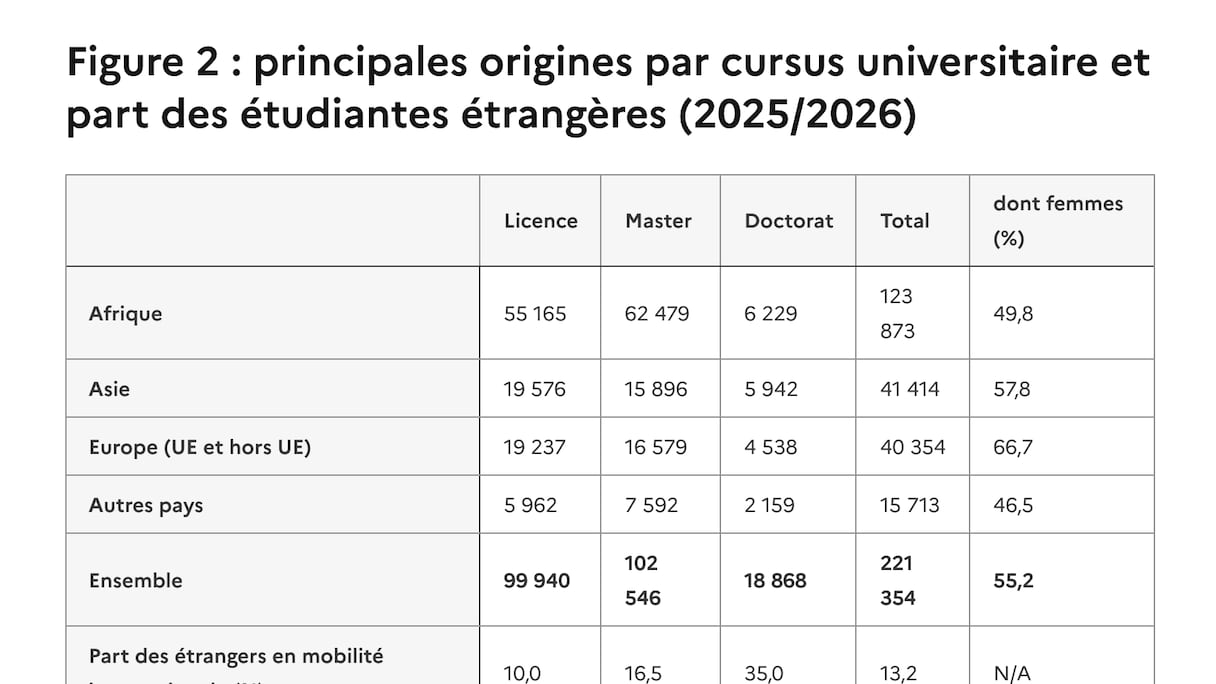
Despite a decline in enrollment, universities, including preparatory programs and university-based engineering courses, accommodated 63% of internationally mobile students, or 221,354 individuals.
African students enrolled at French universities numbered 123,873, representing 56% of foreign students at these institutions, with women accounting for 49.8%. Among African students at French universities, science was the most popular field, attracting 42% of enrollments.
Meanwhile, business, management and sales schools, engineering schools outside the university system, art and architecture schools, and other higher education institutions—including journalism schools, advanced technician programs (STS) and preparatory classes for the grandes écoles (CPGE)—enrolled 131,436 international students, including 57,746 Africans.
In terms of countries of origin, seven countries account for approximately 42% of international students in France, or 147,441 individuals. Five of these are African: Morocco, Algeria, Senegal, Tunisia and Cameroon. Together, these five countries account for 110,617 students, representing 61% of all students from the African continent.
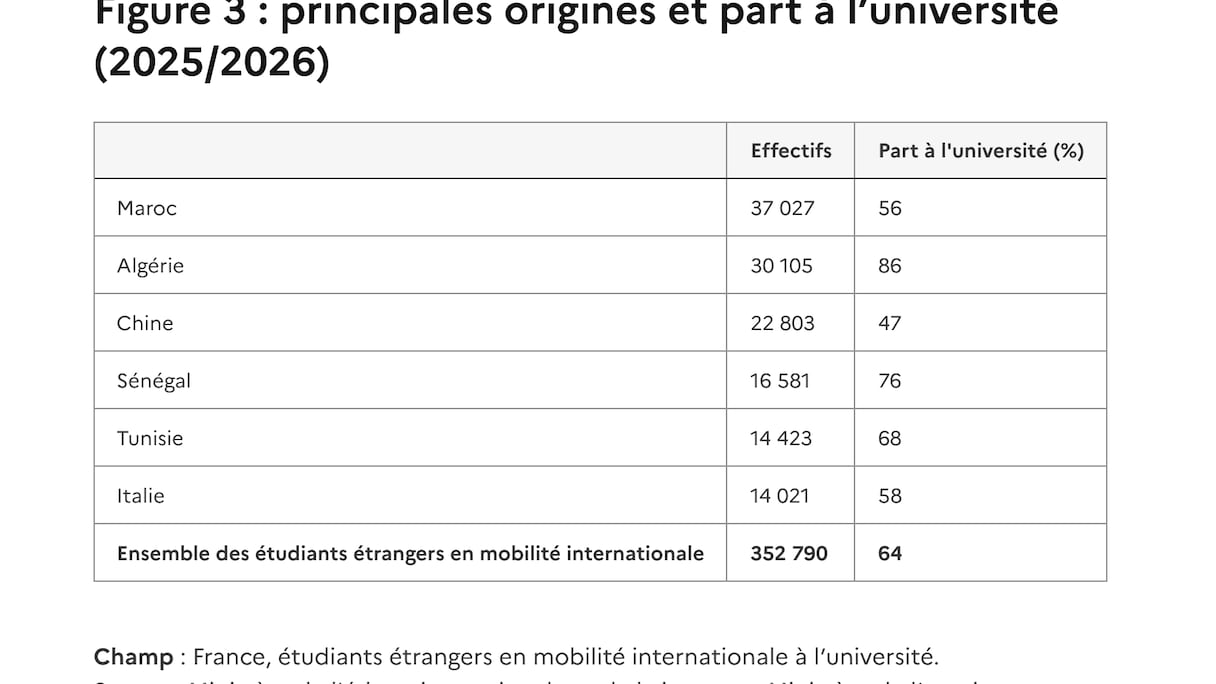
Morocco retains its position as the leading country of origin among international students in French higher education, with 37,027 students. That represents 10.5% of all international students enrolled in France and 16.53% of those coming from Africa. Morocco ranks ahead of Algeria (30,105 students), China (22,803), Senegal (16,581), Tunisia (14,423), Italy (14,021) and Cameroon (12,481).
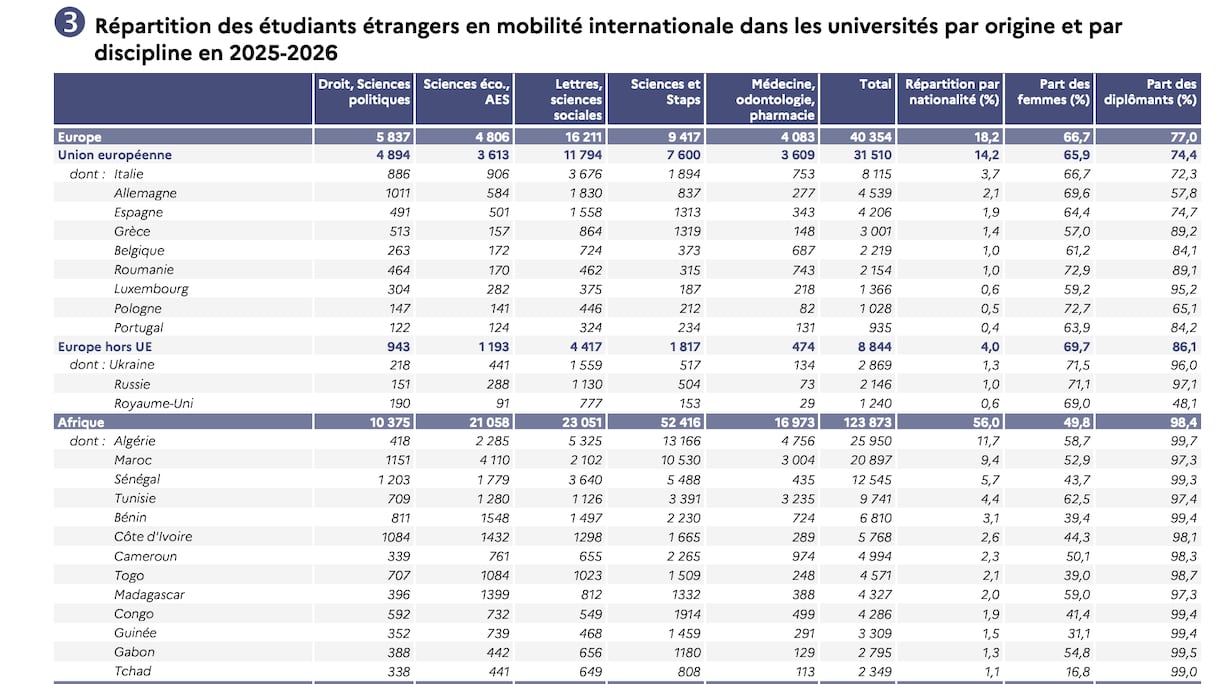
By field of study, the report reveals that 36.6% of international students are enrolled in scientific disciplines, 26.7% in humanities and social sciences, 16.0% in economics and management, 11.1% in medicine and 9.6% in law.
Read also : Africa outperforms global tourism market as arrivals grow 4% in H1 2026
These overall figures conceal significant differences between countries.
Among African countries, Morocco, which has the largest international student community in France, has 50.4% of its students enrolled in scientific disciplines, compared with 19.7% in economics, 14.4% in medicine, 10.6% in humanities and 5.5% in law.
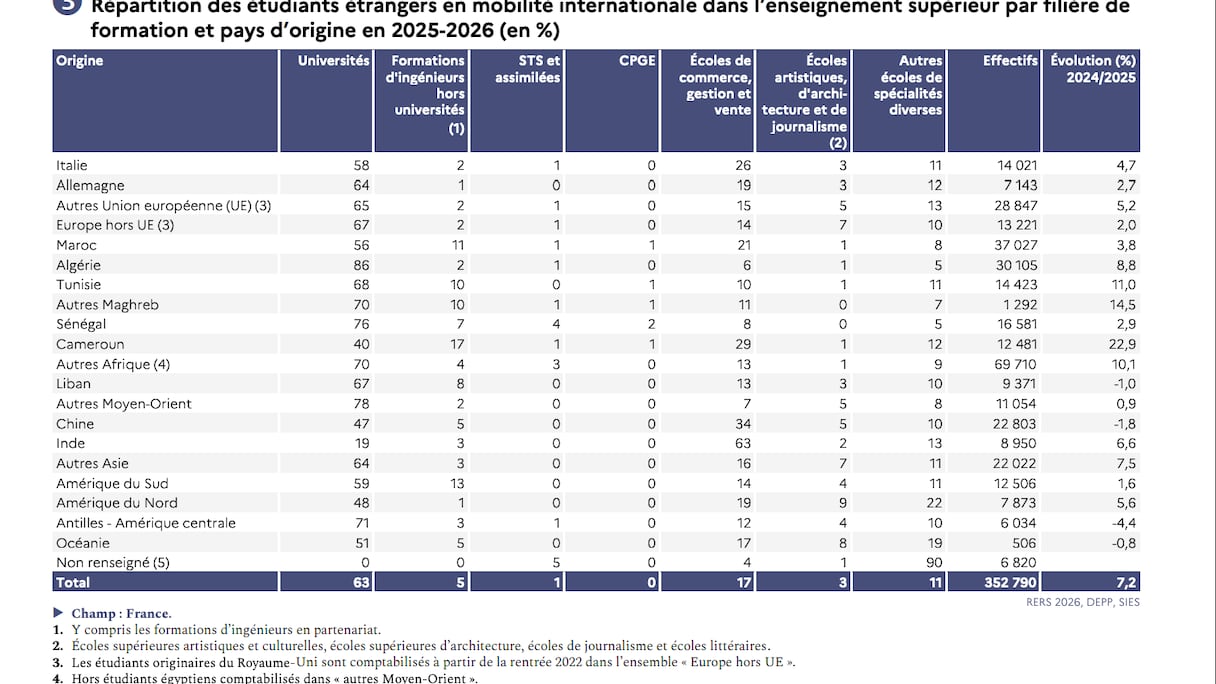
“This country stands out for its lower proportion of students attending university: they favor specialized schools, including business and engineering schools, much like students from India and North America,” the report notes.
Morocco is the most represented country in French engineering schools, accounting for around 20% of international student enrollments, ahead of China, Cameroon and Tunisia.
Algeria, the second-largest country of origin with 30,105 students, also has a strong concentration in scientific disciplines, which account for 50.7% of its students. Humanities account for 20.5%, medicine for 18.3%, economics for 8.8% and law for 1.6%. Unlike Morocco, nearly nine out of ten Algerian students (86%) are enrolled at universities.
Elsewhere in North Africa, Tunisia has almost as many students enrolled in scientific disciplines (34.8%) as in medicine (33.2%), followed by economics (13.2%), humanities (11.6%) and law (7.3%).
In sub-Saharan Africa, 43.7% of Senegalese students are enrolled in scientific disciplines, 29.0% in humanities, 14.2% in economics, 9.6% in law and 3.5% in medicine. Nearly 76% of Senegalese students attend universities, with the remainder spread across various specialized schools and higher education institutions.


Étudiants africains dans les écoles d'ingénierie en France: Maroc (4073 étudiants, soit 11% des étudiants marocains), Cameroun (2122 étudiants, 17%), Tunisie (1442 étudiants, 10%), Sénégal (1167 étudiants, 7%) et Algérie (602 étudiants, 2%)
For its part, Côte d’Ivoire has the lowest proportion of students enrolled in scientific disciplines compared with the four African countries sending the largest numbers of students to France, at just 28.9%. Economics accounts for 24.5% of Ivorian students, humanities for 22.5%, law for 18.8% and medicine for 5.0%.
Read also : Morocco leads Africa’s aerospace industry as Tunisia expands its footprint
Finally, looking specifically at French engineering schools outside the university system, which are highly sought after for the quality of their programs, Morocco ranks first with 4,073 students, representing 11% of all Moroccan students pursuing higher education in France.
Among African countries, the Kingdom ranks ahead of Cameroon, which has 2,122 students enrolled at these institutions, representing 17% of Cameroonian students pursuing higher education in France.
Cameroon thus has the highest proportion of students enrolled in French engineering schools, ahead of Morocco (11%), Tunisia (10%), Lebanon (8%), Lebanon (7%) and China (5%).
