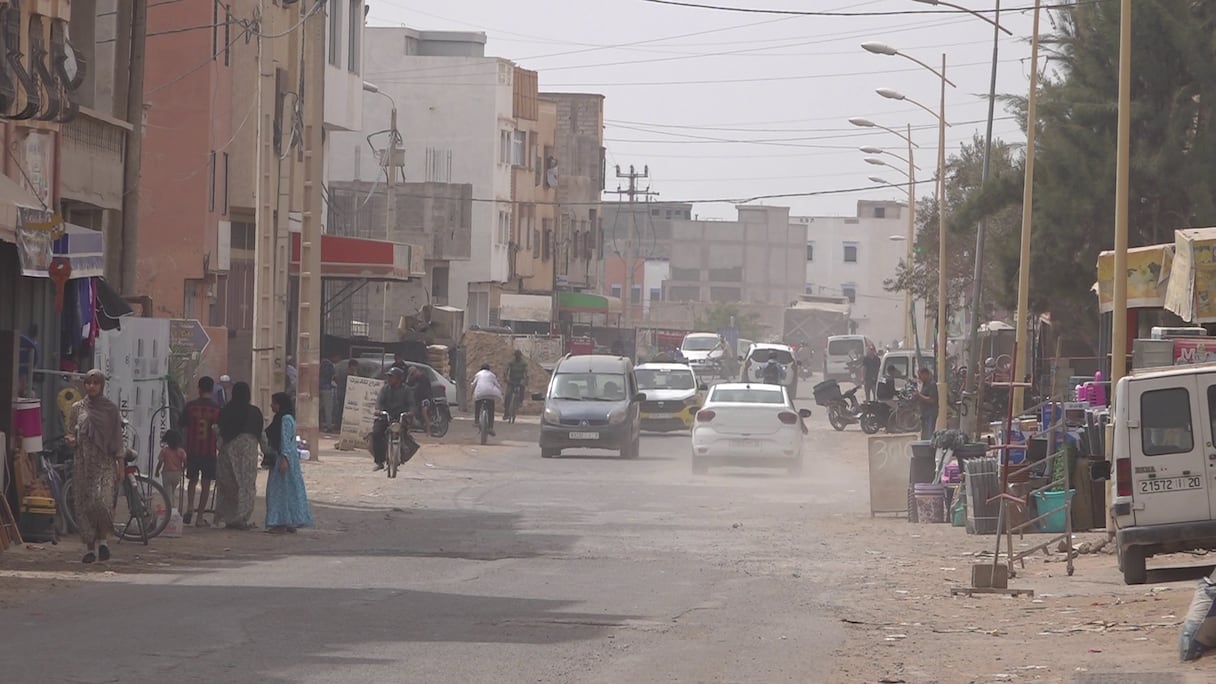
For people living in Drarga, getting around their commune can mean picking a way past potholes, breathing in dust and navigating streets residents say have been left behind by the population and industry growing around them.
There are more than 107,000 people here. There is also Souss-Massa’s largest industrial zone.
What residents say they do not have enough of are decent roads, sewerage, street lights, parks and basic neighborhood facilities.
“The situation is worrying,” resident Adil Sandadi told Le360, describing streets and alleys riddled with holes that have become hazards for pedestrians and motorists.
Dust hangs over some neighborhoods, he said, while rubbish from homes and businesses accumulates elsewhere, bringing foul smells with it.
For a commune of more than 107,000 people, Sandadi said, there are few parks or gardens where families can get away from either.
Residents have been waiting for more than routine patchwork. Sandadi points to a development agreement already approved by the Drarga communal council which included work on the Aït El Abbas road, running from the commune’s entrance through Tikiouine and National Road No. 1 towards the Tamaait boundary in the direction of Houara.
The agreement, he said, has yet to make it from approval to the ground.
With communal elections due in 2027, Sandadi does not want it left there until campaign season. He called on the authorities and the various partners financing the program to carry out the work rather than allow it to become an electoral talking point.
Population has meanwhile kept growing. Mohamed Aït El Moudden, a local civil-society activist, said Drarga is now the second-most populous commune in Agadir Ida Outanane after Agadir itself, while its basic infrastructure has failed to keep pace.
He blamed successive communal councils for conditions he described as “catastrophic” and “unacceptable.”
Drarga is hardly on Agadir’s margins. Traffic entering the city from the Marrakech-Agadir motorway and National Road No. 1 passes through the commune, while its industrial zone gives it an economic weight that residents say is difficult to square with the condition of its neighborhood infrastructure.
The industrial zone was launched in 2018 as part of Souss-Massa’s industrial acceleration plan. On Tuesday, the first machinery is due to move in on one of Drarga’s most troublesome fronts.
Second deputy mayor Mohamed El Ouanzari told Le360 that work on the main road through the commune will begin on September 29, with around DH130 million earmarked for the project.
The road runs from the commune entrance off National Road No. 1, near the Royal Gendarmerie center, towards Ibnou Nafiss roundabout, through Tlat Izem and on to the Aït El Fassi bridge at Tigmi Nboubker.
Two contractors will split the work. One will handle the stretch from the Crocoparc roundabout to Ibnou Nafiss roundabout and another section between Tlat Izem and Iguidar bridge. The second will take the road from Tagadirt bridge to the Aït El Fassi boundary at Tigmi Nboubker. They have 12 months.
The road is to be widened and fully rehabilitated, with pavements laid for pedestrians, green strips developed along its sides and storm-water drains installed. Street lighting will be renewed and medium- and high-voltage electricity poles removed, particularly around Gouira and the entrance to Tagadirt.
Drarga commune is the project owner, while Al Omrane has been assigned its implementation and supervision.