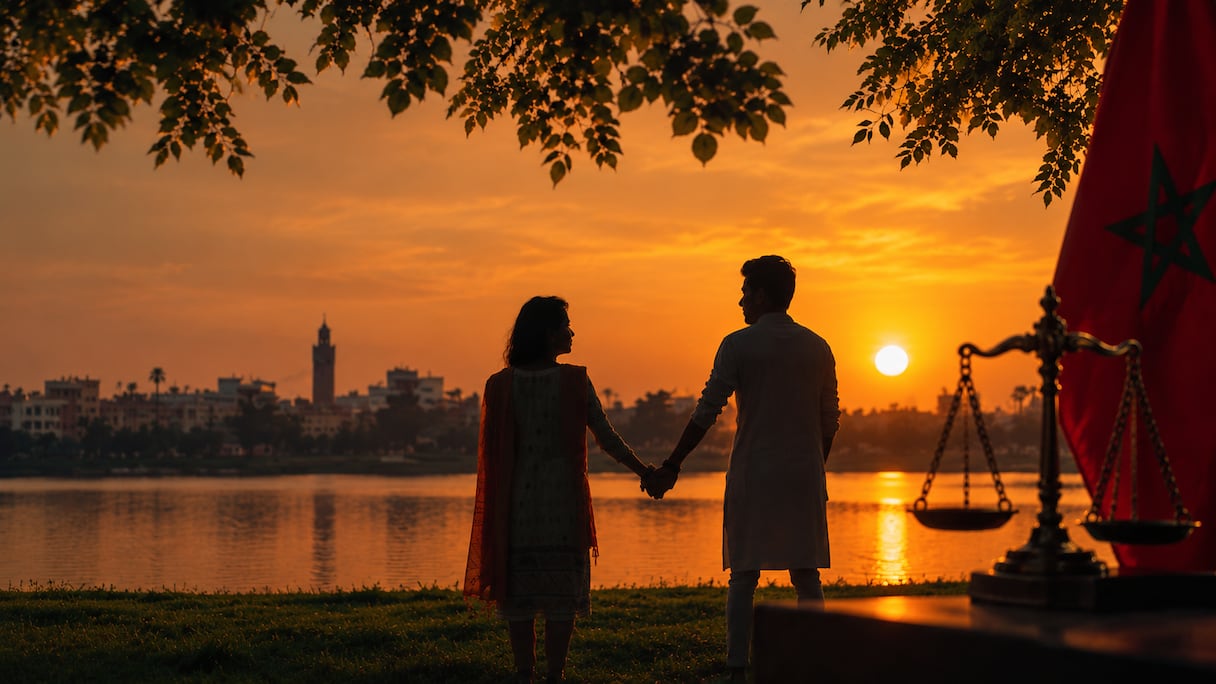
The Authenticity and Modernity Party (PAM)’s victory in the 2026 legislative elections has reignited debate over the criminalization of sexual relations outside marriage. On Reddit, several posts have drawn comparisons between two statements by party figures, interpreting them as possible early signs of a move to decriminalize consensual sex outside marriage.
The first statement dates back to August 2024. In an interview with Hespress, Justice Minister Abdellatif Ouahbi defended proposals for legal reform and opposed automatically criminalizing couples living together outside marriage in private spaces. Referring to the saying that when a man and a woman are alone together, “the devil is the third among them,” he replied: “The devil should present his ID card to testify.” His remarks sparked controversy both publicly and on social media.
The second statement came from Fatima Ezzahra El Mansouri, head of government, mayor of Marrakech and a PAM member: “We have differences with the PJD on social issues and on our modernist vision of Moroccan society.” Although she did not specify which issues she meant, some internet users saw her remarks as an extension of Ouahbi’s position.
The debate has drawn opposing reactions. Some users denounce society’s hypocrisy over sex outside marriage, while others argue that existing laws offer protection. Although these exchanges are not representative of public opinion, they illustrate how polarizing the subject remains.
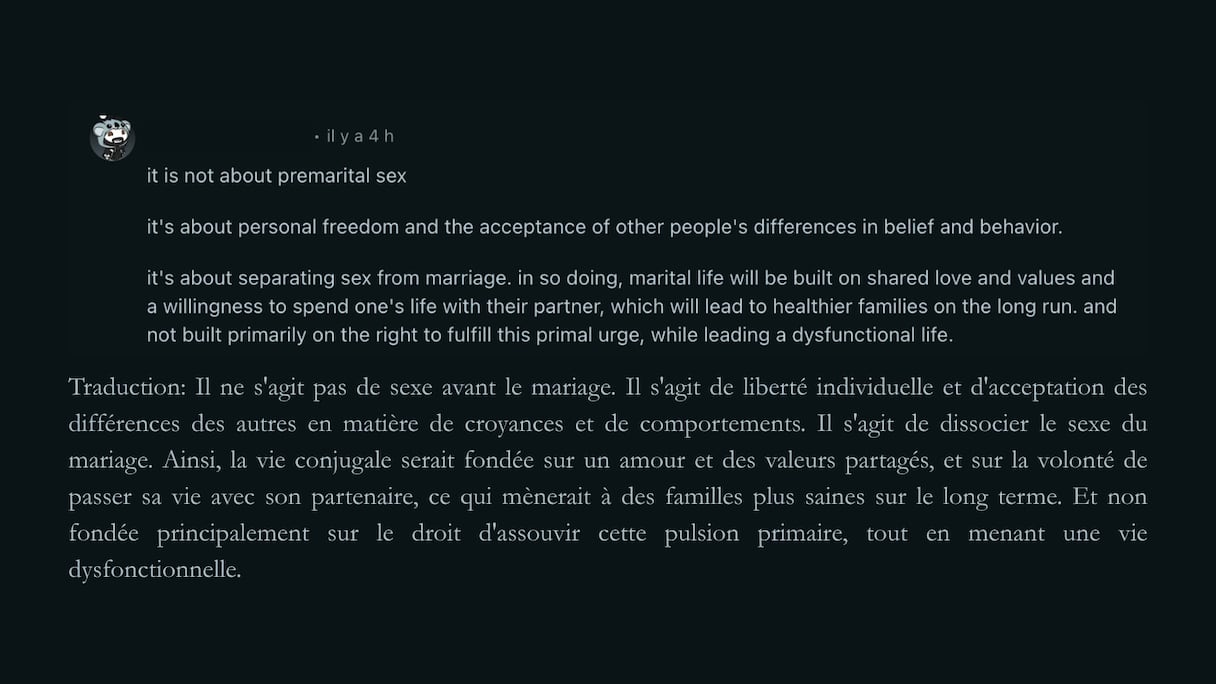
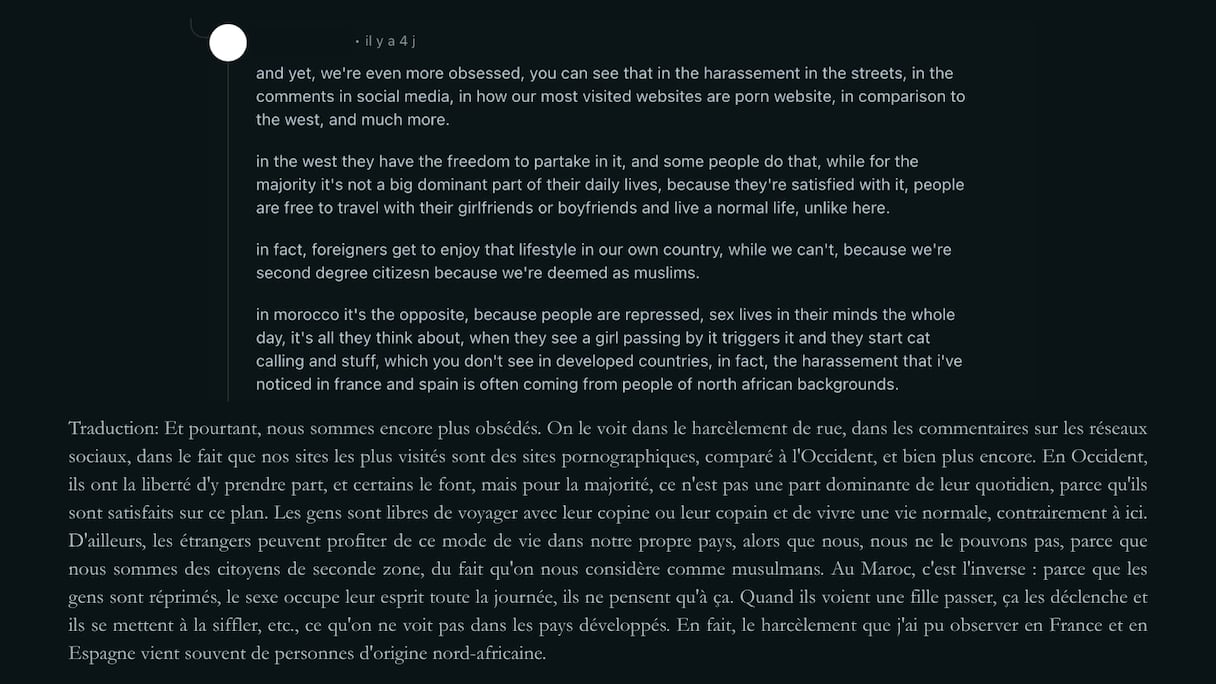
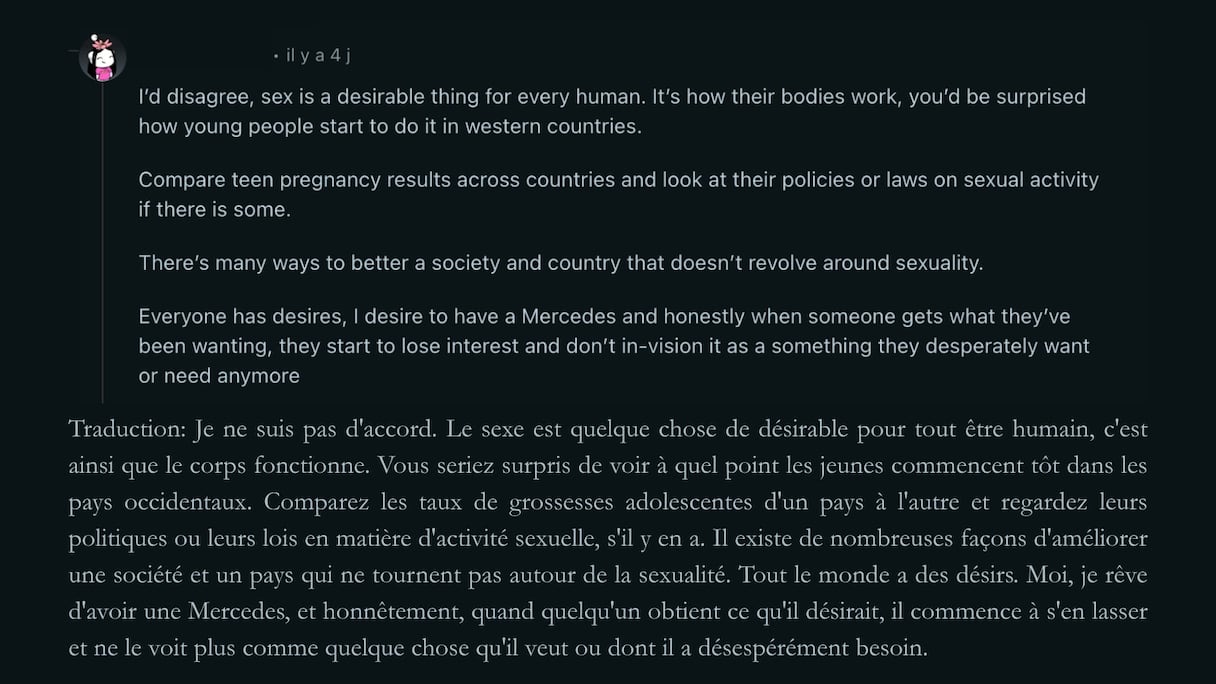
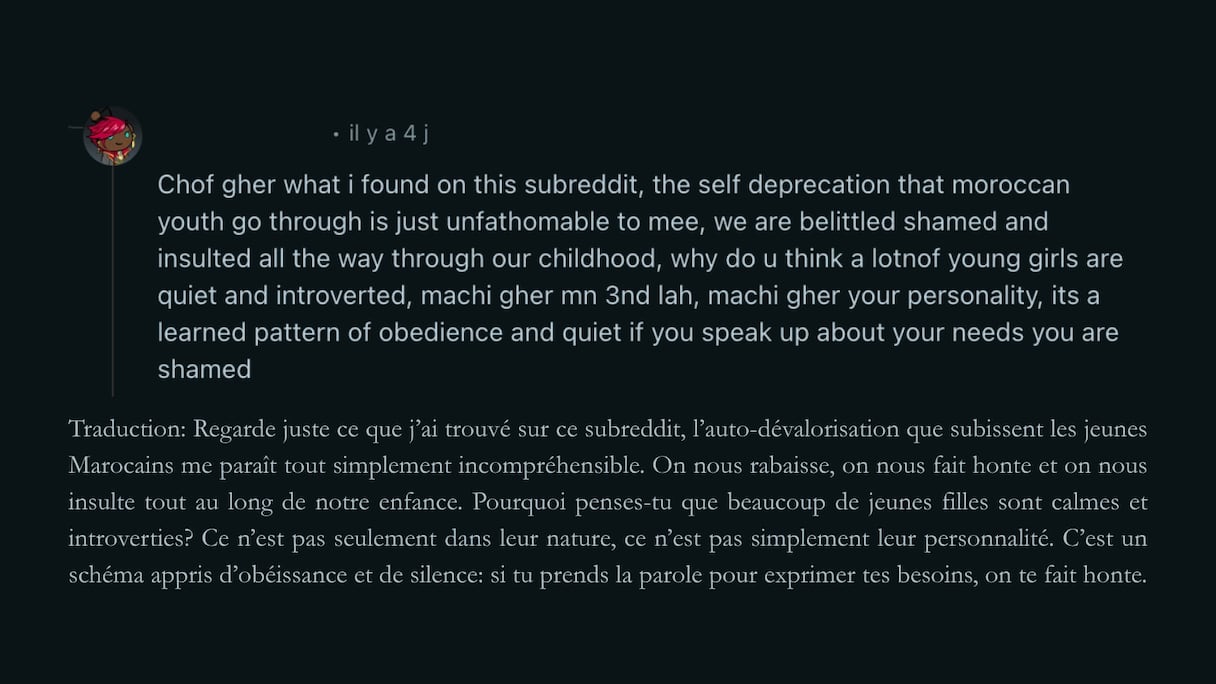
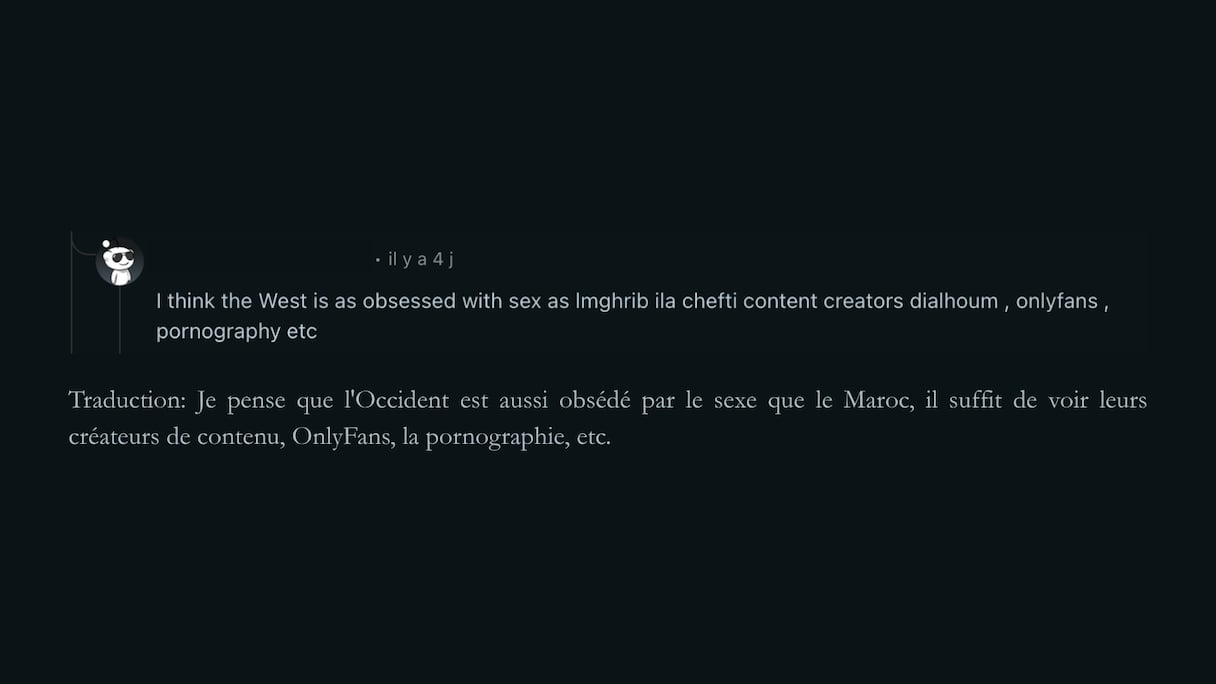
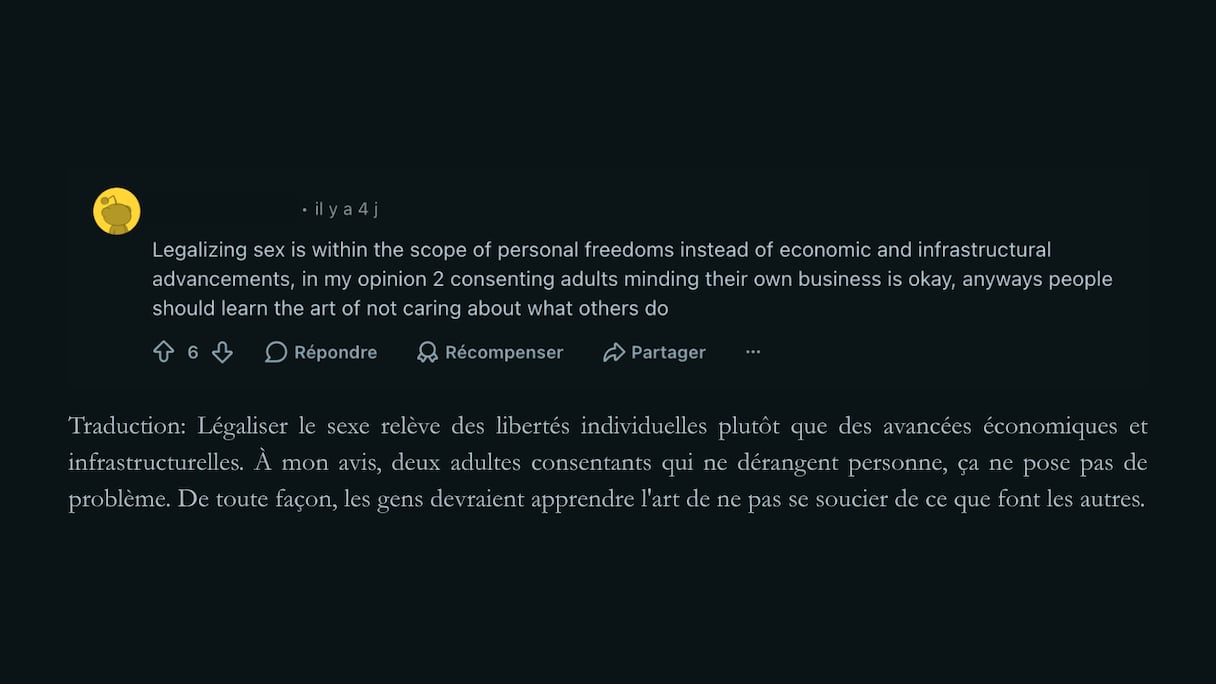
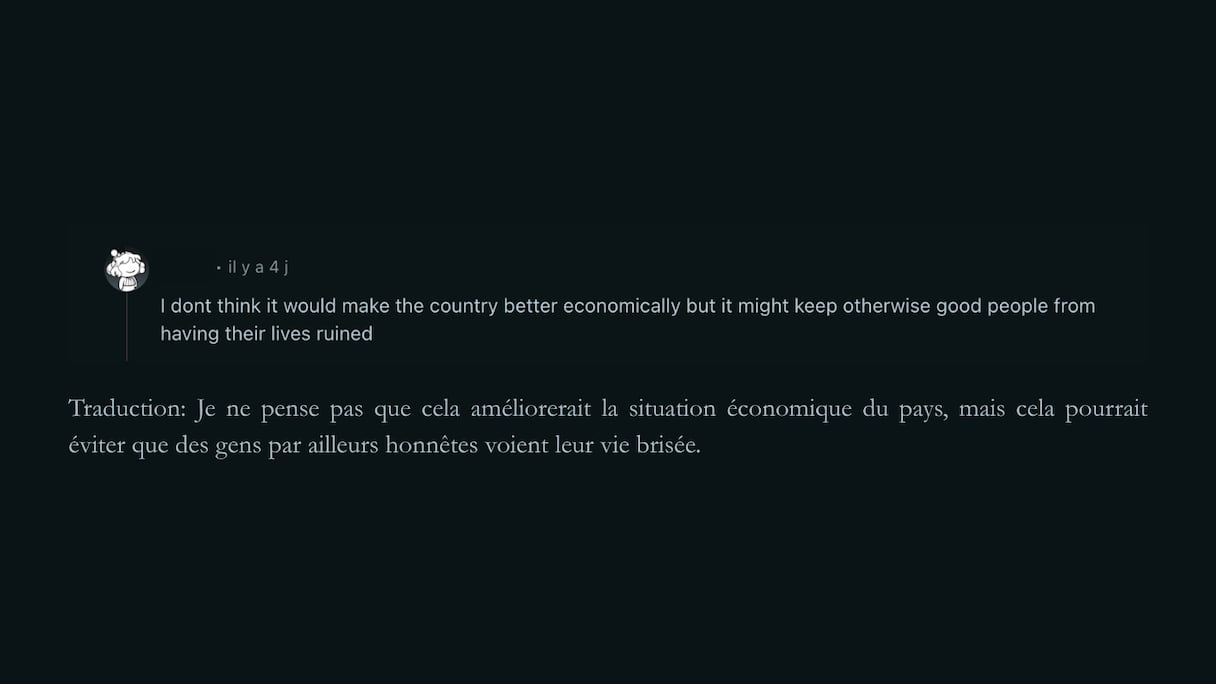
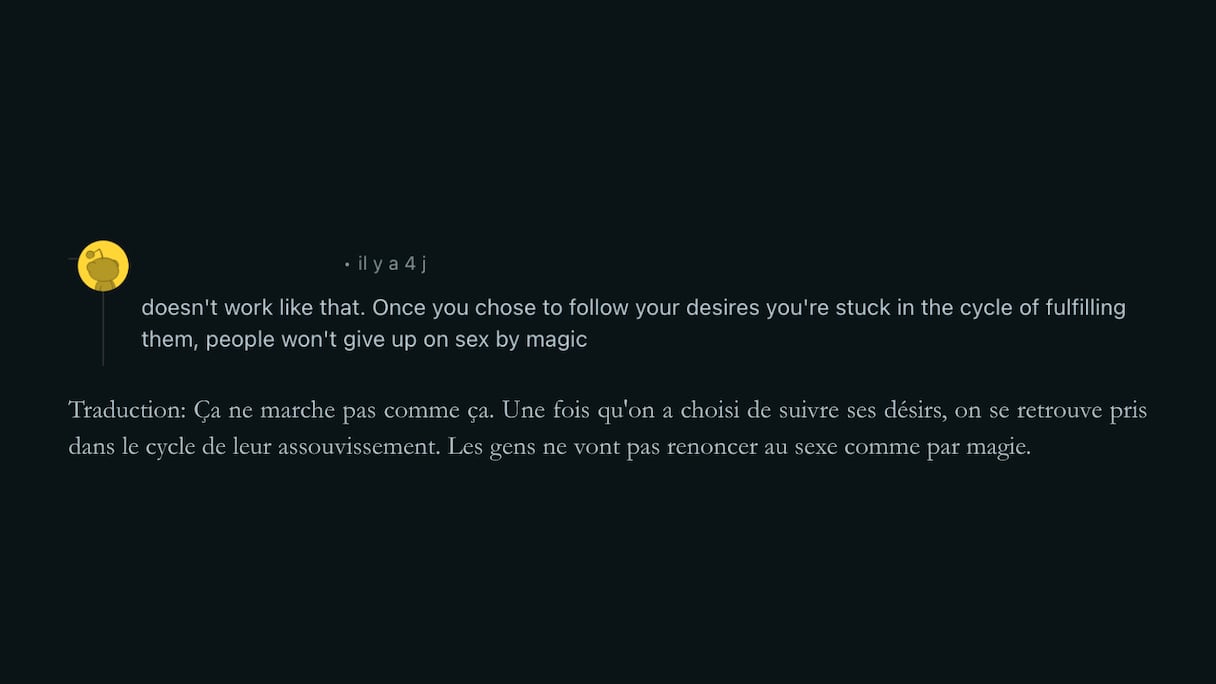
On Reddit, Moroccan users debate the legalization of sexual relations outside marriage.
At the center of the debate is Article 490 of the Penal Code, which makes sexual relations between unmarried people of different sexes punishable by one month to one year in prison. In 2020, the organization Mobilizing for Rights Associates (MRA) recorded 13,018 prosecutions under the provision.
A 2021 study of individual freedoms in Morocco, conducted by Menassat, highlights the gap between the law and social practices. Some 76.3% of respondents believed consensual sexual relations were very widespread in Moroccan society, while half considered premarital sex a matter of individual freedom for both women and men.
Perhaps more strikingly, the study found that 69.2% of respondents were unaware that Article 490 existed. Once informed of its provisions, opinion remained divided, with a narrow majority favoring keeping the law. Opponents cited individual freedoms but also argued that legislation should not be responsible for shaping social morals or providing moral education.
Speaking to Le360, sociologist Soumaya Naamane Guessous summed up the disconnect: “Morocco has changed, society has changed, young people have changed.” One of the most important factors, she said, is the rising age of marriage. In the past, young people married “practically at puberty,” allowing them to pursue their sexual desires within the law. Today, the average age at marriage is 24 for women and 32 for men. Mixed-gender socializing, social media, pornography and greater freedom of movement in public spaces have also contributed to changing behavior. The sociologist cautioned, however, that no institution has reliable figures on the prevalence of such practices.
Read also : El Mansouri Gov’s proposed 5,000-dirham marriage grant: What we know so far
These changes have not affected men and women equally. Naamane Guessous describes a society that is “very permissive about premarital sex” for men while continuing to forbid it for women. In wealthy households, which she describes as “a small minority,” a son may be allowed to invite his partner home, whereas families that permit their daughters to do the same remain “very rare.” In her view, “the overwhelming majority of families want their daughters to be virgins when they marry.”
Couples are stopped by the authorities less frequently than they once were, the sociologist observes. But “as long as the article remains in place,” unmarried couples can still be “subject to checks and harassment.” She points to the hotel sector, where a Justice Ministry circular instructed hotels to stop requiring marriage certificates. Its implementation varies from one establishment to another. Foreign visitors are not asked for the document, but for Moroccan guests, the outcome “depends on the person at the reception desk,” she said.
For both Naamane Guessous and filmmaker Sonia Terrab, founder of the Moroccan Outlaws 490 movement, it is the most vulnerable who bear the brunt of the law. “The people who really pay the price are vulnerable groups,” the sociologist says, citing young people, women and the working classes. In an interview with RFI on January 12, 2020, Terrab recalled meeting numerous young people while filming a documentary about marginalized youth who had been jailed simply for walking in public with their girlfriends. During a screening inside a prison, she said she asked inmates how many were incarcerated under these laws. According to her account, “half raised their hands.”
For Naamane Guessous, framing the debate solely in terms of sexual freedom would be “reductive.” She draws a connection between the legal prohibition and the plight of single mothers and abandoned children. According to the sociologist, a child born outside marriage is not legally recognized as a legitimate child, and the law does not require the father to acknowledge paternity, “even in cases of rape.”
She also points to the absence of public discussion about contraception outside marriage, apart from occasional campaigns around World AIDS Day. She says representatives of the Ministry of Endowments and Islamic Affairs have argued that discussing the subject would amount to “encouraging” it. In her view, acknowledging the reality would instead make it possible to raise awareness about preventing unwanted pregnancies and encourage men to take responsibility for contraception.
Read also : Morocco: New govt pledges social media ban for children under 15
Living in constant violation of the law
Beyond these practical consequences, the women interviewed describe the psychological burden the law places on those affected. Naamane Guessous speaks of “unease” and a sense of “insecurity” arising from constantly living in breach of the law, under what she likens to the “sword of Damocles.” She also links the resulting frustration to street harassment.
Speaking to RFI, Terrab described the hundreds of testimonies received through her movement’s social media pages: young people recounting humiliation at the hands of police officers or people around them; others saying they had left Morocco because of these laws; and young women describing abortions endured in shame and suffering.
From a legal perspective, Fidae Irissi Ismaili, a lawyer at the Casablanca Bar, sets out two sets of arguments in a video shared on Moroccan Outlaws’ social media accounts. The first concerns Morocco’s international commitments. She argues that Article 490 is incompatible with the Convention on the Elimination of All Forms of Discrimination against Women, General Recommendation No. 35 of the committee overseeing its implementation, the United Nations Charter and other UN conventions to which Morocco is a party.
The second argument is constitutional. The lawyer points out that the preamble to Morocco’s Constitution gives precedence to international conventions ratified by the country. She also cites Article 24, which states that “everyone has the right to the protection of their private life”.
Although statements such as those made by Ouahbi and El Mansouri are enough to revive the debate, politicians rarely address the issue publicly, Naamane Guessous observes. They may discuss it “behind closed doors,” she says, but avoid taking a public position for fear of “losing electoral support.” She cites a proposal to ease restrictions on abortion that was submitted to Parliament but never put to a vote.
More broadly, the sociologist attributes the lack of legislative progress to insufficient mobilization by civil society, persistent “resistance,” and a period she characterizes as one of “obscurantism, with Wahhabism.” She also links young people’s abstention from elections to the failure to bring about legislative change.
As early as January 2020, Terrab argued that political parties were struggling to reach 18- to 24-year-olds, an age group she described as “completely apolitical.” She also pointed to internal divisions within parties over these issues and said she was “very skeptical” that more young people would turn out to vote in the 2021 elections.
To break the deadlock, Naamane Guessous proposes starting by “sitting down and having a calm discussion.” She then advocates repealing Article 490 in the name of individual freedom, while accompanying that change with policies to guide and educate young people, whose understanding of these issues, she says, is now shaped largely by social media and the internet.
