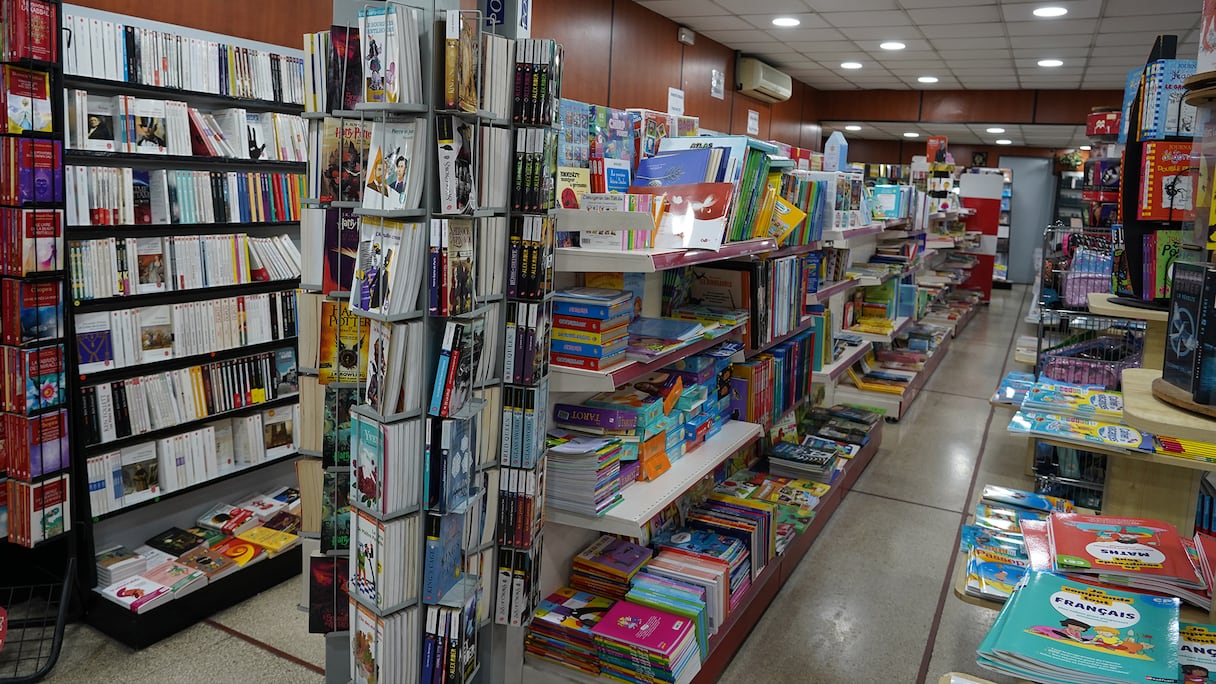
In Casablanca, the start of the school year has not put an end to the hunt for textbooks. With lists in hand, parents continue to go from one bookstore to another, hoping to find the titles they are still missing. According to the booksellers interviewed, some titles are only now beginning to arrive on shelves, while others remain unavailable.
“Many textbooks are currently missing, particularly those from the ‘Al Raed’ collection, which have become impossible to find on the market,” says Majida Belkadi, manager of the Libre Service bookstore. According to her, several other textbooks approved by the Ministry of National Education, including “Al Moumtaz,” “Mourchidi” and “Fi Rihab,” are also unavailable.
“Arabic-language textbooks are the ones in shortest supply,” she confirms. The shortage has forced parents to go from one bookstore to another. “They spend their time searching here and there without knowing where to find the books their children need,” Majida Belkadi adds.
The situation is similar in the Habous neighborhood. One bookseller lists several titles that remain difficult to find, including “Al Manar.” “There are a particularly large number of unavailable textbooks this year,” she says.
Some titles are nevertheless beginning to arrive in small quantities. “There is a science activities textbook that we have not even received yet. ‘Al Moufid’ and ‘Étiquette,’ for baccalaureate students, have only just arrived,” she explains. According to her, many other books are still arriving late.
Read also : Back-to-school rush boosts demand for books and school supplies in Fez
According to the bookseller, nearly 30 titles could still be unavailable. Among them is “Al Raed,” whose printing remains uncertain. “We do not even know yet who is going to print it. The publisher that previously handled it no longer does so, and we do not know who has been given the printing contract,” she continues.
Booksellers say these delays could have been avoided with better planning. “Normally, everything should be available as early as June, since the titles selected for the school year are already known,” the Habous bookseller says. In some years, however, supply difficulties can continue well after the start of the school year. “The problem can last until October, with some textbooks still unavailable,” she regrets.
At the Maârif Culture bookstore, Brahim Boulahcen reports the same situation. According to him, some books, particularly among the new French editions for 2026, have not yet arrived in Morocco.
Supply difficulties also affect textbooks published and printed locally. “There are also shortages of public-school curriculum textbooks produced in Morocco,” he says. The reasons behind these shortages remain difficult to determine, according to him. “Either the quantities printed are insufficient, or demand was not properly anticipated. In the end, demand exceeds supply,” he says.
Read also : Back-to-school shopping brings new buzz to Rabat’s medina
The manager of Maârif Culture also points to the direct sale of textbook packages by some private schools, a practice he considers unfair competition. “Moroccan private schools sell packages of schoolbooks directly on their premises,” he says. According to him, the practice continues despite guidelines intended to regulate it and contributes to disrupting supplies to bookstores.
For Hassan El Kamoun, president of the Independent Booksellers Association of Morocco (ALIM), the current difficulties are also linked to the number of copies of certain textbooks placed on the market, particularly those intended for Pioneer Schools. “The books are printed, but in insufficient quantities. If demand is for 100,000 copies and only 40,000 or 50,000 are placed on the market, stocks are quickly depleted and the shortage continues,” he explains.
Hassan El Kamoun also points to the low margins booksellers receive on some of these textbooks. “We are only given a 10% discount. On a book that costs 4 dirhams, that amounts to 40 centimes,” he says. According to him, that margin barely covers transportation costs and other expenses borne by bookstores. “With such a small discount, we lose out on every level,” he laments.
The ALIM official notes, however, that the difficulties do not affect the entire market in the same way. “Between 80% and 90% of books for private schools are available,” he says. Textbooks for Pioneer Schools and certain ministry-approved books are more affected by availability problems.
Another factor cited is pressure on printing capacity. “This year, for example, the elections competed with the production of books for the start of the school year. Many printing companies are also working on the elections,” Hassan El Kamoun explains.
Read also : MAD 700 in public schools, up to MAD 4,000 in private: The back-to-school Bill
For him, better planning could nevertheless prevent such situations. “Normally, preparations for the school year begin several months in advance. Publishers must know how many copies to print and prepare the books early enough for them to be distributed before the start of the school year,” he says.
But on the ground, the same scenario appears to be repeating itself. “It is a problem that comes back every year. Every school year, we face the same problems,” laments the ALIM president, who is calling on the ministry to better monitor textbook availability and production volumes.
In the meantime, parents continue to bear the consequences of these delays. “They go from one bookstore to another, look for parking, pay parking fees, stand in line and ask everywhere, all in vain,” Hassan El Kamoun says. The race to find textbooks continues even as students have already returned to the classroom.
