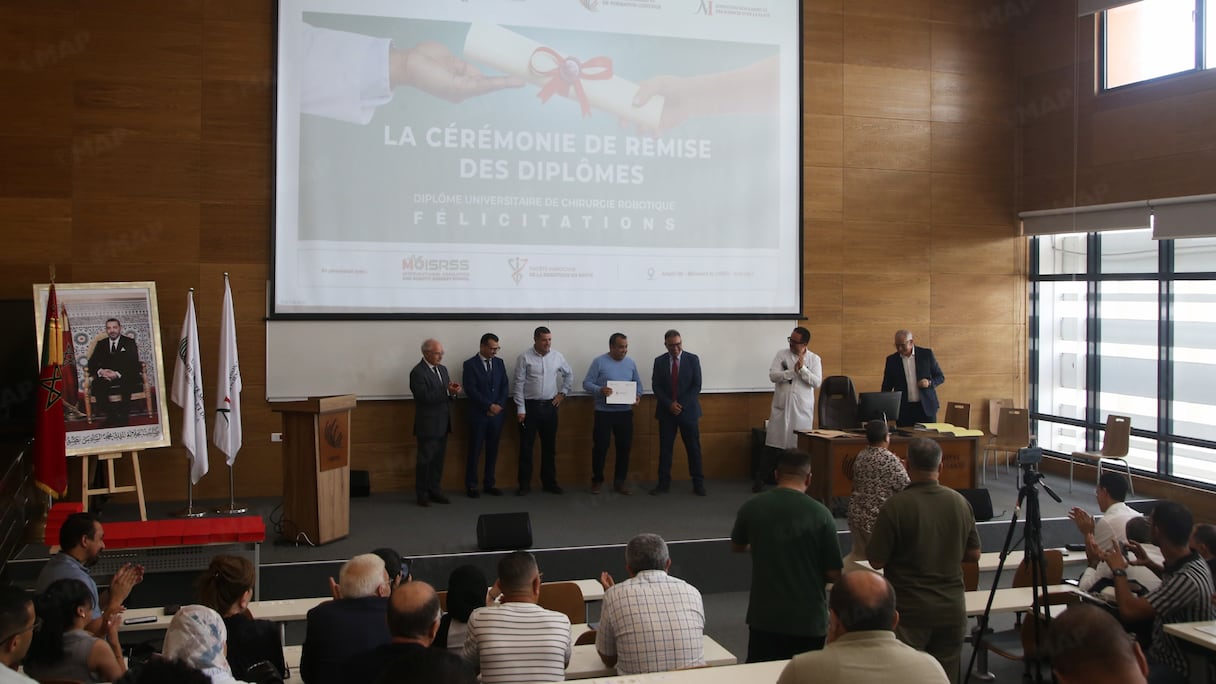
The Mohammed VI School of Interventional Simulation and Robotic Surgery held a ceremony on Saturday, September 12, 2026, at Mohammed VI University of Health Sciences in Casablanca to award certificates to surgeons and operating-room nurses who completed robotic surgery training during 2026.
Launched on January 26, 2026, as part of the school’s academic activities, the program is designed to strengthen health professionals’ skills in robot-assisted surgical techniques by combining theoretical instruction, practical training and simulation.
The training relies on the school’s educational facilities, which include simulation equipment, two robots dedicated to training, augmented reality platforms and several units covering different interventional specialties.
Speaking at the ceremony, Professor Mohamed Chahbouni, director of the Mohammed VI International Center for Simulation in Health and Sciences in Casablanca, stressed the importance of the program in developing health professionals’ skills and keeping pace with the growth of robotic surgery in Morocco.
He said more than 60 surgeons and nurses from Morocco and other African countries have benefited from the training, helping to strengthen national expertise and support the development of robotic surgery in the Kingdom.
Chahbouni also highlighted the role of simulation in acquiring and refining technical skills, as well as improving the safety of surgical procedures.
Professor Jacques Hubert, a urologist and emeritus professor at the University of Lorraine, also stressed the importance of training and simulation in helping health professionals understand and use robotic technologies.
He explained that robot-assisted surgery requires specialized preparation and gradual learning, allowing surgeons and operating-room teams to master the different stages of a surgical procedure in a controlled environment before applying them in practice.
Hubert said such training mechanisms can help improve the quality of surgical procedures and patient safety, stressing the importance of supporting the gradual integration of robotic surgery through training programs tailored to different medical specialties.
Sofiane Samoud, an assistant professor of pediatric surgery and one of the program’s trainees, spoke about the importance of the training for his professional practice. He said the program provides health professionals with a better understanding of new technologies in surgery.
He particularly emphasized the value of simulation and hands-on training in acquiring new skills and preparing health professionals to use robotic systems.
The Mohammed VI School of Interventional Simulation and Robotic Surgery is affiliated with the Mohammed VI International Center for Simulation in Health and Sciences, which operates under the Mohammed VI Foundation for Health Sciences, and is part of the Mohammed VI University of Health Sciences.
The school is also an academic, educational and technological institution dedicated to training, research and innovation in surgery and interventional specialties. Its mission is to develop initial and continuing education programs for health professionals, with the aim of advancing medical excellence and strengthening patient safety.
