The figures are included in the 2027 gender-responsive performance budget report, accompanying the draft Finance Bill. The report examines the gap between women’s growing educational qualifications and their limited access to stable employment, as well as the social, economic and institutional barriers that continue to restrict their participation.
The gap is visible across several indicators. Women remain underrepresented among salaried workers, are more exposed to unemployment and are concentrated in lower-paid income brackets. They also face greater difficulties accessing healthcare coverage, financing businesses and balancing paid work with family responsibilities.
Moroccan women make gains in education, but remain largely shut out of the labor market
Girls’ access to education has improved considerably over recent decades. According to the report, reforms to the national education and training system, including the 2022-2026 education roadmap, have helped narrow the gap between girls and boys across different levels of schooling.
Female students now account for nearly 48% of pupils in preschool and primary education. Their share exceeds 50% in upper secondary education and reached 56.1% in higher education during the 2024-2025 academic year, up from 51.6% in 2020-2021.
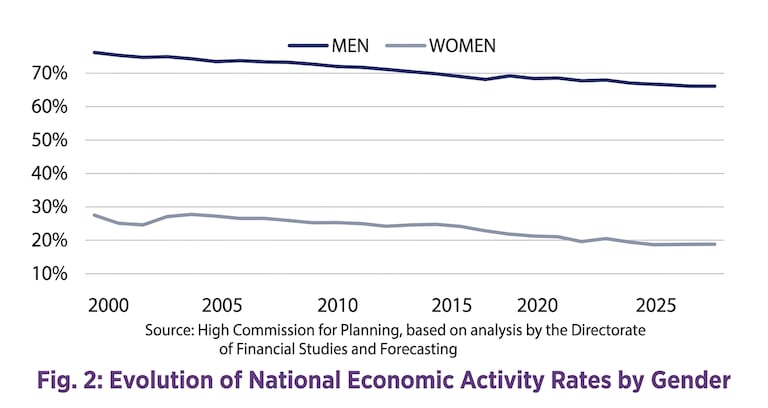
Yet the trend in economic participation has moved in the opposite direction. The female activity rate dropped from 30.4% in 1999 to 19% in 2025, a decline of 11.4 percentage points. The male rate also fell over the same period, from 79.3% to 68.5%, but remained almost 50 percentage points higher.
Education improves women’s chances of entering the labor market, but it has not shielded even the most qualified from the decline. Among women with higher education qualifications, the activity rate fell from 60.9% in 2000 to 45.4% in 2025. It also declined among women with intermediate qualifications, from 23.1% to 12.8%, and among those without qualifications, from 26.8% to 14.4%.
The figures suggest that the problem is not limited to access to education. The labor market has not absorbed women’s growing qualifications at a comparable pace.
Rural women face the steepest decline
The decline has been pronounced in rural areas. The activity rate among rural women fell from 36.9% in 2014 to 18.2% in 2025, a drop of 18.7 percentage points.
In urban areas, the rate moved in the opposite direction, rising slightly from 17.8% to 19.4% over the same period. The report identifies the sharp fall in rural women’s participation as the main factor behind the overall decline at the national level.
Age also shapes women’s participation. Among those aged 15 to 24, the activity rate dropped from 25.8% in 2000 to 11.8% in 2025. For women aged 25 to 34, it fell from 34.4% to 31.3%.
The gap becomes especially wide among women aged 35 to 44. In 2025, their activity rate stood at 23%, compared with 94.3% among men of the same age group, a difference of 70.5 percentage points. Among women aged 45 to 59, the rate declined from 28% to 21.2% over the 2000-2025 period.
Care responsibilities weigh on women’s employment
Family responsibilities are another factor examined in the report. Data covering 2020 to 2024 show that women’s activity rates vary according to the number of children under 15 in their households. Rates are highest among women in households without children, fall to their lowest level in households with two children, then rise again among those with three or more.
The report also draws attention to Morocco’s demographic changes and the pressure they could place on unpaid care work, which is largely performed by women.
People aged 60 and over accounted for 13.6% of the population in 2024, up from 9.4% in 2014. Their share is projected to reach 25.2% by 2060. At the same time, the average household size fell to 3.9 people in 2024.
Read also : Morocco expands protections for women working on Spanish farms
The old-age dependency ratio rose from 13.1% in 2004 to 22.6% in 2024 and is expected to reach 36% in 2040 and 43.8% in 2060. These changes, alongside the growing prevalence of nuclear households, could increase the demand for family care and further limit women’s ability to take up or remain in paid employment.
Female unemployment reaches 20.5%
Women who do enter the labor market also face a higher risk of unemployment. The female unemployment rate rose from 12.8% in 2000 to 20.5% in 2025, while the male rate fell from 13.6% to 10.8%.
The situation is more difficult in cities, where female unemployment stood at 26% in 2025, compared with 8.1% in rural areas. The urban rate was 26.7% in 2000, while the rural rate stood at just 1.7%.
Higher education does not necessarily protect women from unemployment. Among women with higher qualifications, the rate reached around 34% in 2025, against 19.7% among men with the same level of education. Women with intermediate qualifications recorded an unemployment rate of 25%, compared with 13.5% for men.
Among people without qualifications, the rates were much closer, at 4.8% for women and 4.6% for men.
The report also highlights the large number of young people outside employment, education or training, commonly known as NEETs. In 2023, this group included around 2.94 million people aged 15 to 29, representing 33.6% of the age group.
Women accounted for approximately 72% of this population, and were nearly three times as likely as men to be outside work, education or training. Marriage and having young children are among the factors associated with young women’s exclusion from economic activity.
The report notes that the likelihood of belonging to this group rises with age, from 25.6% among those aged 15 to 24 to 50.2% among those aged 25 to 29.
Services become the main employer, but pay gaps persist
Women’s employment has also shifted across economic sectors. Services became the leading employer of women, accounting for 51% of female employment in 2025, compared with 20.5% in 2000.
Agriculture, forestry and fishing saw their share fall from 62.1% to 32.1% over the same period. Industry, including handicrafts, accounted for 16% of female employment in 2025, down from 17.4%.
The report points to persistent inequalities in pay and social protection. Women represented 32% of employees declared to the National Social Security Fund (CNSS) in the private sector in 2025.
The average declared monthly wage stood at 6,276 dirhams for men and 5,885 dirhams for women, a difference of 6.6%. More than half of female employees declared to the CNSS, or 52.2%, earned between 1,000 and 3,266 dirhams a month, compared with 34.2% of men.
A study cited in the report found that the unexplained component of the overall wage gap, attributed to gender-based pay discrimination, accounted for around 91% of the difference.
Access to healthcare coverage has improved, but remains limited for many working women. Between 2017 and 2025, the share of employed economically active women without health coverage fell from 77.8% to 59.7%. Among female salaried workers, the proportion declined from 48.4% to 35.7%.
Women manage fewer than one in six businesses
The gap also extends to entrepreneurship. Women managed 60,363 businesses in 2024, out of a total of 388,446, representing 15.6% of all businesses.
Their presence varies significantly by sector. Women account for 45% of businesses in other services and 43.1% in human health and social work. Their share reaches 30.2% in education and around 24% in financial, scientific and technical activities.
By contrast, women manage 17.4% of businesses in trade, 14.8% in manufacturing, 9.8% in transport and storage, 8.2% in construction and 6.8% in extractive industries.
Access to finance remains a major obstacle. Businesses led by women account for just 10.8% of total loans, according to the report, which identifies financing, professional networks, skills and access to markets as areas requiring further support.
Read also : Only 19% of Moroccan women are in the labor force, World Bank says
Barriers extend beyond qualifications
The report identifies a combination of labor market, family and social factors behind women’s low economic participation. These include the availability of jobs, wages, childcare services, transport, workplace conditions and employers’ recruitment practices.
Survey data from the Arab Barometer cited in the report show that women identify the lack of available jobs as their main obstacle to employment, at 17.9%. The absence of childcare facilities comes next, at 14.5%, followed by low wages at 13.6% and prejudice against women during recruitment at 13.2%.
Other concerns include insufficient legal protection, cited by 10.3%, limited social acceptance of women’s employment at 8.9%, inadequate skills and training at 7.7%, inflexible working hours at 7.1% and a lack of transport options at 6.9%.
A 2026 World Bank assessment included in the report also points to areas where Morocco could improve its legal and institutional framework. The country scored 60.95 in the legal frameworks category, below the global average of 66.97.
It performed above the global average in supporting frameworks, with 49.38 points against 46.83, and scored 52.34 in the assessment of perceptions of law enforcement, compared with a global average of 53.31. Childcare, transport and pay remain among the areas identified for further progress.
Government measures target childcare, transport and financing
The report outlines several public initiatives intended to improve women’s access to employment. One measure under the national employment roadmap seeks to reduce barriers by expanding childcare facilities and preschool services, developing transport solutions for working women and extending public lighting in semi-urban areas.
The Finance Ministry’s Directorate of Studies and Financial Forecasts has also established a unit to collect and analyze gender-disaggregated data at national and local levels, allowing authorities to monitor developments and assess interventions.
In 2026, the directorate worked with UN Women on a study exploring the use of big data to track gender gaps in labor market access. The work included developing a digital gender dividend indicator, mapping childcare services and identifying geographically isolated areas.
Another initiative, launched in July 2023 by the Ministry of Economy and Finance in partnership with the World Bank, seeks to develop a roadmap for women’s economic inclusion. Its four priorities are financial inclusion and access to resources, working conditions, transport and mobility, and childcare.
The initiative includes measures to improve women’s access to digital financial services and business financing, encourage more flexible working arrangements, make public transport safer and more accessible, and expand childcare provision.
Read also : Seven women, 11 ministers delegate in El Mansouri’s 32-member cabinet
In June 2026, the ministry established a dedicated unit for women’s economic inclusion to oversee the initiative and monitor its implementation.
The report also refers to Morocco’s national strategy to promote the care economy through 2035, presented in July 2026. Developed with support from the International Labour Organization and UN Women, the strategy covers childcare, care for older people who lack independence, support for people with disabilities, and the needs of family caregivers and care workers.
It is structured around five priorities, including expanding care services, formalizing care professions, securing sustainable financing, promoting a fairer distribution of care responsibilities and strengthening governance. The strategy includes 21 policy directions and 103 proposed projects.
