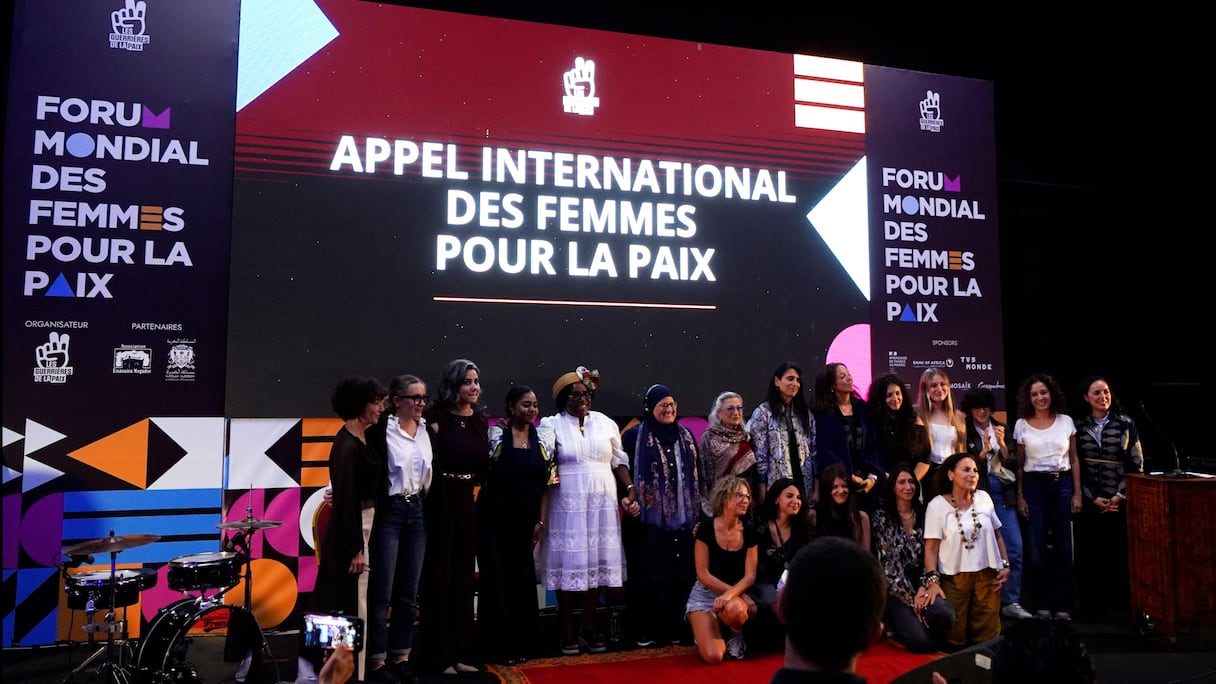
They came from Iran, Afghanistan, Palestine, Israel, Sudan, Cameroon and other countries. Their homelands are at war or have been caught up in conflict, yet on Saturday, November 14, they sat together around the same table in Essaouira. Almost all had lost someone, a brother, a friend, a home. That is where their stories began.
Essaouira has long been a place of coexistence. For centuries, Muslims, Jews and Christians shared its streets, earning the city a reputation that Hanna Assouline describes as a “haven of peace and tolerance.” It was against this backdrop that women whose lives and experiences might otherwise set them apart found room to speak to one another.
During a panel dedicated to the “International Women’s Call for Peace,” participants spoke about things that are rarely said aloud. They described what it means to carry war in their bodies, in their families and in their memories, each sharing her experience in her own way.
Their backgrounds and struggles were different, and their wounds were not the same. But they shared one goal: to make peace more than an ideal or a distant hope. They want it recognized as an urgent demand, voiced by women who often bear the heaviest cost of conflict.
Hanna Assouline, founder of the Peace Warriors
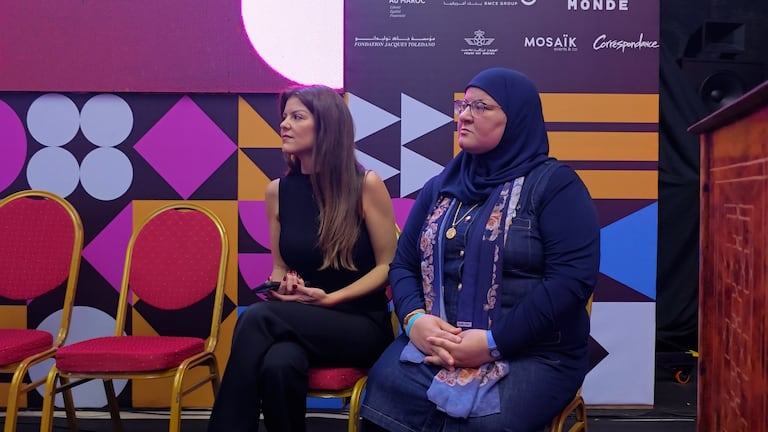
For Hanna Assouline, founder of the Peace Warriors movement, peace has never been just a cause to fight for. “It is first and foremost an identity, and it is also a Moroccan identity,” she said.
A French-Moroccan woman of Jewish faith, Assouline said she had carried this sense of plurality with her since childhood. It is the foundation, she explained, for everything she does today.
“It is this need to bring people together, to repair what has been broken and to highlight everything we have in common, at a time when everyone is trying to divide us, reduce us to labels, turn us against one another and make us believe that our differences are reasons to fight, when they are actually our greatest wealth,” she added.
The choice of Essaouira was therefore no coincidence. For Assouline, the city represents fraternity and, in this case, sisterhood between Muslim and Jewish women.
«The people who know what war costs, the people who have paid the price, are the ones who know what peace demands.»
— Hanna Assouline
Around her were Israeli, Palestinian, Iranian, Afghan and Sudanese women, many of whom had lost loved ones. Assouline did not try to soften that reality. Instead, she sees it as a source of strength for the movement.
“Very often, it is from the very heart of pain that lessons in dignity and resilience emerge. They impose on us a sense of responsibility, but also humility.”
For her, there is no contradiction in women who have suffered through war becoming some of the strongest advocates for peace.
“The people who know what war costs, the people who have paid the price, are the ones who know what peace demands. They know there is no other option but to fight even harder to save their future and that of their children.”
She called for these women to be given platforms and for their voices to be heard everywhere, until they drown out the language of hatred.
Read also : Bayt Mal Al-Quds Agency distributes 3,000 school kits to students in Jerusalem ahead of new school year
Ghadir Hani, Palestinian activist and Israeli citizen
Ghadir Hani took the stage with women from Sudan, Afghanistan, Iran, Cameroon, France, Morocco, Palestine and Israel standing behind her. A Palestinian and Israeli citizen, she opened her remarks with a personal admission: “My heart is heavy with shared pain, but it is full of hope.”
Hani comes from a region where war is often presented as inevitable. She knows how the conflict operates, she said: “Men manage the conflict behind closed doors, while women pick up the pieces and try to rebuild what remains of our broken societies.”
From Kabul to Khartoum, and from Gaza to Tel Aviv, she said, conflicts are interconnected.
«There can be no lasting peace without justice, and no security without women at the decision-making table.»
— Ghadir Hani
Male violence and war serve the same purpose, she argued: silencing women. “But today, shoulder to shoulder, hand in hand, the time for silence is over,” she said.
Pinned to her lapel was a badge bearing the number of UN Security Council Resolution 1325, which calls for women’s participation in peace negotiations. For Hani, it is not an accessory but a demand.
“There can be no lasting peace without justice, and no security without women at the decision-making table.”
Her struggle is deeply personal. She rejects a world in which people are killed, starved or held hostage, whether they are Palestinian or Israeli children.
“Opening your heart to another person’s pain in difficult times is not a sign of weakness. It is the highest form of political and human courage.”
When each side retreats into its own suffering, she warned, the war never ends.
“We are not asking for peace as a crumb or an act of goodwill. We demand it as a human right. We refuse to remain eternal victims. We refuse to be enemies. We are the makers of a shared future.”
Nava Hefetz, rabbi
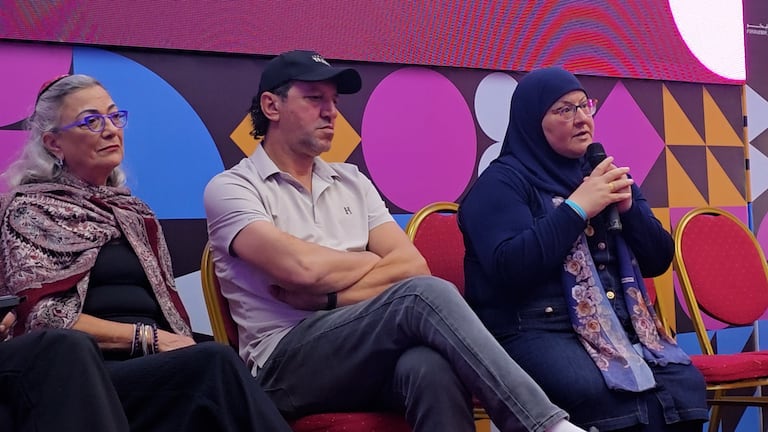
“I have been disowned by my entire family, except for my children. They call me a traitor. They tell me to go to Gaza and let Hamas rape me. But I absolutely refuse to give in. Despair is not a work plan. We have hope, and we turn that hope into action.”
Nava Hefetz, an Israeli rabbi based in Jerusalem, campaigns for women to have a place in decision-making in both Israel and Palestine. She said her commitment to this cause had led to rejection by members of her own family.
After greeting Hanna Assouline, whom she described as her “adopted daughter,” Hefetz opened her speech with a call for change: “This is not the time for smiles. This is the time for change.”
She said she had already seen signs of progress. The conflict in her region has lasted more than a century, longer than the Hundred Years’ War in Europe, she noted, yet women remain excluded from decision-making.
«I am an Israeli woman. I am a Palestinian woman, an Iranian woman, a Sudanese woman, a Cameroonian woman, an Afghan woman, a Moroccan woman.»
— Nava Hefetz
In Israel’s most recent elections, 33 women were elected to the Knesset. Hefetz said this result came from a collective effort. For more than a year, a group of women had met the leaders of almost every political party to demand so-called zipper lists, alternating between male and female candidates.
Her work also extends to Gaza. Together with Professor David Hassan, she founded children’s villages and a center for women there. She recalled asking women at the center what they needed most urgently.
“A shower. We haven’t been able to touch one another for months. We live in camps, with men all around us.”
Hefetz said the response showed how easily basic needs can be overlooked by people living in more comfortable circumstances.
“It’s something so trivial to us, the privileged. The center now has 1,000 women, and the goal is to bring together 10,000 by 2027. Because one woman, and another woman, and another woman, eventually become a force.”
That conviction was reflected in the identities she listed before the audience.
“I am an Israeli woman. I am a Palestinian woman, an Iranian woman, a Sudanese woman, a Cameroonian woman, an Afghan woman, a Moroccan woman. They are the ones who will bring peace, not men.”
Ghita El Khyari, former Moroccan diplomat
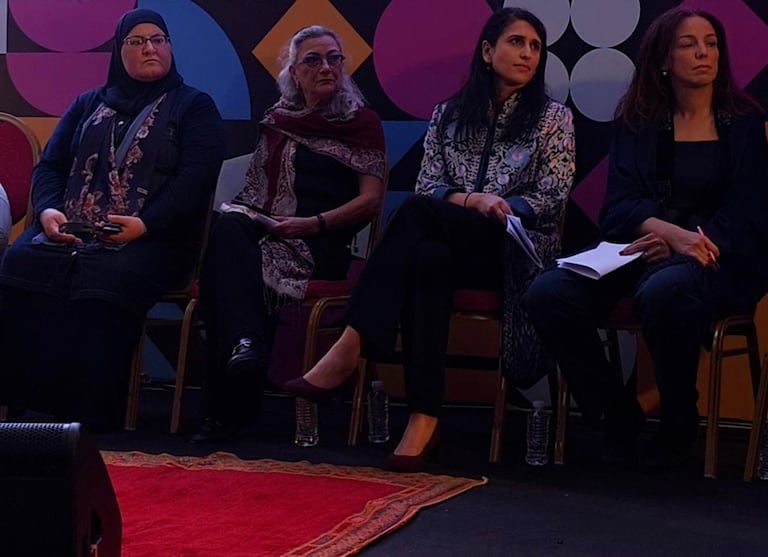
“I don’t come from a country at war. I have never experienced bombs or forced exile. And yet, I too am a Peace Warrior.”
A Moroccan and former head of a United Nations fund dedicated to women, Ghita El Khyari began her speech in Essaouira by explaining what she had not experienced before describing why she nevertheless felt she belonged among the women gathered there.
She said that despite attending numerous international conferences, she had “never been so moved” as she had been during the previous two or three days. She also expressed pride in seeing Morocco support the initiative with such openness and determination.
El Khyari said she appreciated the term “warrior” because it challenged two common misconceptions. The first is that seeking peace is a naive pursuit, when it often demands more courage than armed conflict. The second is the idea that women form a naturally peaceful group.
For her, women’s role in peacebuilding has nothing to do with an inherent quality.
«What makes us more capable of building peace is not so much who we are, but what we go through.»
— Ghita El Khyari
No country in the world has achieved equality between men and women, she said. Discrimination gives women an understanding of what it means to belong to a minority or to be marginalized.
“You recognize them because they carry a part of you within them, just as you carry a part of them within you.”
She said her conviction had been confirmed through her work. In 2016, she built the UN Women’s Peace and Humanitarian Fund from the ground up, shortly after its creation by the United Nations. Starting in four countries, the fund went on to support nearly 1,900 organizations across around 50 countries and mobilize $250 million.
An evaluation found that women’s participation in peacebuilding was the most underused resource available to the United Nations, she said.
“Their right to participate is inalienable. But beyond that, their participation benefits society as a whole.”
El Khyari also cited research indicating that a peace agreement negotiated with women at the table is 35% more likely to last at least 15 years. Women and their organizations, she said, “hold the knowledge” because they understand conditions on the ground and can respond immediately when a crisis occurs.
But she also came to raise the alarm. Women’s participation in peace processes is declining.
“We are at 5%, I think, and that is a warning sign.”
International aid has recently fallen by around a quarter, the largest decline since it began being measured, she said. Nearly half of women’s organizations risk closing within the next six months, while they receive just 0.2% of development aid.
For El Khyari, the repression of these organizations and the withdrawal of their funding are “a dark omen for the future of the countries in which they operate.”
Her appeal to governments and donors came down to one figure: at least 1% of their budgets should be allocated to these organizations.
She acknowledged that her argument might sound overly focused on financial returns, but said it was an effective way to make the case.
“Investing in women’s rights organizations is the best return on investment you can get. They achieve so much with so little. Imagine what they could do with more.”
Read also : On royal instructions, Lalla Meryem receives Al-Quds children taking part in Bayt Mal Al-Quds summer camp
A former UN official, El Khyari said she had experienced many frustrations with the organization. Still, she defended multilateralism.
“We need multilateralism and international law that is applied equally everywhere.”
She ended with a message about funding and peace: “Money is the lifeblood of war, but it is also the lifeblood of the fight for peace. The day we give these women the place and support they deserve, peace will have a real chance.”
Esther Omam, Cameroonian activist
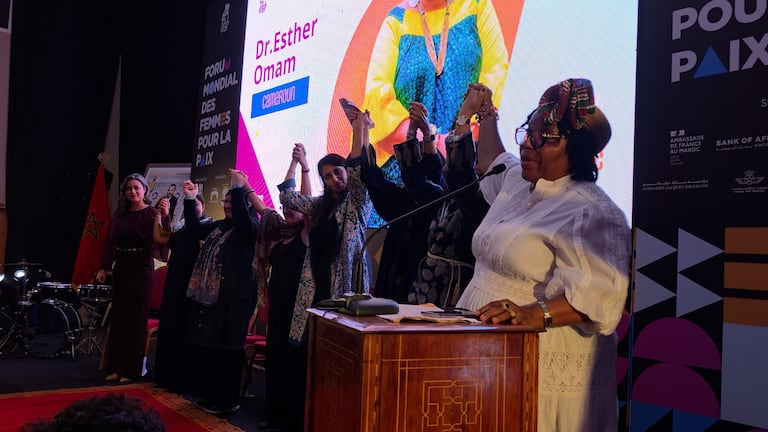
The machetes were already out. Armed men were preparing to slit her children’s throats when one of them recognized her eldest daughter.
“Isn’t she the one who came to the first village the soldiers had burned, carrying tablets to purify water?”
She said yes. The man then ordered his companions to stop.
“It was because they recognized her that my children were spared.”
Esther Omam, executive director of Reach Out Cameroon, has spent years working in the country’s Anglophone crisis, in the Northwest and Southwest regions. These are areas where, she said, “we have buried our children, we have seen families flee.”
Her car was burned, her home was attacked three times and members of her team were abducted. She also received images of coffins and crosses intended to intimidate her into silence.
“There are nights when we hear noises outside and the whole family is overcome with fear. Some children grow up too quickly because the conflict has entered their homes.”
Omam had to move her family to Douala for a year and a half to keep them safe, but she continued her work throughout that period.
She also pointed to the scale of her organization’s activities. In 2024, Reach Out Cameroon reached more than 2.8 million people, including nearly 1.5 million women and girls, she said. In 2019, she briefed the UN Security Council. She also led a march of 4,500 people after seven children were killed at a school.
Omam recounted taking a delegation of women to meet separatist leaders. The meeting lasted four and a half hours behind closed doors, with the aim of lifting a ban on children attending school.
“We cried and cried and cried.”
The conflict did not end, she acknowledged, but some children returned to class, “even without uniforms, without books, without the security every child deserves.”
«A woman who builds peace is seen as a threat, not because we are violent, but because we have the courage to speak to everyone.»
— Esther Omam
Her willingness to engage with all sides came at a cost. Because she speaks to both the government and armed groups, she was suspected of taking sides and her organization was suspended.
“A woman who builds peace is seen as a threat, not because we are violent, but because we have the courage to speak to everyone.”
She said she never received a clear explanation for the suspension, even though the government continued to work with her organization “because it needs us.”
She refused to step back.
“I chose to continue, not because I am not afraid, but because peace is too important to be left solely to those who carry weapons.”
Fatemeh Jailani, Afghan activist
“The only right Afghan women have left today is not to have their bones broken by their husbands.”
Speaking at the World Forum of Women for Peace, Fatemeh Jailani made no attempt to soften the reality facing women in Afghanistan. The operations director of the organization SINGA gave a stark account of the situation in her country, arguing that their plight cannot be understood solely through the Taliban’s return to power in 2021. To understand how Afghanistan reached this point, she said, it is necessary to look much further back in history.
Jailani stressed that she was not speaking only for herself. She was also representing activists, teachers, artists, entrepreneurs, journalists and her own mother. Some live in exile, while others remain in Afghanistan, where “the smallest act of courage can cost you everything.”
Their message, she said, is that what Afghan women are experiencing today began long before the fall of Kabul.
«A system that makes every woman a prisoner must also turn every man into her jailer.»
— Fatemeh Jailani
Jailani went back to the 19th century, when Britain and Russia competed for control of Central Asia in a rivalry known as the Great Game. She said this period illustrates the role Afghanistan has long been forced to play in international rivalries.
“Afghanistan was never a player. It was the board on which others played.”
In the 20th century, the powers involved changed, but the country remained caught up in conflicts driven by others. After the Soviet invasion, the United States and its allies channelled weapons through Pakistan. Pakistan supported radicalized resistance groups and funded religious schools where many boys, often orphaned by war, were indoctrinated.
“This is the environment from which the Taliban emerged,” she said.
After the September 11, 2001 attacks, the United States and its allies removed the Taliban from power. A new war followed, accompanied by promises of democracy. Nearly 20 years later, however, Washington negotiated its withdrawal directly with the Taliban, without the Afghan government or women at the negotiating table.
“Yet they had everything to lose,” Jailani said. Eighteen months later, Kabul fell.
She returned to the expression often used to describe Afghanistan as the “graveyard of empires,” urging the audience to look beyond the defeated foreign powers.
“If you dig into that graveyard, whose bodies do you find? Not just those of empires.”
She spoke of Afghan women, men and children, as well as landmines left behind by decades of war. Nearly half the population is now living in a humanitarian crisis, she said. Some families have been forced to sell their possessions, and in certain cases even their children.
For Afghan women, the Taliban’s return to power meant the gradual loss of almost all their freedoms. First they lost the right to travel. Then girls were barred from attending school beyond the age of 12. Parks, sports, employment and even access to medical care were subsequently restricted. Their presence in public life has been steadily curtailed.
It was against this backdrop that Jailani returned to the opening line of her speech, describing the right not to suffer violence at the hands of a husband to the point of having one’s bones broken as one of the few rights left to Afghan women.
She also stressed that men are not spared by this system.
“A system that makes every woman a prisoner must also turn every man into her jailer.”
She then asked: “What are the Taliban, if not young boys who grew up in wars they never chose?”
Jailani described the lasting effects of decades of conflict and the way violence can become entrenched in society. But she immediately drew a distinction between explaining the circumstances and excusing the actions of those in power.
“That serves to explain. It does not in any way justify the gender apartheid they impose or the persecution of ethnic minorities.”
Her speech then turned to the international community. Jailani challenged Western democracies over the gap between the principles they defend and some of their decisions. She recalled the promise of the 1948 Universal Declaration of Human Rights that all human beings are born free and equal in dignity and rights.
She cited a 2024 ruling by the Court of Justice of the European Union concerning the protection of Afghan women, as well as arrest warrants issued by the International Criminal Court in July 2025 against Taliban leaders over alleged gender-based persecution.
At the same time, she said, the European Union, France and other countries have been negotiating with the Taliban authorities over returns to Afghanistan in the name of security and migration control.
For Jailani, this contradiction has consequences.
“Other autocracies are watching, one transaction at a time. Those who thrive on domination know that normalizing it somewhere makes it easier to normalize everywhere.”
She warned against a diplomatic approach that could end up normalizing the practices of regimes accused of persecution.
Jailani did not reject all dialogue with the Taliban, but said it must have clear limits.
“Dialogue with the Taliban is inevitable, but it must serve only to defend fundamental rights.”
Afghan women, she insisted, must no longer be absent from negotiations that determine their future.
“Never again negotiate their freedom with the Taliban without Afghans, their women and their people being present at the table as equals.”
Before concluding, she returned to the consequences of the international community’s abandonment of Afghanistan, which she said helped pave the way for Al-Qaeda and the September 11 attacks.
“And yet, here we are, making the same mistakes all over again,” she warned.
Her final message was addressed to the entire room.
“If we do not defend the world we claim to believe in, not only for our own citizens but also for others, one day we will wake up in a world ruled by those with whom we negotiated away other people’s freedom.”
She ended with a warning: “Speak up. No one will be spared. Not you, not me, and certainly not democracy.”
Aïda Tavakoli, Iranian activist
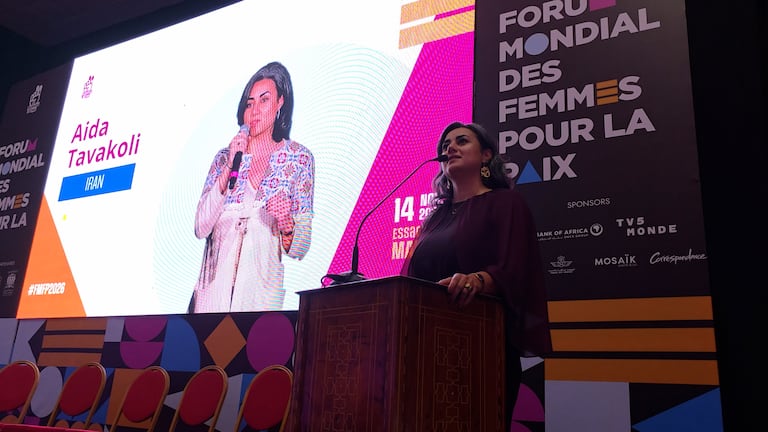
How can one speak about peace when one’s own country is being bombed and it is no longer possible to reach one’s family? Aïda Tavakoli began her intervention at the World Forum of Women for Peace with this question, drawn from her own experience.
A French-Iranian activist working in development, Tavakoli spoke about the recent months in Iran and the sense of helplessness she had experienced from France. Beyond the war itself, she wanted to denounce the lack of commitment to peace before conflicts break out.
She recalled seeing images of her own neighborhood being bombed without knowing whether her relatives had survived. For 88 days, she said, Iranians living abroad were unable to contact their families or find out what had happened to them.
During that period, she was invited onto television programs where some presenters asked whether the bombing of her country gave her hope.
“I was watching my neighborhood being bombed, unable to contact my family to find out whether they had survived,” she said.
The contrast between what people experience on the ground and the debates taking place at a distance left a deep impression on her. In France, she saw civil society become increasingly divided between pro-war and anti-war positions, and between pro-Palestinian and pro-Israeli camps.
“I saw the democracy I live in losing its bearings,” she said.
When people become entrenched in opposing camps, she argued, they stop listening to those who are actually living through the consequences of conflict.
That is what Tavakoli rejects. For her, the question should not be limited to identifying who started a war or assigning blame once the bombing has begun. It should also ask what could have been done to prevent it.
“Everyone criticizes the person who started the war, but no one really asks the question: what could we have done to prevent it from breaking out?”
This question brought her back to Iran and the “Woman, Life, Freedom” movement, which emerged after the death of Mahsa Amini in 2022. She recalled the mobilization of young Iranians and their appeals to the international community to support civil society, protect activists and take action against human rights violations.
In her view, those calls did not receive the response they needed.
“When people are abandoned and injustices are allowed to continue every day, bad actors can start a war.”
She went further: “War does not happen only because certain people decide to start it. It also happens because those who could have acted failed to do their job.”
This led her to question international priorities. She pointed to the enormous investments made over the years in military technologies, drones and weapons designed to strike with increasing precision. She contrasted those investments with a much simpler question:
“How much have we invested in peace?”
She deplored the lack of resources for dialogue initiatives and civil society groups, particularly those in Israel and Palestine trying to make alternative voices heard despite war and bereavement.
Read also : Gaza: Hamas agrees to deal with Israel
Peace, she argued, cannot be treated as an issue to address only after the weapons have fallen silent.
“Peace is not the absence of war,” she said.
It requires sustained work to address injustice, inequality and violations of fundamental rights. It also demands time, resources and a genuine willingness to listen to the people directly affected.
«If you want peace, start building it.»
— Aïda Tavakoli
Her final message was directed at people in civil society who find themselves trapped in divisions that can make dialogue impossible.
“Civil societies are not boxes. They are people with real stories. Listen to them.”
She then addressed political leaders directly: “If you want peace, start building it.”
Mayada Adil, Sudanese activist
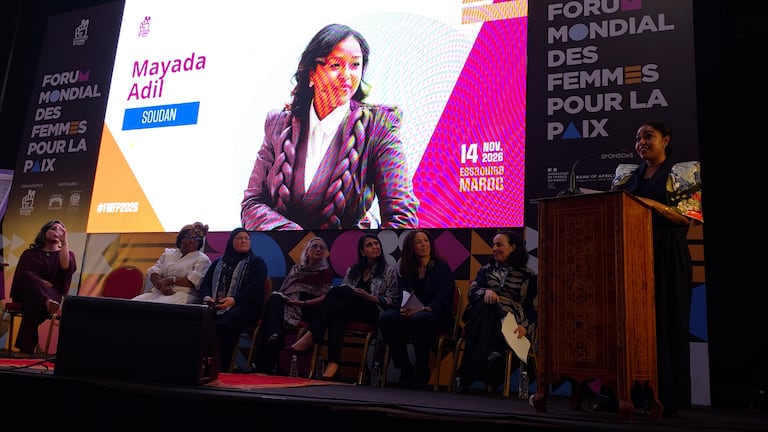
“I come from the land of the Kandakas, the great queens, the ruling queens of the Kingdom of Kush.”
Sudanese activist Mayada Adil opened her speech in Essaouira with this image, going back 2,000 years to recall how a woman at the negotiating table had once helped preserve a civilization. She then described how Sudanese women have been pushed out of peace processes and urged the audience not to let her country disappear from the world’s attention.
Adil recounted the story of a Kandaka named Amanishakheto, whom she described as a “one-eyed warrior with no patience,” who challenged the Roman emperor Augustus.
“She took the head of one of his statues and buried it beneath the steps of her stone wall, so that everyone who came to challenge her kingdom would walk over the emperor.”
The queen later sat down at the negotiating table and left without paying tribute to Rome.
“One woman at the table, and a civilization survived for many generations.”
For Adil, this ancient figure has a counterpart in more recent history. In 2019, a peaceful revolution inspired the world, with Sudanese women once again at the forefront.
She recalled the image of a young woman dressed in white, standing on the roof of a car and singing in front of thousands of peaceful protesters. The world came to know her as the Kandaka, but her real name is Ala Salah.
Yet that momentum stopped at the doors of decision-making rooms.
“When the seats were distributed, the women were thanked, applauded and then invited to wait outside the rooms.”
The war that broke out in April 2023 made the situation even worse. Adil cited UN Women, saying that not one Sudanese woman had participated in any of the formal peace negotiations.
“Not one.”
Since the conflict began, she added, women have been systematically used as a weapon of war.
She then recalled her testimony before the United Nations Security Council three years earlier. She said she had told the Council that she was not speaking simply as a young activist, but as “S., 24 years old, a victim of rape on July 9, 2023, in Khartoum, in front of her family.”
She also described the case of a woman who was repeatedly raped in a camp in Darfur by a man wearing an official uniform. He threatened to assault other women if she spoke out.
Adil said she had told the Council that “the perpetrators of these crimes are walking free as we speak, treating women’s bodies as their own battlefield.”
The response left her bitter.
“All I heard in return was ‘deeply concerned,’ so many times that I could collect those empty words. Concern does not get these women a blanket, medicine or a safe place.”
Her question, she said, remains the same: “Why is Sudan a forgotten crisis?”
She offered her own explanation, one she said is rarely voiced in a room like this.
“Our skin is not white enough. We are not the perfect immigrants, we are not the perfect refugees, and we are not the perfect victims.”
The figures she cited illustrate the scale of the crisis. The United Nations has verified more than 546 incidents of sexual violence affecting over 800 victims, almost all women and girls. But this represents only a fraction of what is happening, she said, because women who speak out are often rejected by their families and communities.
At least eight million children are out of school, including around 4.1 million girls.
Despite these circumstances, Sudanese women have repeatedly tried to make their voices heard.
“We have taken our voices to the highest levels of governance, to every international organization, to every women’s forum. But it doesn’t seem to be working.”
That was why she turned to the feminists gathered in Essaouira, from Palestine, Israel, Iran, Afghanistan, Morocco, France, Cameroon and elsewhere.
“You are my last resort.”
«Do not let Sudan and the Sudanese people be buried in silence.»
— Mayada Adil
She urged them to carry Sudanese voices, “our beautiful stories as well as our painful stories,” into their everyday lives and their own struggles for other women.
She closed her speech by returning to the image with which she had begun.
“Two thousand years ago, a Kandaka buried the head of an emperor so that he would never be forgotten. I am not asking you to bury anyone, of course. I am only asking you not to let Sudan and the Sudanese people be buried in silence.”
The third edition of the World Forum of Women for Peace ended with a shared conviction: peace cannot be achieved without the women who pay the price of war.
