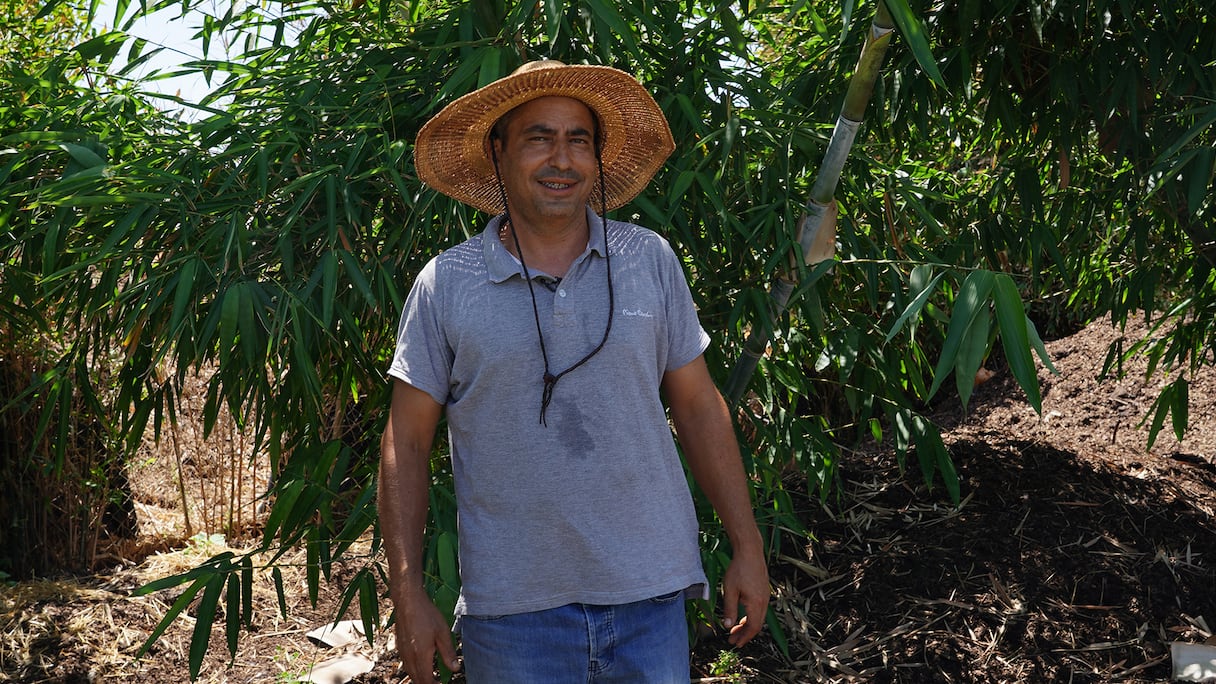
Morocco, a country with a strong agricultural tradition, is facing increasingly irregular rainfall, alternating between prolonged droughts and flooding. Younes Mrabet says the country’s agricultural soils have deteriorated to the point where, in his view, they have become sterile, meaning seeds can no longer germinate without chemical or organic fertilizers. He believes there is an urgent need to restore soil health and equip farmers with composting techniques that many have yet to master.
That conviction led him on a nine-month journey through the Middle Atlas, beginning in Aïn Leuh and continuing from one rural market to another. Along the way, he met farmers and shepherds, staying with local families. His main takeaway, he says, was that many producers lacked the knowledge to make biofertilizers for their own use, despite the growing need. That observation, more than composting itself, now shapes his work in Benslimane.
A trained veterinarian, Mrabet spent years in Casablanca treating companion animals. He recalls keeping a seed germination chamber in his veterinary clinic, tending to it between consultations. Seven years ago, his interest in plants evolved into a more serious pursuit. He began propagating plants through cuttings and seed germination before encountering problems with growing substrates. After several trials, he decided to produce his own, a process that eventually led him to manufacture biofertilizers, compost and vermicompost.
He now operates two sites: a vermiculture farm in Had Soualem and his Benslimane farm, where he has lived for the past nine months. He says he ended his veterinary career when he no longer had the energy to continue, describing the decision not as an escape from stress but as the natural continuation of a long-standing passion for forests and living things.
Composting with the ASP method
Part of the composting process begins directly at livestock stables before manure is transported to the farm. Mrabet says the approach helps reduce transport costs, noting that a single truck trip covering 30 to 50 kilometers costs at least 1,500 dirhams. According to him, pre-composting manure on site can reduce the number of truckloads needed from ten to one, lowering both expenses and fuel consumption.
The pre-composting technique, known as the ASP method, is widely used abroad but remains uncommon among Moroccan compost producers, he says. Mrabet emphasizes that he did not invent the method but adopted it after studying foreign composting practices.
Unlike conventional composting, which requires turning manure piles mechanically several times a week using specialized machinery, the ASP method keeps the pile in place. Instead, it is hydrated and aerated through air injection powered by solar energy. Mrabet believes avoiding mechanical turning preserves the fungal networks responsible for breaking down the manure, whereas repeated mixing with heavy equipment disrupts them.
After a maturation period of two to three months, the compost is sifted and enriched with earthworms before passing through a chicken enclosure, where the birds consume remaining organic residues and add their droppings, producing the final vermicompost.
Read also : Morocco sends seed collection to the world’s largest crop vault in Norway
On his one-hectare farm in Benslimane, Mrabet grows a variety of vegetables and herbs, including tomatoes, potatoes and mint, without using insecticides or fungicides for more than 15 years, he says. He describes himself as both a producer and an experimenter, deliberately testing cultivation under difficult conditions, such as water-poor soils or even concrete surfaces, to develop techniques that could be applied elsewhere.
Much of the work on the farm is carried out by volunteers recruited through the internet and social media, most of whom have no previous agricultural experience. The farm can accommodate up to ten volunteers for stays ranging from one day to a week. Working days are limited to four hours and are complemented by cultural activities, yoga and stretching sessions. Mrabet says he now spends between 90% and 95% of his time living on the farm.
Although his nine-month tour of the Middle Atlas did not persuade the farmers he met to switch to organic agriculture, Mrabet believes the main obstacle is what he describes as a deep-rooted fear of insects. Farmers, he says, have learned to cultivate crops by eliminating insects rather than working alongside them. Replacing insecticides with biofertilizers therefore challenges long-established practices, particularly in a context where harvests are essential for families’ livelihoods, leaving little room for risk.
Mrabet believes the material resources needed for this transition already exist and that the main barrier is a lack of information. The best way to convince farmers, he says, is to lead by example. That is the goal of the work he continues in Benslimane, where he hopes to scale up production with partners interested in regenerative agriculture based on living soils.
