For months, part of Spain appeared convinced of one thing: the 2030 World Cup final would inevitably be played at the Santiago Bernabéu. Madrid seemed to tick every box. A European capital, a legendary stadium, a world champion national team and a historic standing in international football. The debate appeared to be settled before it had even begun.
Then Morocco entered the equation. Not simply as a co-host of the World Cup, but as a credible candidate to stage the final. And it was precisely from that moment that the tone of some Spanish media outlets began to change.
For several weeks, the stories have kept coming. Morocco is supposedly being favored. A mysterious “Moroccan lobby” is influencing decisions. Some have even gone as far as suggesting that FIFA could be seeking to reward the Kingdom for geopolitical considerations rather than sporting ones. The message remains the same: if Casablanca gets the final, it will not be because of the strength of its bid.
There is nothing innocent about this strategy. When a candidate is genuinely weaker, there is no need to run a campaign to discredit it. You simply let the facts speak for themselves. If sections of the Spanish press are devoting so much energy to undermining Morocco’s bid, perhaps it is because they know it has become strong enough to represent a genuine threat.
Because behind the rhetoric lies a much more concrete reality. Morocco now has a coherent, clear and centralized project. The infrastructure is identified, investments are underway and, most importantly, the entire organization is built around a single entity: the Morocco 2030 Foundation. That is probably one of the country’s greatest strengths.
FIFA has little interest in endless procedures or having to deal with multiple interlocutors. It favors structures that can make decisions quickly, coordinate efficiently and ensure deadlines are met. From that perspective, the Morocco 2030 Foundation offers precisely what an event of this scale requires: unified governance capable of dealing directly with FIFA, government ministries, local authorities and the various project owners.
By contrast, the Spanish bid appears far more fragmented. It requires coordination between the central government, autonomous communities, municipalities, the Spanish Football Federation, companies operating some of the stadiums and several private clubs that still own their venues. Each has its own interests, constraints and timelines.
Read also : New York Times highlights Morocco’s growing case to host the 2030 World Cup final
FIFA’s evaluation report had already highlighted this complexity. While Spain’s infrastructure received praise, several stadium agreements had either been signed late or included specific exemptions. FIFA, therefore, rated the legal risk of the Spanish bid as “medium,” precisely because some contractual agreements remained incomplete at the time of the evaluation.
Since then, the difficulties have not disappeared. Two cities, Málaga and La Coruña, have withdrawn from the project. Vigo is still demanding to be included and has threatened legal action. The selection of host cities continues to fuel controversy, with some political figures accusing the process of lacking transparency in its selection criteria.
This is compounded by a Spanish Football Federation that is still trying to move past the Rubiales affair and Operation Brody. While those cases obviously do not prevent Spain from hosting the World Cup, they contribute to an institutional instability that nobody needed as the country approaches an event of such strategic importance.
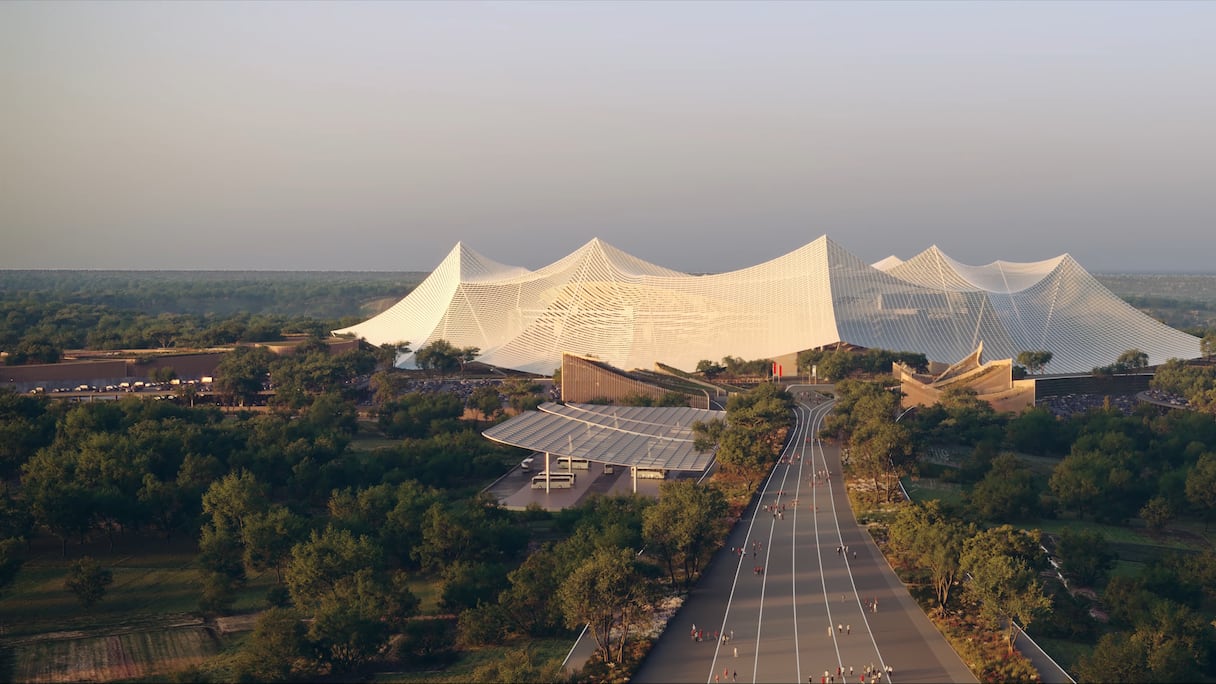
The contrast with Morocco is therefore striking. The Kingdom is moving forward according to a clearly defined roadmap. Stadium construction and renovation work is progressing. Transport infrastructure is following its schedule. Investments are part of a strategy that extends well beyond the World Cup itself. And then there is the Grand Stade Hassan II, with its announced capacity of 115,000 spectators, which in itself represents an argument that is difficult to ignore in the race to host the final.
But a stadium is not everything. FIFA will not choose the final solely on the basis of a venue’s capacity or architecture. It will assess the entire package: government guarantees, security, mobility, commercial operations, operational planning, construction schedules and the ability to deliver the event without major disruptions. And it is precisely in these areas that Morocco has made significant progress since being awarded the World Cup.
What stands out today is that the Spanish debate sometimes appears to be driven more by emotion than by facts. Spain’s World Cup triumph is regularly presented as an argument in favor of the Bernabéu. Yet no FIFA regulation gives a World Cup-winning country any advantage in the selection of the final venue. In the same way, publishing editorial after editorial denouncing an alleged “Moroccan lobby” does not change FIFA’s evaluation criteria or the realities on the ground.
At its core, this media battle reveals something else: concern. For a long time, the Kingdom was viewed simply as the African partner in this three-country bid. Today, it is being seen as a candidate capable of hosting the biggest match of the tournament. The distinction is enormous.
There are still several months before FIFA makes its final decision. Nothing has been decided. Madrid still has strong arguments, as does Barcelona. But one thing now appears clear: if some voices are working so hard to weaken the image of Morocco’s bid, it may be because that bid has stopped being a mere possibility on paper. It has become a genuine option.
And that is precisely what has some of Spain worried.
