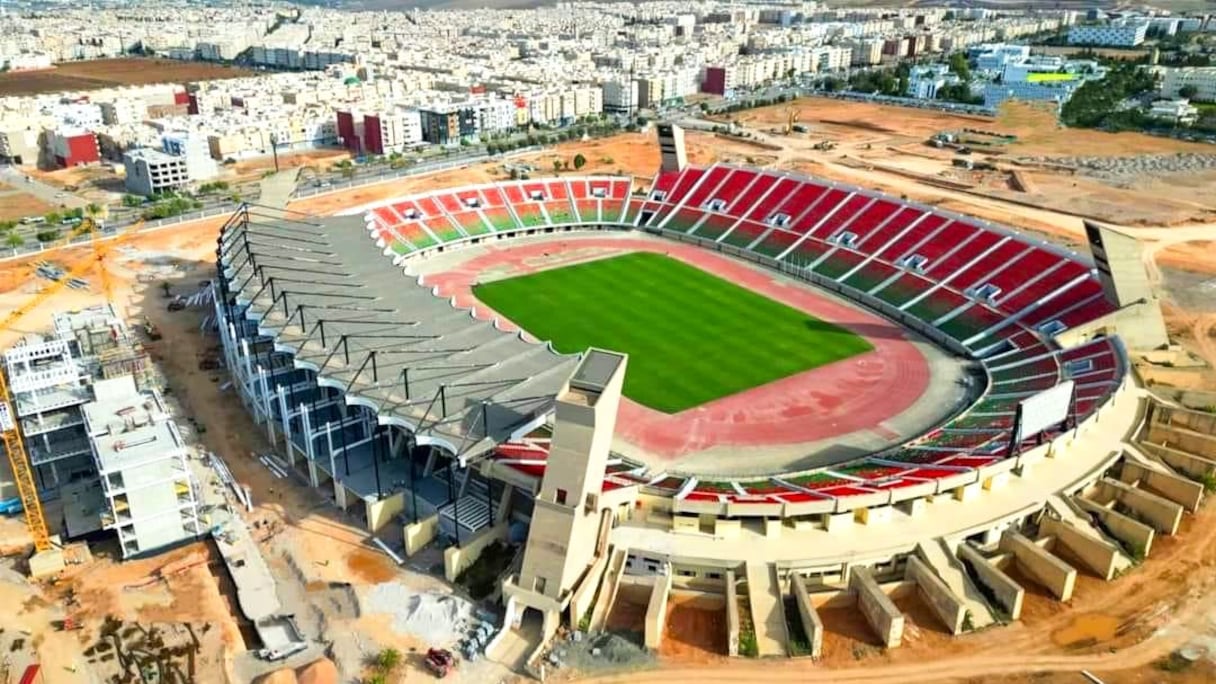
The Grand Stade de Fès is set for a major transformation. The National Agency for Public Facilities (ANEP) has launched an international tender for its rehabilitation, with an estimated budget of MAD 2.816 billion. The project is intended to bring the venue in line with FIFA standards, particularly in terms of quality and sustainability.
The operation is part of Morocco’s preparations for the 2030 World Cup, which the country will host alongside Spain and Portugal. The project provides for the redevelopment of the entire stadium to make it more modern, efficient and better integrated into its surroundings.
One of the main objectives is to cut energy consumption by at least 30%. To achieve this, the Grand Stade de Fès will be equipped with more energy-efficient lighting, higher-performance air-conditioning systems and improved thermal insulation.
The project also provides for 5% to 10% of the electricity consumed by the stadium to come from renewable sources. A smart building management system will also be installed to monitor energy consumption and optimise the operation of the various facilities.
Water management is another priority of the rehabilitation. The project aims to reduce consumption by at least 40%, notably through water-efficient sanitary equipment, rainwater collection and reuse, particularly for irrigation. The rainwater management system will also be upgraded.
Read also : 2030 World Cup: MAD 2.8 billion to bring Fes Sports Complex up to FIFA standards
The rehabilitation is also designed to reduce the environmental impact of the construction work, notably through the use of low-carbon concrete, recycled steel and locally sourced materials to limit transport-related emissions.
Construction waste management will follow a circular-economy approach, including the sorting, reuse, recovery and recycling of materials.
The project also aims to better integrate the Grand Stade de Fès into the city by improving accessibility, strengthening connections to public transport and developing pedestrian routes and cycling lanes.
In the long term, the stadium is also expected to obtain a sustainability and environmental quality certification, ensuring that environmental standards are taken into account from the design stage through to commissioning.
With an investment of MAD 2.816 billion, the rehabilitation of the Grand Stade de Fès is among Morocco’s major projects ahead of the 2030 World Cup. Beyond the sporting aspect, the project aims to provide the spiritual capital with a modern, sustainable facility adapted to the needs of its residents.
