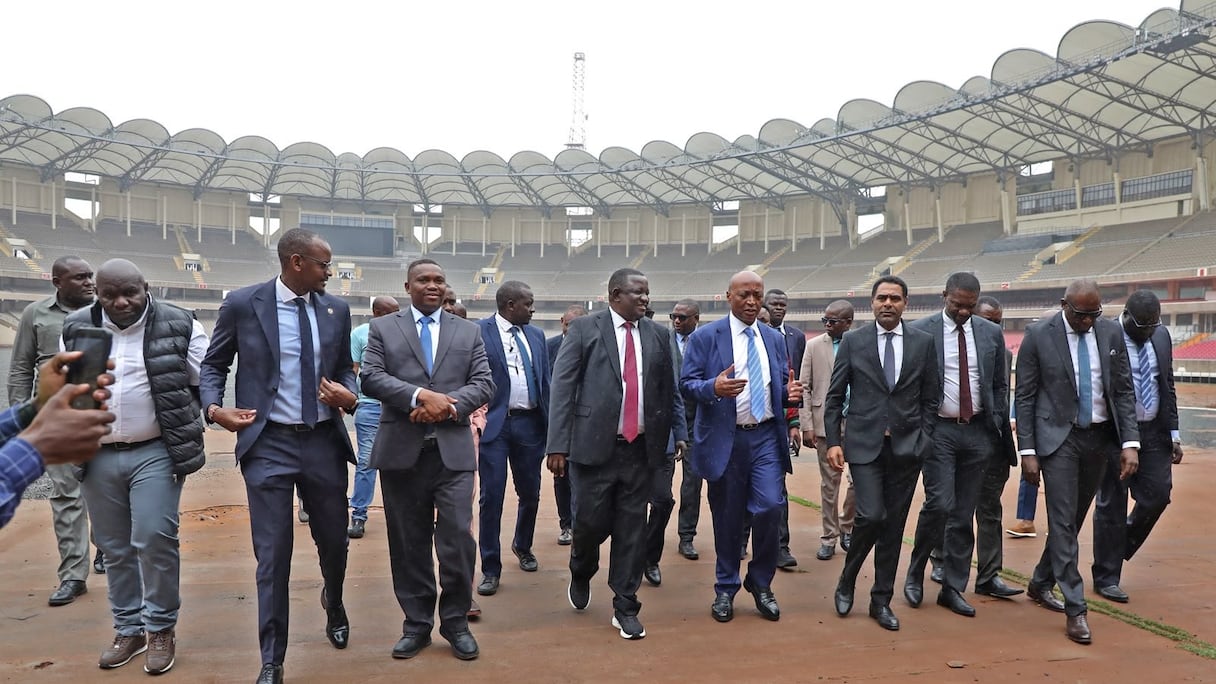
Delays affecting several sports infrastructure projects in Kenya, Uganda and Tanzania have raised questions over the three countries’ readiness to host the 2027 Africa Cup of Nations, according to French newspaper Le Monde.
The next edition of the Africa Cup of Nations, scheduled to take place from June 19 to July 17, 2027, is facing challenges linked mainly to the progress of construction work, particularly in Kenya and Uganda, with around nine months remaining before the tournament gets underway, the newspaper reported.
Uganda is reportedly causing the greatest concern, after inspection reports seen by Le Monde revealed that several shortcomings remain at some stadiums and facilities, including Nelson Mandela Stadium in the capital Kampala and Hoima Stadium, which had yet to meet all Confederation of African Football (CAF) requirements.
In Kenya, several projects are also still behind schedule, including Talanta Stadium in Nairobi, which has a capacity of around 60,000 spectators, as well as other sports facilities expected to be ready to host matches during the tournament.



AFP
Tanzania, by contrast, appears to be in a relatively better position than Kenya and Uganda. However, according to information reported by Le Monde, staging a tournament across three countries presents additional challenges involving transport, accommodation, logistical coordination and infrastructure linked to the competition.
Against this backdrop, CAF President Patrice Motsepe said at a press conference held after his inspection tour of the three countries that CAF was not considering any “alternative plan” or “third plan,” stressing its commitment to holding the tournament in Kenya, Tanzania and Uganda.
Motsepe nevertheless acknowledged that there was a “major state of emergency” nine months before the start of the Africa Cup of Nations, given the delays affecting some projects. He also announced that another inspection visit to the three countries would be scheduled for January 2027.
Le Monde said the statements have revived discussion about the possibility of moving the tournament to another country, reporting that its sources indicate CAF is in fact preparing for the possibility that the host nations may not be ready and is exploring solutions that could be used if the scheduled deadline cannot be met.
According to the French newspaper, five African countries have, in principle, the infrastructure and capacity required to step in and host a tournament of the scale of the Africa Cup of Nations. They are Morocco, Algeria, Egypt, South Africa and Côte d’Ivoire.


Grand stade de Tanger. Le360
Le Monde reported that Morocco, Algeria and South Africa were among the countries contacted by CAF, while stressing that this does not mean any of them has agreed to host the next edition or formally submitted a bid to do so.
Morocco is among the potential options because of its sports infrastructure, having hosted the 2025 Africa Cup of Nations, although the Kingdom is also preparing to co-host the 2030 FIFA World Cup with Spain and Portugal.
South Africa also has extensive experience in staging continental and international tournaments, as well as several major stadiums, while Algeria has modern sports facilities that have previously hosted continental and international competitions.
Egypt and Côte d’Ivoire are also on the list of potential alternatives, according to Le Monde, because of their previous experience hosting the Africa Cup of Nations and their available infrastructure.
The newspaper added that some members of CAF’s executive committee have begun to question whether the three host countries will be able to meet the deadline, recalling the 2019 Africa Cup of Nations, when Cameroon was stripped of hosting rights because of delays in preparations and Egypt was awarded the tournament before Cameroon eventually hosted the 2021 edition.
Despite these concerns, CAF has not made any official decision to move the 2027 Africa Cup of Nations away from Kenya, Tanzania and Uganda, with the three countries remaining the tournament’s official hosts.
According to Le Monde, Patrice Motsepe’s new visit in January will be an important opportunity to assess the progress of the work before it becomes clearer whether the tournament can remain in East Africa or whether an alternative solution will be required.
