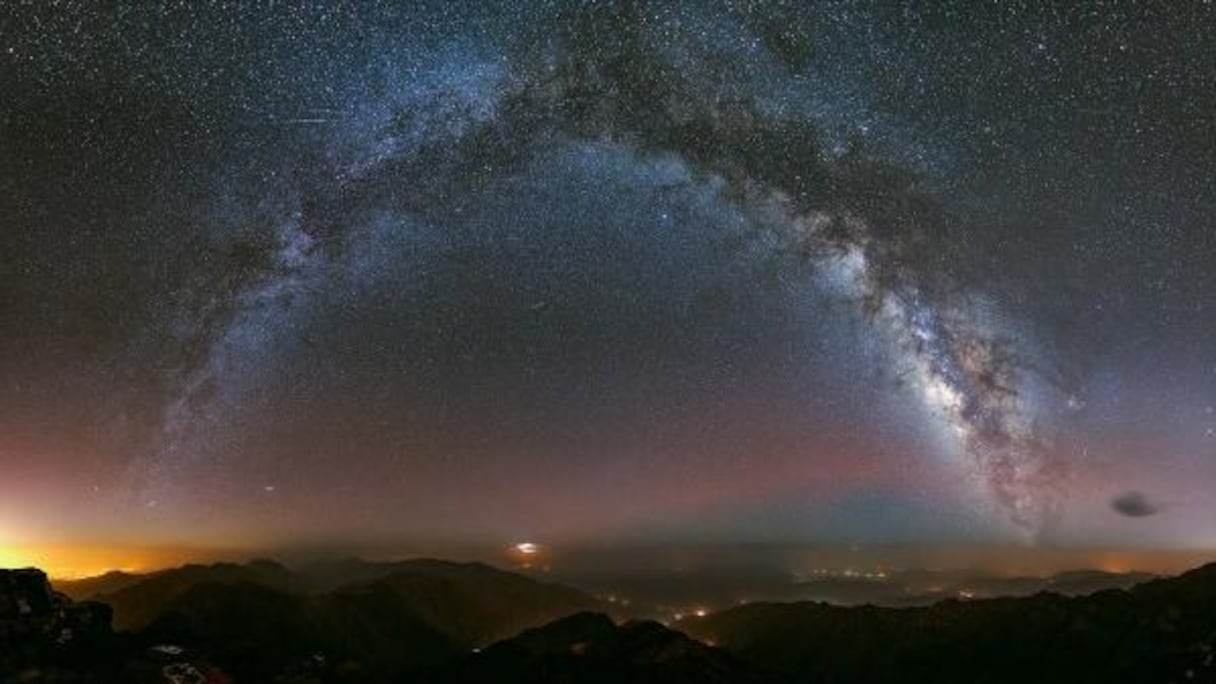
Scientists have found evidence that the Milky Way swallowed a smaller galaxy about 11.8 billion years ago, when the universe was less than 15% of its current age, according to a study published in Nature Astronomy on Monday, August 17.
The discovery was made by studying clusters of stars near the center of the Milky Way, providing evidence of the earliest known merger involving our galaxy.
The smaller galaxy, classified as a dwarf galaxy and known as Low-energy-Kraken-Heracles, or LKH, contained stars with a combined mass equivalent to about 500 million times that of the sun at the time of the merger. That was roughly a quarter of the Milky Way’s mass at the time.
Researchers used observations from the Hubble and Gaia space telescopes to examine stellar clusters across a region extending about 20,000 light-years around the Milky Way’s center.
They studied the age, chemical composition and trajectories of the stars to determine their origins, finding evidence that some of them formed in LKH before becoming part of the Milky Way following the merger, which took place about two billion years after the Big Bang.
“Our home is the Milky Way galaxy, but we do not know how our house was built,” said Davide Massari, lead author of the study. “In this paper we discover where the first significant batch of bricks came from: a dwarf galaxy that we call LKH.”
The findings shed light on how the Milky Way grew during its early history, when scientists have debated whether its development was mainly driven by stars forming within the galaxy or by mergers with smaller galaxies.
“Some past studies have argued that the earliest phases of our galaxy’s evolution were defined by stars born only in our galaxy. Here, we have shown that stars born in external galaxies also need to be considered,” said Massari.
The researchers found that the LKH merger brought stars and other material into the young Milky Way, while the interaction between gas from the two galaxies likely contributed to the formation of new stars.
The study also indicates that some stars originally formed in LKH may still be found in the inner regions of the Milky Way, although large amounts of interstellar dust make individual stars difficult to identify.
The Milky Way later experienced other major mergers, including its absorption of the dwarf galaxy Gaia-Sausage-Enceladus about 1.8 billion years after the LKH merger. It has also been combining with the Sagittarius dwarf galaxy for roughly the past 6 billion years.