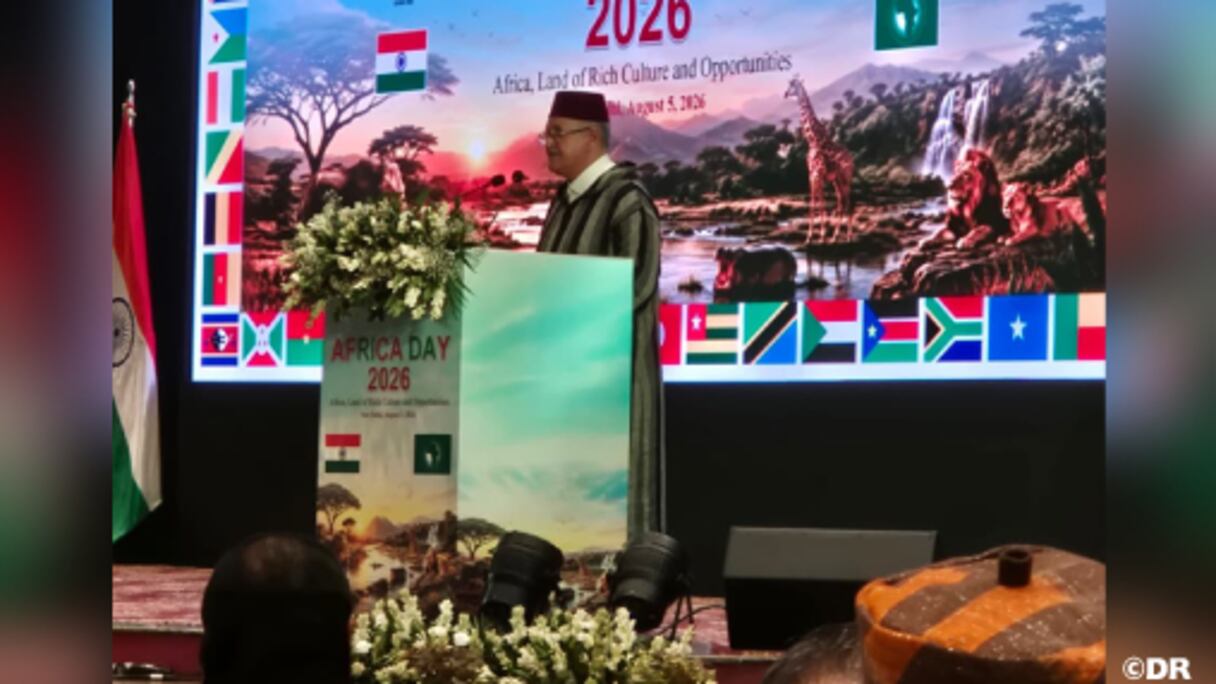
Morocco took part on Wednesday, August 5, evening in the Africa Day celebration in New Delhi. The event, organized by the Group of African Heads of Mission accredited to India, was attended by senior Indian officials, African ambassadors, and representatives from the diplomatic, business, academic, and cultural communities.
Held under the theme “Africa, a Land of Rich Cultures and Opportunities,” the celebration saw the presence of India’s Minister of External Affairs, Subrahmanyam Jaishankar, as well as ambassadors of African countries accredited to the Indian capital.
In his address, Jaishankar emphasized that relations between India and Africa are rooted in centuries of human, commercial, and cultural exchanges. These ties, he noted, are further strengthened by a shared struggle against colonialism and a common commitment to the principles of sovereignty, dignity, and South-South cooperation.
He highlighted Africa’s continued priority in India’s foreign policy, driven by the priorities identified by African countries. This partnership, he explained, focuses on strengthening local capacities, promoting trade and investment, advancing digital transformation, and reforming global governance.
Jaishankar also underscored the robust economic ties, reporting that trade between India and Africa reached $93 billion last year. Cumulative Indian investments across the continent, exceeding $80 billion, span sectors such as telecommunications, energy, infrastructure, agriculture, pharmaceuticals, and digital services.
He reaffirmed New Delhi’s support for stronger African representation in international institutions, stating that a multipolar world order and reformed multilateralism cannot be fully achieved without Africa playing a role that reflects its global importance.
Mohamed Maliki, Morocco’s Ambassador to India and Dean of the African Diplomatic Corps in New Delhi, affirmed that the celebration reinforced the shared commitment to the long-standing strategic partnership between Africa and India. This partnership, he stated, is built on a common history, shared aspirations, and a joint vision for a more inclusive, just, and prosperous international order.
Maliki described the Africa-India partnership as one based on trust, mutual respect, solidarity, and the shared conviction that sustainable development must be inclusive and guided by local priorities. He added that the relationship now extends beyond governments to include universities, research centers, businesses, innovators, artists, and young people.
He characterized Africa as a continent of vast opportunities, possessing the world’s youngest population, abundant natural resources, and rapidly expanding markets. He stressed African countries’ determination to forge partnerships with credible partners like India that promote innovation, industrialization, and sustainable growth.
Considering current geopolitical, economic, and environmental challenges, Maliki called for stronger strategic dialogue between Africa and India. The aim, he said, is to build a future founded on peace, sustainable development, innovation, shared prosperity, and a more inclusive, balanced, and equitable international order.
Morocco’s participation also showcased the country’s cuisine, with guests enjoying a selection of traditional Moroccan dishes widely appreciated for their variety and flavors.
The celebration featured an exhibition of works by African artists, organized in collaboration with the Indian Council for Cultural Relations (ICCR), which highlighted the richness and diversity of the continent’s cultural heritage.
The evening also included musical performances by several African countries and India, offering the audience a glimpse into the participants’ artistic and cultural diversity.
Africa Day commemorates the establishment of the Organization of African Unity (OAU) on May 25, 1963, which became the African Union (AU) in 2002. It is celebrated annually worldwide to promote African unity and strengthen the continent’s international partnerships.
The celebration was originally slated to take place alongside the fourth India-Africa Forum Summit, planned for late May in New Delhi. However, the summit was postponed to a later date due to the evolving health situation in parts of the continent linked to the Ebola outbreak.