
The company’s board of directors announced the inquiry on Sunday, November 8, saying it would examine reports that Huang had been the target of a foreign intelligence operation.
A committee of independent directors, assisted by external legal counsel, will oversee the investigation. Nvidia said it had no reason to believe that US national security or company secrets had been compromised, but that the inquiry would examine all available information.
Huang, 63, has agreed to cooperate with the review and will remain in his position during the investigation.
The announcement followed reports by The New York Times and the Financial Times about his relationship with Alice Huang, a Chinese businesswoman whose company, Megaspeed, is based in Singapore. Citing US intelligence assessments, the newspapers reported allegations that she had been recruited by China’s Ministry of State Security to gather information. These claims have been disputed by Beijing.
The two are not related.
A business relationship under scrutiny
Alice Huang was an executive at Megaspeed, a data center company that has become one of Nvidia’s major customers in Southeast Asia. The company purchased more than $4.8 billion worth of Nvidia chips between June 2024 and the publication of the New York Times report.
US authorities had also been examining Megaspeed over concerns that some of its transactions may have involved the transfer of AI chips subject to US export restrictions to China.
According to The New York Times, US authorities began monitoring Alice Huang more than a year ago. The newspaper reported that surveillance identified communications between her and Jensen Huang, leading US officials to conclude that the two were romantically involved.
Nvidia and its CEO had previously described their interactions as business-related. In an interview with Bloomberg News last month, Huang said they had been connected through Megaspeed and that their dealings were “completely normal and not unusual.”
Huang apologizes to his family and colleagues
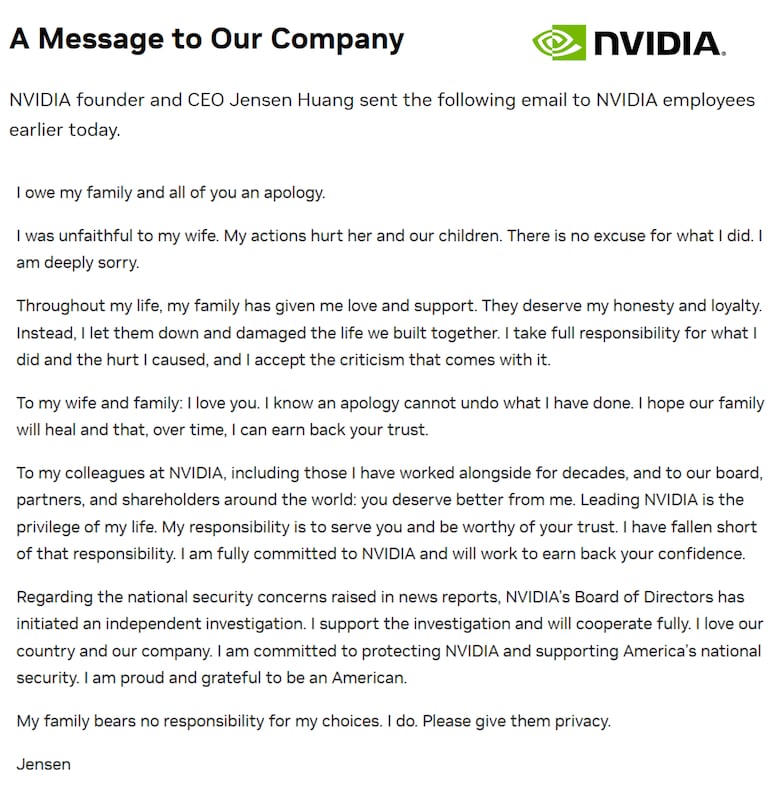
In a message sent to Nvidia employees on Sunday, Huang acknowledged being unfaithful to his wife, Lori, and apologized to his family.
“I was unfaithful to my wife. My actions hurt her and our children. There is no excuse for what I did. I am deeply sorry,” he wrote.
He also addressed the concerns surrounding the reported intelligence operation, saying he supported the board’s investigation and would cooperate fully. He reaffirmed his commitment to Nvidia and said he was committed to protecting the company and supporting US national security.
President Donald Trump defended Huang when asked about the matter by reporters on Sunday. He described the Nvidia chief as an “honorable guy” and said he believed he should remain CEO.
China has rejected the allegations. On Monday, Foreign Ministry spokesperson Guo Jiakun described the espionage claims as unsubstantiated and characterized them as attempts to discredit China, according to NBC News.
Nvidia has not announced a timeline for the investigation. Its board said it would provide further updates when appropriate.
