OpenAI said Tuesday, September 8, that an internal artificial intelligence system had solved the Navier-Stokes existence and smoothness problem, one of seven Millennium Prize Problems that have remained among mathematics’ most difficult unanswered questions.
The company said its system produced an analytical proof showing that a three-dimensional fluid that begins in a smooth state can develop a singularity in finite time. It also produced a formal version of the proof using Lean, a system that can be used to formally verify mathematical arguments.
OpenAI said the result came from an internal model that is significantly more capable than GPT-6 Astra. Rather than relying on a single AI system working alone, the company organized thousands of AI agents into groups that could explore different approaches to the problem and communicate within their respective groups.
The system could access online information and run code, with around 10,000 AI agents working on the Navier-Stokes problem at the same time.
The process began after OpenAI said it heard rumors on September 1 that two Millennium Prize Problems had been resolved. Inspired by the reports and the performance of its internal model, the company launched an effort to test the system on all of the remaining Millennium Prize Problems as well as several other high-impact mathematical questions.
OpenAI said its agents explored different ways of tackling the Navier-Stokes problem, working simultaneously on possible proofs and attempts to show that a solution could not exist.
The system also worked on a related problem involving the Euler equations, which describe fluid motion without accounting for viscosity, the internal friction that makes fluids resist changes in motion. OpenAI said nearly 100 agents worked on the Euler problem for about 50 hours and produced a disproof of its unforced version. The result then helped guide the system toward the Navier-Stokes problem.
OpenAI said the system eventually reached its Navier-Stokes result on September 5, about 88 hours after the first agents were launched. The company then spent another 17 hours formally checking the proof using Lean.
Around 10,000 AI agents were involved in the Navier-Stokes effort. They exchanged 2.7 million messages and generated around 130 billion output tokens while working on the problem.
OpenAI described the achievement as an important demonstration of the progress made by its AI systems, but said it should not be viewed as an endpoint.
“This milestone represents substantial work by mathematicians and AI researchers. However, this is not a culmination, but rather a snapshot in time, of progress on AI development,” the company wrote in its statement.
What exactly did the system solve?
The Navier-Stokes equations describe how fluids such as air and water move. They also raise a major mathematical question: can a fluid that starts moving smoothly eventually reach what is called a singularity, a point where its speed becomes unlimited in a finite amount of time?
These equations are used in many practical fields, including aircraft design, weather forecasting and the study of blood flow. But mathematicians have spent decades trying to determine whether the equations always produce smooth and predictable motion or whether the fluid’s movement can eventually become so extreme that such a singularity forms.
One reason the problem is so difficult is viscosity, the internal friction in a fluid that helps smooth out its movement. It works against the formation of a singularity, raising the question of whether the fluid’s own motion can eventually overcome this effect.
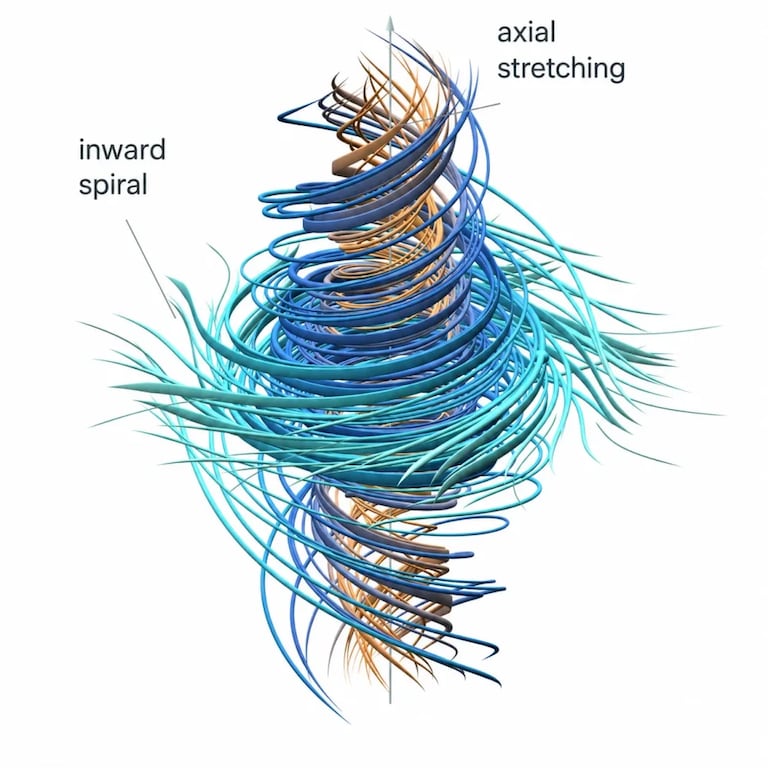
OpenAI says its system found a solution in which a vortex, or spinning area of fluid, moves inward and becomes increasingly stretched. As the central part of the vortex gets smaller, the fluid moves faster and faster until its speed grows without limit.
The challenge was to show that this could happen because of the fluid’s own movement rather than because of an unrealistic external force. OpenAI says its solution does this while keeping the fluid’s total energy finite.
According to OpenAI, the different forces involved in the fluid’s movement become extremely large but balance each other out in a precise way. This allows the fluid’s speed to keep increasing without limit while the external force remains smooth.
Why is this one of mathematics’ Millennium Problems?
The Navier-Stokes question was named one of the seven Millennium Prize Problems by the Clay Mathematics Institute in 2000. The institute selected the problems because they represented some of the deepest mathematical questions that had resisted serious attempts at a solution.
The seven problems cover areas ranging from prime numbers and geometry to computer science, quantum physics and fluid dynamics. The institute created a $7 million prize fund, with $1 million assigned to each problem, to recognize solutions to questions considered of historic importance and draw public attention to the fact that major mathematical problems remain unsolved.
Navier-Stokes was included because mathematicians still could not establish the most basic properties of its solutions. In particular, they had not been able to prove whether smooth solutions always exist and remain smooth in three dimensions. The equations themselves date back to the 19th century, while the modern mathematical question has remained unresolved for decades.
Only one of the seven Millennium Problems has so far been officially resolved: the Poincaré Conjecture. Russian mathematician Grigory Perelman announced his solution in papers posted in 2002 and 2003, nearly a century after Henri Poincaré first posed the question. The Clay Mathematics Institute later awarded Perelman the $1 million Millennium Prize, which he declined.
OpenAI said it does not intend to claim the $1 million Millennium Prize for its Navier-Stokes result.
Instead, the company said it is focused on understanding the capabilities of its internal model and using what it learns to guide the next stage of AI development.
“We believe we are now in the next period of AI progress,” OpenAI said, adding that it wants to build systems that are steerable, accountable and connected to people.
